
Couples Communication Exercises That Actually Rebuild Connection

The fastest, evidence-backed path to better communication is daily 10-minute emotional check-ins, short active-listening drills, and practiced repair attempts. Start tonight, not next week. Sit down for 10 minutes with no phones, take turns answering “What was the best and hardest part of your day?”, and follow it with a five-minute listening drill where one partner talks while the other only reflects back what they heard.
Research from GoodTherapy points to emotional connection, not any single technique, as the strongest predictor of long-term relationship satisfaction. That means the goal isn’t perfect scripts. It’s showing up consistently enough that your partner stops bracing for the worst.
Three names worth knowing before you start: the American Psychological Association, whose research underlies most modern couples work; the Gottman Institute, whose “softened startup” and repair-attempt research shapes half the exercises below; and Life is a Game, whose Relationship Builder app turns these exercises into a habit instead of a one-time effort.
Tonight’s micro-action:
-
Set a 10-minute timer, no devices, and ask your partner one open question about their day.
-
Practice one reflective listening round: they talk for two minutes, you summarize back what you heard before responding.
-
Agree on one repair phrase you’ll both use when a conversation gets tense, like “Can we pause and restart that?”
Key Takeaways
Daily 10-minute emotional check-ins combined with reflective listening drills and a practiced repair signal produce more relationship improvement than any single advanced technique.
| Point | Details |
|---|---|
| Start with connection | Daily 10-minute check-ins build the emotional safety that makes every other exercise work. |
| Regulate before you talk | Use the 75/25 somatic boundary before any hard conversation to avoid flooding. |
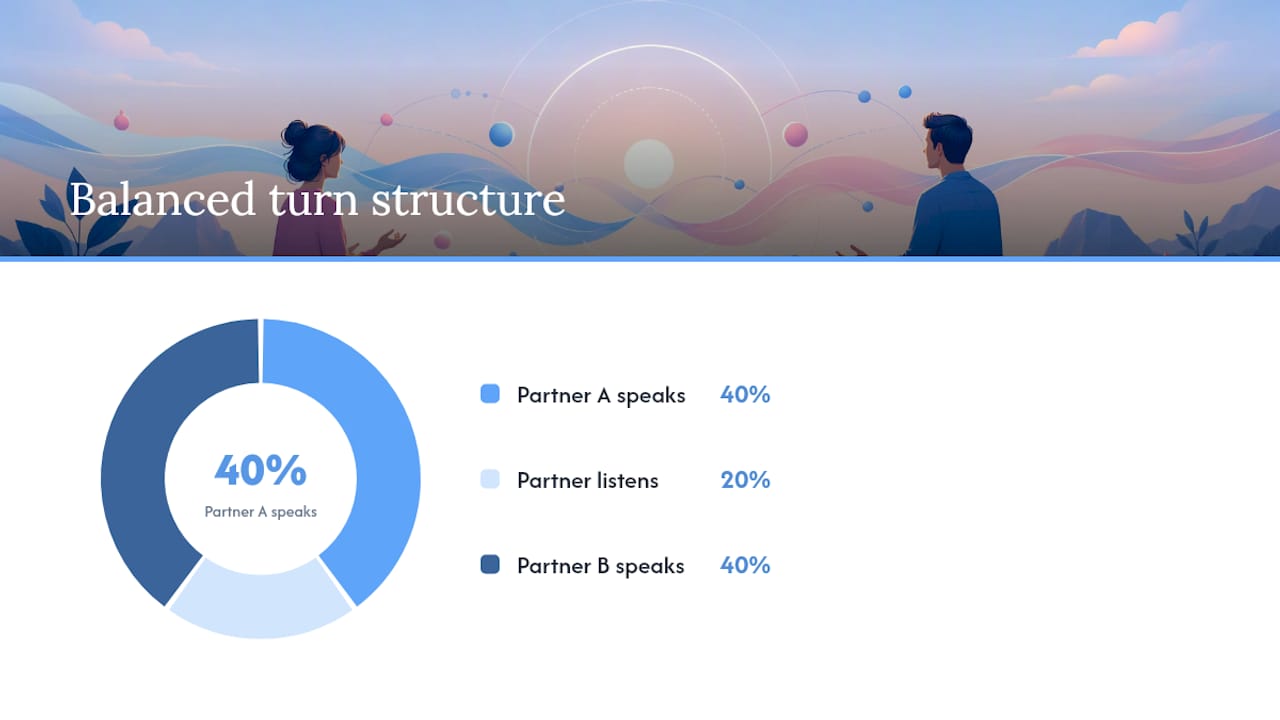
| Structure prevents dominance | Timed turns like 40-20-40 guarantee equal airtime and reduce one-sided conflict. |
| Practice repair when calm | Agree on a repair signal during peace, not mid-argument, so it works when needed. |
| Sustain the habit with tools | Life is a Game’s Relationship Builder app offers guided versions of these exercises with daily reminders to keep practice consistent. |
Authoritative Links, Worksheets, and Practice Guides
-
Gottman Institute’s 10 communication exercises for structured, research-backed practice formats.
-
Reflective listening guidance PDF for a step-by-step listening framework.
-
Psychology.com’s couples communication worksheet for a printable practice guide.
-
MindTools’ listening-in-parts guide for isolating specific listening skills.
Table of Contents
-
Why Connection-First Methods Outperform Technique-Only Advice
-
Practice These Exercises With Guided Support From Life is a Game
Couples Communication Exercises You Can Practice Tonight
These 15 exercises cover the full range of what actually shows up in couples therapy rooms, adapted for home use. Work through them in order if you’re new to structured practice, or pick the two or three that address your specific friction points.
1. Daily 10-minute emotional check-in
Purpose: Build a consistent habit of emotional visibility before problems pile up. Time: 10 minutes, ideally same time each day.
-
Sit facing each other, phones out of reach.
-
Partner A shares one high point and one low point from the day (2 minutes).
-
Partner B reflects back what they heard without offering advice.
-
Switch roles.
-
Close with one appreciation each.
Script: “My high was finishing that project. My low was feeling ignored on the call with your mom.” The Gottman Institute frames this as a stress-reducing conversation, and it works precisely because it’s low stakes and repeatable.
Pro Tip: Do this before dinner, not right before bed. Tired brains skip the listening part and just wait for their turn to talk.
2. Softened startup / I-statements
Purpose: Raise a complaint without triggering defensiveness. Time: 5 minutes to prepare, 10 to deliver and discuss.
-
Write down the issue using “I feel X when Y happens” instead of “You always.”
-
Read it out loud to yourself first.
-
Deliver it calmly, without stacking multiple complaints.
-
Let your partner respond before adding anything else.
Example: “I feel dismissed when my texts go unanswered for hours” lands very differently than “You never answer me.” The Gottman Institute’s research on softened startups found this framing measurably reduces defensiveness and predicts more productive conversations.
3. Active/reflective listening with 40-20-40 turns
Purpose: Guarantee equal airtime and genuine listening, not just waiting to talk. Time: 15 minutes total.
-
Set a timer: Partner A speaks for the first 40% of the time uninterrupted.
-
Partner B reflects back the core message (the middle 20%).
-
Partner B speaks for the final 40%, and Partner A reflects.
-
No rebuttals during reflection, only accuracy checks.
This timed-turn structure, described in reflective listening guidance from Neil Katz and Kevin McNulty, prevents the common trap where one partner dominates every conversation.
4. Mirroring
Purpose: Slow down reactive conversations enough for real understanding. Time: 5 to 10 minutes.
-
Partner A says one sentence.
-
Partner B repeats it back word for word, then asks “Did I get that right?”
-
Partner A corrects if needed.
-
Repeat for three or four exchanges before responding freely.
This feels awkward at first. That’s normal, and it fades after two or three sessions.
5. The 75/25 somatic boundary
Purpose: Keep nervous-system regulation in the room before a hard conversation escalates. Time: 2 minutes before you start.
-
Both partners rate their stress level on a 1 to 10 scale.
-
If either is above a 7, pause and take three slow breaths together.
-
Agree that once regulated to a 7 or below, at least 75% of the conversation stays calm before either person can raise their voice.
-
If either crosses that line, call a time-out.
Somatic grounding before a talk-based technique isn’t optional for a lot of couples. Research on attachment and regulation suggests that a dysregulated nervous system makes even good scripts useless. Stop the exercise and switch to breathing if either partner starts talking over the other or raising their voice.
6. RAVE: Reflect, Accept, Validate, Explore
Purpose: Respond to a partner’s feelings without immediately problem-solving or arguing. Time: 10 minutes.
-
Reflect: repeat back what you heard.
-
Accept: acknowledge the feeling is real for them, even if you disagree with the reasoning.
-
Validate: name why it makes sense given their perspective.
-
Explore: ask one curious question about their experience.
Script: “That sounds frustrating. I get why you’d feel that way after last week. Can you tell me more about what triggered it?”
7. Flashlight (turn inward)
Purpose: Interrupt blame spirals by redirecting attention to your own reaction. Time: 3 minutes.
-
When you notice yourself blaming, pause.
-
Ask silently: “What am I actually feeling right now, underneath the anger?”
-
Say that feeling out loud instead of the accusation.
“You’re so careless” becomes “I feel scared when bills are late.” This single swap changes the entire trajectory of a conversation.
8. Repair attempt protocol
Purpose: Give both partners a fast, agreed-upon way to de-escalate mid-conflict. Time: Ongoing, but practice it for 10 minutes when calm.
-
Pick a phrase or gesture together in advance, like a hand on the chest meaning “I need a pause.”
-
Practice using it once during a calm conversation so it’s not only associated with fights.
-
When either partner uses it during real conflict, both agree to stop talking for at least 20 minutes.
-
Resume only when both feel regulated.
Pro Tip: Practice the repair signal when you’re not fighting. If the only time you ever use it is mid-argument, it feels like a weapon instead of a tool.
9. Gratitude practice
Purpose: Counterbalance criticism with regular, specific appreciation. Time: 5 minutes, daily or several times a week.
-
Each partner names one specific thing the other did that day.
-
Be concrete: “Thanks for handling the school pickup” beats “You’re great.”
-
No qualifiers or comparisons attached.
10. Behavior-change request protocol
Purpose: Ask for a change in a way that’s specific enough to actually happen. Time: 10 minutes.
-
Name the behavior you want changed, not the character trait.
-
State the specific, doable request: “Can you text me if you’ll be more than 30 minutes late?”
-
Ask if that’s something they can commit to, and if not, negotiate a version they can.
-
Confirm the agreement out loud.
11. Weekly timed check-in
Purpose: Catch small resentments before they calcify into big ones. Time: 20 to 30 minutes, once a week.
-
Pick a consistent day and time.
-
Each partner shares one thing that went well and one friction point from the week.
-
Use the 40-20-40 turn structure from exercise three.
-
End with one plan for the coming week.
12. Name-the-cycle exercise
Purpose: Stop blaming each other and start seeing the repeating pattern you’re both stuck in. Time: 15 minutes.
-
Together, describe the recurring fight in third person: “The cycle starts when one of us withdraws and the other chases.”
-
Give the cycle a neutral name, even a silly one.
-
Next time it starts, name it out loud: “There’s the cycle again.”
Externalizing the pattern this way reduces blame because you’re both fighting the cycle, not each other.
13. 40-20-40 speaking-turns drill (skill isolation version)
Purpose: Practice one listening skill at a time instead of all of them at once. Time: 15 minutes.
-
Round one: only practice testing understanding through questions.
-
Round two: only practice summarizing.
-
Round three: only practice offering feedback.
Breaking listening into discrete components, a method MindTools describes as “listening in parts,” makes it easier to notice which specific skill needs the most work.
14. Sandwich feedback method
Purpose: Deliver constructive feedback without it landing as an attack. Time: 5 minutes.
-
Open with something genuine and specific you appreciate.
-
State the concern clearly and briefly.
-
Close with a forward-looking, positive statement.
15. Planning and commitment exercise
Purpose: Turn a good conversation into a concrete plan instead of a vague good feeling. Time: 10 minutes.
-
Summarize what you agreed on during the conversation.
-
Assign one specific action to each partner.
-
Set a date to check back in on progress.
How to Build a 6-Week Couples Communication Practice Plan
Consistency beats intensity. A couple who practices for 10 minutes daily for six weeks will outpace a couple who does a marathon two-hour session once and never again.
-
Week 1: Regulation and safety. Practice the 75/25 somatic boundary and daily check-ins only. Keep sessions under 10 minutes.
-
Week 2: Listening basics. Add mirroring and the skill-isolation drill three times this week.
-
Week 3: Softened startups. Introduce one real, low-stakes complaint per week using I-statements.
-
Week 4: Repair and de-escalation. Practice the repair attempt protocol when calm, then use it if a real conflict arises.
-
Week 5: Requests and feedback. Try the behavior-change request protocol and sandwich feedback method.
-
Week 6: Integration. Run a full weekly check-in combining 40-20-40 turns, gratitude, and a planning exercise.
Ground rules that make every session work better can be informed by companionship and emotional recovery: what really works, ensuring emotional safety before tackling tough topics.
-
Phones face down and out of reach, not just silenced.
-
One person keeps time; when the timer ends, the speaker finishes their sentence, nothing more.
-
Either partner can call a time-out using your agreed repair signal, no explanation required in the moment.
-
Start every session with one sentence: “I want us both to feel heard tonight.”
-
End every session with one sentence: “Thank you for showing up for this.”
Two micro-habits protect momentum between sessions. Set a daily phone reminder for your check-in time, since habit scaffolds and gamified reminders measurably increase adherence compared to relying on willpower alone. And keep a two-line journal: one line on what worked this week, one line on what you’ll adjust next week.
The Five Skills Behind Every Exercise That Works
Every exercise above draws on five underlying skills. Master these and you can improvise in situations no worksheet anticipated.
-
Active listening means fully attending to your partner’s words before formulating your response. Reflective listening research shows it reduces conflict intensity because the speaker feels genuinely heard. Micro-drill: three rounds of one sentence spoken, one sentence mirrored back, no response allowed until round three.
-
I-statements keep focus on your own experience instead of your partner’s character. This is the mechanism behind the softened startup that Gottman research links to lower defensiveness. Micro-drill: rewrite five “you” complaints as “I feel” statements before your next hard conversation.
-
Softened startup is the delivery method for I-statements, raising an issue gently rather than launching an attack. Progress looks like your partner leaning in instead of crossing their arms when you bring something up.
-
Validation means confirming a feeling makes sense without necessarily agreeing with the underlying claim. Micro-drill: practice saying “That makes sense given what happened” five times about things you don’t fully agree with.
-
Repair attempts are the small gestures, humor, or pauses that stop conflict from spiraling. Reflective listening notably doesn’t require agreement, which is worth teaching explicitly. A partner who worries that listening means “losing” the argument will resist the whole process, so naming that upfront removes a major barrier.
All five depend on regulation first. A partner whose nervous system is flooded can’t access any of this, which is why every exercise list above starts with a calming step before technique.
What to Do When Practice Stalls or One Partner Won’t Join
Resistance is common, and it usually isn’t about the exercises themselves.
-
One partner refuses to participate: Don’t force a full session. Ask for five minutes of the daily check-in only, and let consistency build buy-in over weeks, not one conversation.
-
Conversations keep escalating: You’re skipping the regulation step. Return to the 75/25 somatic boundary before attempting any talk-based exercise.
-
Avoidance patterns: Name the cycle out loud rather than pushing harder. “We’re doing the thing where I chase and you withdraw” often breaks the pattern better than more talking.
-
Repeated rule-breaking (interrupting, phone-checking): Reset the ground rules explicitly at the start of the next session instead of letting resentment build silently.
For an at-home repair script: “I notice we’re both getting louder. Can we take 20 minutes and come back to this?” Then physically separate rather than continuing in the same room.
Pro Tip: If a time-out gets used as an excuse to never return to the conversation, set a specific return time out loud before you separate.
Some patterns need more than home exercises. Seek a licensed couples therapist if there’s any physical intimidation, if the same destructive cycle repeats for months with no change, or if one partner consistently shuts down every attempt at connection. These exercises support a healthy relationship. They don’t substitute for professional intervention when safety is a concern.
Why Connection-First Methods Outperform Technique-Only Advice
Most communication advice leads with scripts. The research suggests that’s backward. GoodTherapy’s synthesis of relationship research identifies emotional connection, not any specific technique, as the strongest predictor of whether a relationship lasts and thrives. Techniques matter, but only once a baseline of safety and connection exists.
That’s why softened startups and repair attempts carry so much weight in the Gottman research. They’re not clever phrasing tricks. They’re evidence that the relationship’s foundation is stable enough to survive disagreement.
Couples who practice daily connection habits before attempting conflict resolution techniques report more productive conversations than those who jump straight to problem-solving scripts.
Life is a Game built its Relationship Builder app around exactly this sequencing: daily prompts for check-ins, guided versions of the exercises above, and progress tracking so momentum doesn’t depend on memory alone. For couples who find that outside stressors like anxiety or racing thoughts derail their ability to show up calmly, Groundwork offers evidence-based support between sessions, and Signal not Noise helps keep the daily check-in habit from sliding once life gets busy.
-
Guided daily check-in prompts instead of relying on memory.
-
Structured versions of listening and repair exercises inside the app.
-
Progress tracking to show which skills are improving over weeks.
How Non-Verbal Communication Shapes Every Conversation
Words carry less weight than most couples assume. Tone, posture, eye contact, and touch often communicate more than the sentence itself, and mismatches between what you say and how your body says it are usually what your partner reacts to first.

Try this five-minute drill: sit facing each other and take turns describing your day using only tone and gesture, no words allowed, while your partner guesses the emotion behind it. It sounds silly. It also reveals how much emotional information you’re already sending without meaning to.
During real conversations, watch for three things: crossed arms or turned-away posture (a withdrawal signal), a raised voice paired with tense shoulders (escalation, not just words), and physical touch like a hand on the arm during a hard moment (an unspoken repair attempt). Practicing eye contact during the daily check-in, even for just the first 30 seconds, tends to lower defensiveness before either partner says a word.
Pro Tip: If your words and body language disagree, your partner will believe the body language. Match your tone to your intent before you speak, not after.
Conflict Resolution Techniques That Don’t Require Winning
Good conflict resolution isn’t about who’s right. It’s about finding a workable path forward that both partners can live with.
Start every disagreement with the softened startup, then move into the 40-20-40 turn structure so neither partner dominates. When a conversation heats up, use your agreed repair signal and take a real break, not a five-second pause that fools no one. The name-the-cycle exercise works especially well for recurring fights about the same three topics, since it shifts the frame from “you versus me” to “us versus the pattern.”
One overlooked technique: agree in advance on what counts as a resolved conflict. Some couples fight the same fight for years because they never define what “done” looks like. Ending with the planning and commitment exercise, where you assign one concrete next step each, turns a vented frustration into an actual resolution.
Empathy-Building Activities That Go Beyond “I Understand”
Saying “I understand” rarely convinces anyone. Demonstrating understanding does.
Try a perspective-swap exercise: for five minutes, argue your partner’s side of a recent disagreement as convincingly as you can, in first person. It’s uncomfortable and often clarifying, because most people discover they can’t actually make the other side’s case as well as they assumed.
The RAVE method from the exercises section doubles as an empathy-building tool on its own, since validating a feeling without agreeing with the reasoning forces you to sit inside someone else’s experience for a moment. A simpler daily version: ask “What was the hardest emotional moment of your day, and what did you need in that moment that you didn’t get?” That second half of the question is what usually gets skipped, and it’s where the real empathy work happens.
Assertiveness Training for Couples Who Avoid Conflict
Some couples don’t fight too much. They avoid conflict entirely, which quietly erodes intimacy just as fast.
Assertiveness means stating a need clearly without either aggression or apology. Practice with low-stakes requests first: “I’d like to pick the restaurant tonight” is a safer training ground than a major grievance. The behavior-change request protocol from the exercises list doubles as an assertiveness drill, since it forces a specific, ownable ask instead of a vague hint.
A simple test for assertiveness: can you state what you want in one sentence, without qualifiers like “maybe” or “it’s not a big deal, but”? If not, practice the sentence alone first, then bring it to the conversation.
Setting Communication Goals Together
Exercises work better with a target. Sit down once a month and name one specific communication goal as a couple, not a personal resolution each of you keeps to yourself.
Make it specific and observable: “We’ll do the daily check-in five nights a week” is a goal you can measure. “Communicate better” isn’t. Write it down somewhere both partners see regularly, and revisit it at your weekly timed check-in to see what’s working and what needs adjusting. Goals that fail usually fail from vagueness, not effort, so specificity does more work than motivation ever will.
What Actually Moves the Needle in Couples Work
Most advice on this topic leads with technique: scripts, phrases, formulas for the perfect apology. The research points somewhere else entirely. Connection comes first, and technique only works once that foundation exists. A couple who memorizes the softened startup but never builds daily emotional habits will still struggle, because the nervous system regulation that makes soft delivery possible was never trained.
The overrated piece of conventional advice is the idea that one big breakthrough conversation fixes a communication pattern. It doesn’t. Six weeks of unglamorous 10-minute check-ins does more than a single three-hour heart-to-heart, because the brain learns safety through repetition, not intensity.
If you take one thing from this guide, prioritize the daily check-in over every other exercise. Everything else, from repair attempts to assertiveness training, works better once that habit is in place, and almost nothing works well without it.
Practice These Exercises With Guided Support From Life is a Game
Reading a list of exercises is one thing. Actually doing them consistently, three weeks in, on a night when you’re both tired, is where most couples fall off. That’s the gap Life is a Game’s Relationship Builder app is built to close: guided versions of the check-ins and listening drills covered here, daily reminders so the habit doesn’t quietly disappear, and progress tracking that shows whether your six-week plan is actually working.
If anxiety, racing thoughts, or old patterns keep derailing your calmer conversations, the AI Therapist offers evidence-based support you can access between sessions, day or night. And if the daily check-in habit is the piece you’re most likely to drop, Signal not Noise keeps it visible with a simple three-task daily structure instead of relying on willpower alone.
Download Relationship Builder and set up your first guided check-in tonight. Start at Lifeisagame and see which app fits where you’re starting from.
Frequently Asked Questions
How long does it take to see improvement from couples communication exercises? Most couples notice a shift in tension within two to three weeks of daily practice, though deeper patterns like avoidance or chronic conflict often take the full six weeks to visibly change.
What’s the difference between active listening and reflective listening? Active listening is the broader skill of fully attending to your partner. Reflective listening is the specific technique of repeating back what you heard to confirm accuracy before responding.
Can we do these exercises without a therapist? Yes, all 15 exercises are designed for home practice with no special materials, though a therapist can help if conflicts involve safety concerns or long-standing destructive patterns.
How often should couples do a check-in? Daily 10-minute check-ins work best for building the habit, with a longer 20 to 30 minute weekly session to cover bigger topics using the 40-20-40 turn structure.
What if my partner refuses to try these exercises? Start small and solo. Practice the softened startup and active listening yourself for a few weeks. Behavior change in one partner often invites participation from the other without any pressure.