
ERP for OCD: How Exposure Therapy Treats Compulsions

ERP (exposure and response prevention) is the first-line, evidence-based psychotherapy for obsessive-compulsive disorder, and most people who complete it see substantial symptom reduction. A large body of research shows ERP works as a first-line treatment, with a large portion of patients improving and a smaller portion reaching full recovery in some studies. That’s not a cure-all promise. A meaningful minority don’t fully remit, and outcomes depend heavily on how consistently someone practices between sessions.
Realistic success with ERP for OCD looks like this: fewer intrusive obsessions taking over your day, less time spent on rituals, and the ability to tolerate uncertainty without needing to check, wash, or reassure yourself into temporary relief. It’s not the disappearance of every unwanted thought.
Here’s what this guide covers:
-
How ERP works on a psychological level (habituation and corrective learning)
-
What the clinical evidence actually says about outcomes
-
What a typical session and treatment timeline look like
-
Concrete exposure examples you can recognize and discuss with a therapist
-
Who benefits most, and what can complicate treatment
-
Why people drop out, and how to stay consistent
-
How to find a therapist trained specifically in ERP
TL;DR:
About two-thirds of OCD patients achieve significant symptom reduction with ERP, but roughly one-third may not fully recover without additional support.
Repeated exposures are essential for habituation and corrective learning, with most sessions focusing on gradually increasing distress levels.
Dropout rates reach around 20 to 30 percent, often caused by difficulty adhering to homework or tolerating discomfort.
Comorbid depression, low insight, or active psychosis can complicate ERP and may require integrated treatment approaches before starting exposure therapy.
Digital tools like Conquer Fear and AI Therapist can help reinforce daily practice and tracking, but they do not replace the need for a trained ERP therapist.
Table of Contents
-
Who Benefits Most From ERP, and Who Needs a Different Approach First?
-
Why Do People Drop Out of ERP, and How Can You Stay Consistent?
What Is ERP for OCD and Why Does It Work?
ERP has two separate parts, and confusing them is one of the most common reasons people misunderstand the treatment. Exposure means deliberately confronting the thoughts, images, objects, or situations that trigger your obsessions, whether that’s touching a doorknob, sitting with an intrusive thought about harming someone, or leaving the house without checking the stove five times. Response prevention means resisting the urge to perform the compulsion, ritual, or mental neutralizing behavior that would normally follow.
Combined, these two components make up ERP, and they’re almost always coached by a trained therapist who also assigns practice between sessions.
The mechanism behind why this works comes down to two overlapping processes. The first is habituation: anxiety naturally rises when you face a feared trigger, peaks, and then falls on its own if you stay in the situation without escaping or ritualizing. Your nervous system essentially runs out of fuel for the alarm response. The International OCD Foundation notes that skipping repetitions before anxiety subsides is one of the most common reasons ERP underperforms. One exposure rarely does the job. Ten repetitions of the same exposure, spaced over days, is usually what breaks the cycle.
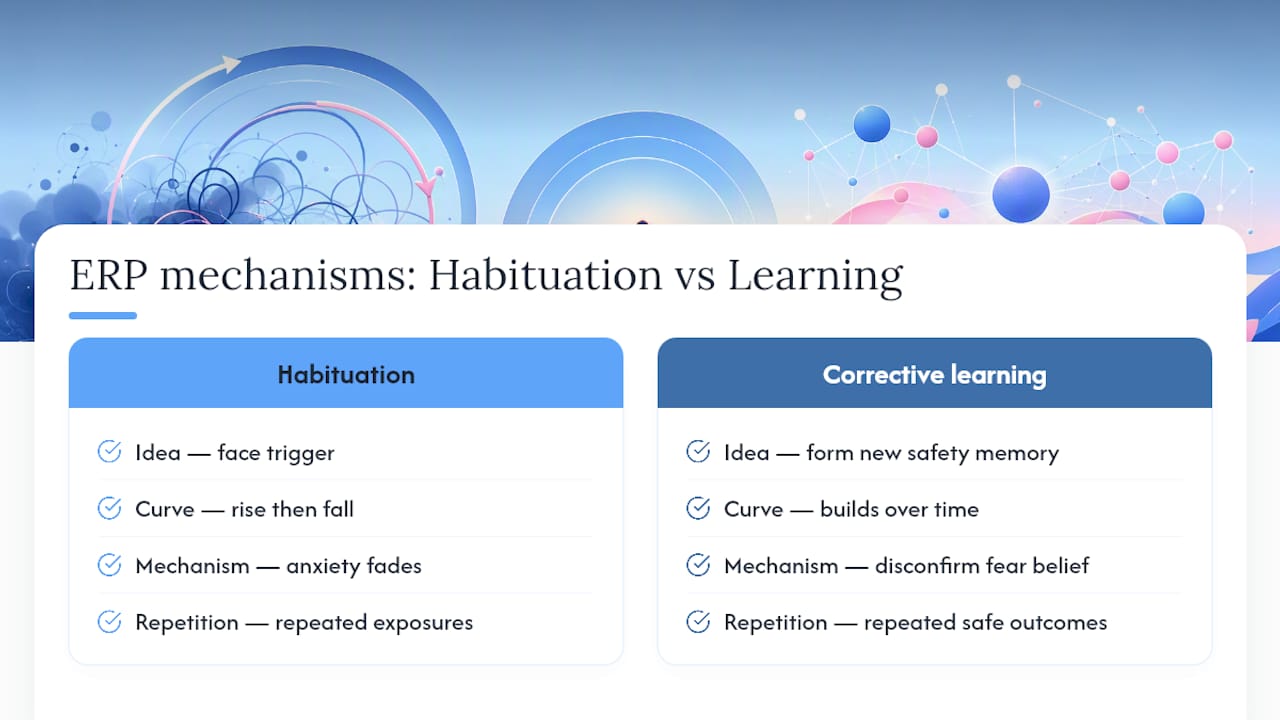
The second process is corrective learning, sometimes called inhibitory learning. Every time you complete an exposure without performing the compulsion and nothing catastrophic happens, your brain stores new information that contradicts the original fear. Over time, that new information competes with and often outweighs the old fear association. This is different from simply “getting used to it.” You’re actively teaching your brain that the compulsion was never protecting you in the first place. It was the thing keeping the fear alive.
A therapist’s job in this process is threefold: building a personalized hierarchy of exposures ranked from mildly uncomfortable to intensely distressing, coaching you through the exposures in session (sometimes participating alongside you), and assigning structured homework so the gains from the office carry into daily life. Homework isn’t optional extra credit here. It’s arguably where most of the actual treatment happens, since a weekly session gives you maybe an hour of practice compared to the dozens of triggering moments you’ll face over the following week.
Pro Tip: If a therapist assigns exposures but never checks in on how the practice actually went, that’s a gap worth raising. Fidelity to the between-session work is one of the biggest predictors of whether ERP succeeds.
What Does the Research Say About ERP Outcomes?
The clinical evidence for ERP is unusually strong for a psychotherapy, which is part of why it holds first-line status in treatment guidelines rather than being one option among many.
OCD was historically viewed as difficult to treat until behavioral approaches like ERP demonstrated real, replicable effectiveness, a shift documented in a comprehensive review of exposure and response prevention research. That review, along with related meta-analytic work, reports that a large portion of people who complete ERP show substantial symptom reduction, and some reach recovery in some studies. Those are meaningful numbers for a condition that can otherwise consume hours of a person’s day in rituals.
The gap between “improved” and “recovered” matters, though. A lot of people land somewhere in between: significantly better, more functional, but still managing occasional obsessions or shorter rituals. That’s not treatment failure. It’s the more common outcome, and it’s still a dramatic shift from where most people start.
Outcomes vary for identifiable reasons. Comorbid depression, low insight into the irrationality of the obsessions, inconsistent homework practice, and errors in how the therapist delivers the exposures all correlate with weaker results, according to the same review’s analysis of predictors. None of these factors make ERP the wrong choice. They shape how it needs to be adapted, whether that means adding medication, addressing depression first, or working with a therapist who slows the pace and builds motivation before pushing into harder exposures.
Why does this matter before you even start? Because ERP asks you to tolerate real discomfort on purpose, and knowing the odds are genuinely in your favor, backed by decades of published outcomes data rather than anecdote, is often what gets someone through the first few uncomfortable sessions.
What Happens in an ERP Session, Session by Session?
The first two or three sessions typically don’t involve exposure at all. They involve assessment and psychoeducation: mapping your specific obsessions and compulsions, ranking their severity, and explaining exactly why the treatment works before asking you to do anything uncomfortable. A therapist following structured ERP protocols uses this window to build trust and make sure you understand the logic of habituation before the harder work starts.
Once exposure work begins, most sessions follow a consistent internal structure:
-
Review the previous week’s homework and any exposures completed independently.
-
Plan the session’s exposure, selected from the hierarchy based on where you’re ready to push.
-
Practice the exposure in session, often with the therapist present or participating.
-
Process the experience, tracking how distress rose and fell and what you learned.
-
Assign new homework, usually repeating the same exposure or stepping up slightly.
Timelines vary by format. Standard weekly outpatient ERP typically runs 12 to 20 sessions, with many people starting to notice measurable change by session six to eight. Intensive outpatient or residential programs compress this into daily sessions over two to four weeks, which suits people with severe symptoms who need faster stabilization or who haven’t responded to standard-pace treatment. Neither format is inherently superior. The intensive route trades a longer calendar timeline for a much higher weekly time commitment.
How Do ERP Exercises Actually Work? Real Examples
Reading about exposure in the abstract doesn’t prepare you for what a session actually looks like, so here’s a walk-through using two common obsession types.
Contamination and handwashing hierarchy. Say someone washes their hands 40 times a day out of fear of contamination. A therapist won’t start by having them touch a public toilet seat. The hierarchy builds gradually:
-
Touch a doorknob at home, wait five minutes, don’t wash.
-
Touch a shared office keyboard, wait ten minutes, don’t wash.
-
Touch a gas pump handle, wait 15 minutes before any hand contact with food.
-
Sit in a public waiting room chair, touch the armrest, resist washing until a natural point (like before a meal).
-
Touch a public restroom door handle, delay washing for 30 minutes.
At each step, the person rates their distress using a 0 to 100 SUDS scale (Subjective Units of Distress Scale) before, during, and after. The exposure gets repeated daily until the peak SUDS rating drops by roughly half, and only then does the hierarchy move up a step. Building a graded hierarchy this way is standard practice across ERP-trained clinicians.
Imaginal exposure for harm obsessions. Someone with intrusive thoughts about accidentally harming a family member can’t practice “in real life” the way a contamination fear allows. Instead, the therapist has them write a detailed script describing the feared scenario, then read it aloud repeatedly, sometimes recorded and played back, until the anxiety it triggers habituates the same way in-person exposure would. This can feel counterintuitive. Writing out your worst intrusive thought seems like the opposite of helpful, but avoiding the thought is exactly what keeps it powerful.

A few rules apply across both formats. Exposures need repetition, not a single brave attempt. Watch for subtle rituals sneaking into the practice, like counting steps or silently praying during an exposure, since that undermines the whole point.
Pro Tip: If an exposure involves genuine physical risk, like handling something actually unsafe, that’s not appropriate ERP and any therapist proposing it should be questioned. Good exposures target irrational fear, not real danger.
Who Benefits Most From ERP, and Who Needs a Different Approach First?
Most people diagnosed with OCD, across contamination fears, checking rituals, symmetry obsessions, and intrusive harm or taboo thoughts, are reasonable candidates for ERP. It’s recommended broadly because the mechanism (habituation and corrective learning) applies regardless of which specific obsession a person struggles with.
Some factors complicate the picture, though, and a skilled therapist adjusts rather than abandons the approach when these show up:
-
Severe depression can sap the motivation needed to tolerate exposure-related discomfort, sometimes requiring depression treatment first or alongside ERP.
-
Poor insight, where someone genuinely believes their compulsions are necessary rather than excessive, often needs additional cognitive work before exposure will land.
-
Active psychosis or substance use typically needs stabilization before ERP can be safely introduced.
-
Safety concerns, including suicidality, require a broader treatment plan beyond OCD-focused exposure work alone.
None of these rule ERP out permanently. They usually mean sequencing or combining care, often pairing ERP with medication-assisted therapy for more complex presentations.
Why Do People Drop Out of ERP, and How Can You Stay Consistent?
Dropout is a real issue with ERP, and pretending otherwise does readers a disservice. Estimates suggest roughly 20 to 30 percent of patients drop out before completing treatment, and low adherence to homework between sessions predicts weaker outcomes even among people who stay enrolled.
The reasons are predictable once you understand the mechanism: exposure is supposed to feel uncomfortable, and discomfort is exactly what makes people want to quit or skip homework. A few things reliably help:
-
Therapists who grade exposures conservatively, rather than pushing too hard too fast, see better retention.
-
Therapist participation in exposures, sitting alongside the patient during a hard one, strengthens the working relationship and measurably improves follow-through.
-
Motivational interviewing techniques address ambivalence before it turns into a missed session or abandoned homework.
-
Daily structured practice, tracked consistently rather than attempted sporadically, keeps momentum between weekly sessions.
Digital tools and gamified apps can support that daily practice layer, helping people log exposures, track SUDS ratings over time, and build the habit of consistent practice. They work best as a supplement to therapist-led ERP, maintaining momentum between sessions or reinforcing gains after treatment ends, rather than standing in for a clinician when symptoms are moderate to severe.
How Do You Find a Therapist Trained in ERP?
Not every therapist who lists “OCD” on their profile actually practices ERP, so a little vetting upfront saves months of ineffective sessions.
-
Search targeted directories through the International OCD Foundation, university-affiliated anxiety clinics, or specialty OCD treatment centers, which screen for ERP-specific training more reliably than general therapist directories.
-
Ask direct questions in a first call or consultation: How many years have you specifically practiced ERP? Do you use in vivo exposure, imaginal exposure, or both? What does homework typically look like between sessions?
-
Watch for red flags: therapists who promise quick fixes, who rely heavily on talking about symptoms rather than practicing exposures, or who never assign concrete between-session homework probably aren’t running true ERP.
Telehealth has also made specialty ERP providers accessible outside major metro areas, which matters given how few clinicians carry deep exposure-therapy training.
How Can Life is a Game Support Your ERP Practice?
ERP’s biggest predictor of success is consistent, repeated practice, which is exactly the gap Life is a Game’s tools are built to close between therapy sessions.
-
Conquer Fear helps structure and schedule exposure practice, letting you build a personal hierarchy and track distress over repeated attempts, the same graded approach clinicians use in session.
-
AI Therapist offers guided, evidence-aligned check-ins for processing an exposure right after you complete it, filling the gap between weekly appointments.
-
Signal not Noise applies a three-task-a-day structure that fits naturally with daily homework assignments, since consistency matters more than intensity in ERP.
These tools are built to support practice and tracking, not to replace a clinician. For moderate to severe OCD, therapist-guided ERP should remain the foundation, with these apps reinforcing the habit in between.
What I’ve Learned Watching ERP Actually Work
The thing conventional descriptions of ERP get wrong is making it sound like a linear staircase: complete an exposure, feel a little better, move to the next step, repeat until recovered. Real progress looks messier. People plateau for weeks on one exposure step, have a rough day that undoes what felt like solid progress, and then suddenly clear three hierarchy steps in a single week once something clicks.
What separates people who get real, lasting results from those who stall isn’t intelligence or willpower in the way most people assume. It’s persistence through the boring, repetitive middle part, the fifteenth time doing the same exposure when it stopped feeling dramatic and started feeling tedious. That’s usually right before habituation actually takes hold. A good therapist matters enormously here, but so does having some structure for the days between sessions when nobody’s checking on you. Combining professional ERP with a consistent way to track daily practice is, in my read of the evidence, the difference between people who plateau and people who keep moving.
— Ryan
Practice Between Sessions With the Right Tools
ERP works, but the sessions themselves are only part of the equation. What happens on the other six days of the week, when you’re facing triggers without a therapist in the room, often determines whether progress sticks or stalls. That’s the specific gap Life is a Game’s apps were built to fill.
Conquer Fear gives you a structured way to build your own exposure hierarchy and track distress ratings across repeated practice, mirroring the graded approach a clinician uses in session but available whenever you need it. AI Therapist adds guided, evidence-aligned support for processing a tough exposure the moment it happens, rather than waiting a week to talk it through. Neither app replaces a trained ERP therapist, especially for moderate to severe OCD where clinical oversight matters. They exist to reinforce what you’re already working on in therapy and keep momentum alive on the days your therapist isn’t watching.
If you’re currently in ERP or preparing to start, try Groundwork to build a consistent between-session practice routine, or explore Conquer Fear to start structuring your own exposure hierarchy today.
Key Takeaways
ERP works because repeated exposure paired with blocked compulsions retrains the brain through habituation and corrective learning, and consistent practice between sessions determines most of the outcome.
| Point | Details |
|---|---|
| ERP is first-line treatment | Clinical guidelines recommend it as the primary evidence-based therapy for OCD, ahead of most alternatives. |
| Outcomes are strong but not universal | Roughly two-thirds of patients improve substantially, with about a third reaching full recovery in some studies. |
| Repetition drives results | Anxiety habituates only with repeated exposures until distress ratings drop, not from a single attempt. |
| Dropout is a real risk | Around 20 to 30 percent of patients discontinue treatment, often tied to poor homework adherence. |
| Life is a Game supports daily practice | Conquer Fear and AI Therapist help structure and track exposure practice between clinician sessions, as adjuncts rather than replacements. |
This article is general information, not a substitute for advice from a qualified doctor. Consult a qualified healthcare professional about your own circumstances before acting on anything here.
Sources
-
Exposure and Response Prevention (ERP) | International OCD Foundation
-
Exposure and response prevention for obsessive-compulsive disorder: A review and new directions