
Start Driving Again: 8 Steps, Gamified Micro Tasks for Fear of Driving
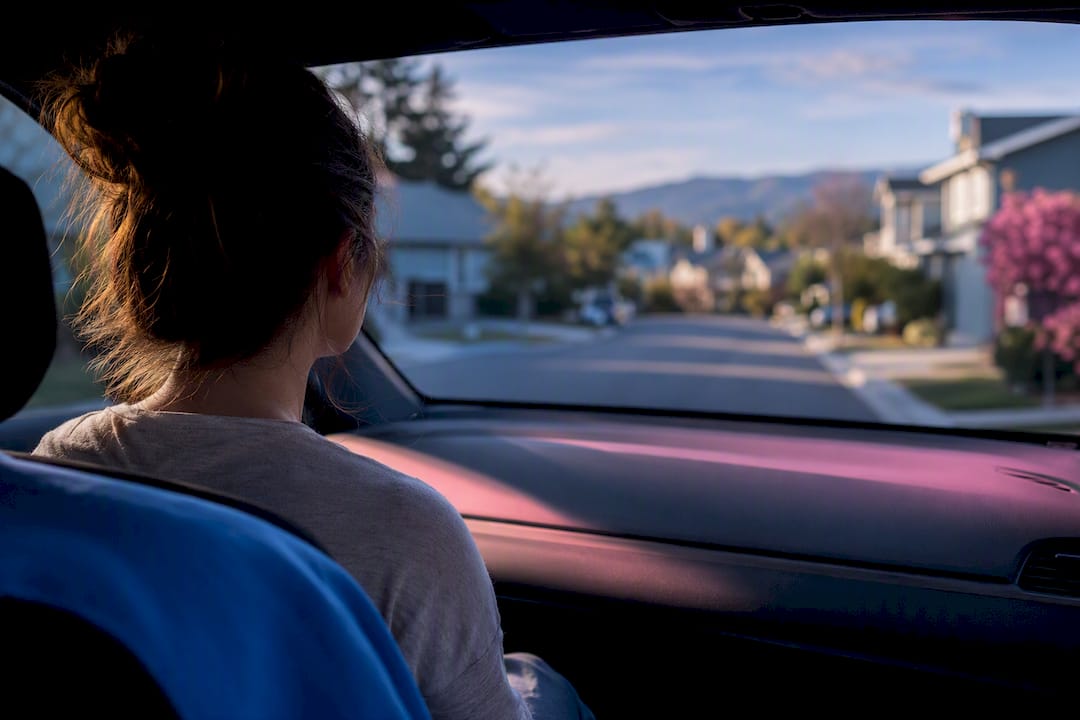
Fear of driving, sometimes called amaxophobia, is an intense but usually treatable anxiety response to being behind the wheel or riding as a passenger. It commonly disrupts daily routines, work, and relationships when left alone, but the outlook is genuinely good: CBT and exposure-based approaches help most people who stick with them. This isn’t a character flaw or a permanent sentence. It’s a learnable problem with a known set of solutions.
TL;DR:
Most driving fear can be addressed through consistent graded exposure, starting with simple steps like sitting with the engine off and gradually progressing.
Anxiety triggers are often specific, such as highways or tunnels, making targeted exposure easier than treating generalized driving dread.
Avoidance behaviors, like taking long detours or relying on others for driving, can gradually shrink your world and increase dependence if not actively managed.
Building a structured, slow-paced exposure ladder and tracking progress with tools like apps are key to overcoming avoidance and reducing fear fully.
Professional help is necessary if fear causes panic attacks, trauma symptoms, or significant life disruption, with therapy focusing on exposure and cognitive restructuring.
Table of Contents
-
What Does Fear of Driving Feel Like, and Where Does It Come From?
-
How Do You Build a Graded Exposure Plan That Actually Works?
-
What’s the Best Way to Support Someone Who’s Afraid to Drive?
-
Why Most Advice on Driving Anxiety Undersells the Boring Part
What Does Fear of Driving Feel Like, and Where Does It Come From?
Driving anxiety shows up in three overlapping ways: in your body, in your thoughts, and in your behavior. Recognizing all three matters, because most people only notice the physical panic and miss the quieter behavioral creep that’s actually doing more damage to their daily life.
Physically, you might notice a racing heart, shortness of breath, sweaty palms, dizziness, or a tight chest the moment you grip the wheel or even picture driving. Cognitively, the mind tends to jump straight to worst-case scenarios: losing control of the car, causing a crash, or being trapped in traffic with no way out. Some people who survived a serious collision experience something clinicians call phantom brake syndrome, a startle response where they instinctively brace or reach for a brake that isn’t there, even as a passenger.
Behaviorally, this is where the fear quietly takes over a life. It looks like:
-
Avoiding highways, bridges, tunnels, or night driving entirely
-
Taking absurdly long detours to dodge a feared road
-
Refusing to drive unless a trusted passenger is present
-
Turning down jobs, visits, or events because they require driving
-
Letting someone else handle every driving errand, indefinitely
The causes are rarely just one thing. A car accident is the obvious trigger, but driving phobias frequently develop without any crash history at all — generalized anxiety disorder, a history of panic attacks, PTSD from an unrelated trauma, or simply growing up with an anxious driver as a role model can all plant the seed. Overestimating how dangerous driving actually is plays a bigger role than most people realize.
When Does Driving Anxiety Become a Diagnosable Phobia?
Nervousness before a long drive is normal. A phobia is different in scope and duration. Clinicians typically look for fear that has persisted for six months or longer and that meaningfully interferes with work, relationships, or independence, not just an occasional bad day on the freeway.
Assessment matters because driving fear rarely travels alone. It frequently overlaps with panic disorder, PTSD, or generalized anxiety disorder, and sometimes with obsessive checking behaviors related to safety. A person with undiagnosed panic disorder might treat every driving episode as a car problem when the real issue is panic attacks that happen to occur most often in the car. Getting that distinction right changes the treatment plan entirely: PTSD-driven avoidance after a crash responds to trauma-informed exposure differently than generalized worry does.
If you’ve been rearranging your work schedule, your errands, or your social life around avoiding the driver’s seat for more than a few months, that’s a reasonable signpost to talk to a doctor or therapist rather than white-knuckling it alone.
What Can You Do Right Now to Manage Driving Fear?
You don’t need a therapist’s office to start making progress. A handful of practical tools, used consistently, can lower your baseline anxiety and set up the graded exposure work that actually resolves the fear long term.
-
Practice paced breathing before you need it. Inhale for four counts, hold for two, exhale for six. Run through this five or six times while parked, before the engine even starts, so your body has a rehearsed off-ramp from panic.
-
Ground yourself with your senses. Name five things you see, four things you hear, three things you can touch. This pulls attention out of catastrophic thinking and back into the actual, current, safe moment.
-
Reduce sensory load in the car. Turn the radio down, keep your phone out of sight, and adjust your seat and mirrors before you move. Small environmental tweaks lower physiological arousal more than people expect.
-
Skip the caffeine before a practice drive. Caffeine mimics the exact physical sensations of anxiety, a racing heart and jitteriness, and can trick your brain into thinking a panic attack is starting.
-
Label the thought instead of believing it. When “I’m going to lose control” shows up, try naming it: “That’s an anxious thought, not a fact.” This small distancing trick, borrowed from cognitive therapy, weakens the thought’s grip without requiring you to argue with it.
-
Start with zero movement. Sit in the parked car with the engine off. Then engine on, still parked. Only after that feels boring should you consider a short, supervised drive around the block.
-
Build a simple safety plan for panic spikes. Know in advance: pull over when safe, breathe, wait it out. Panic peaks and fades within minutes even when it feels endless.
Pro Tip: Keep a tiny “wins” log on your phone, just a one-line note after each practice session. “Drove to the mailbox, stayed calm for 90%.” Seeing progress in writing counters the mind’s habit of only remembering the scary parts.
One caution worth repeating: none of this works if you use these tools to avoid driving altogether. Breathing exercises and grounding are meant to make exposure tolerable, not to replace it. If a technique becomes another way to dodge the driver’s seat indefinitely, it’s worked against you instead of for you.
How Do You Build a Graded Exposure Plan That Actually Works?
The principle behind every effective treatment for driving fear is simple to state and hard to do: approach beats avoidance. Every time you dodge a feared driving situation, the brain logs it as confirmation that the situation was too dangerous to handle, and the fear gets a little stronger. Every time you approach it in a manageable dose and get through it, the opposite happens, and avoidance loses its grip.
A workable exposure ladder moves from barely uncomfortable to genuinely challenging, over weeks, not days:
-
Sit in the parked car, engine off, for five minutes.
-
Sit with the engine running, radio off, for five minutes.
-
Drive around an empty parking lot for ten minutes.
-
Drive a short, quiet residential route you know well, same time of day each rep.
-
Add a slightly busier street with a couple of intersections.
-
Drive the same route during a bit more traffic.
-
Attempt a short stretch of highway with a trusted passenger.
-
Drive your actual regret routes: the one you’ve been avoiding for months.
Keep as many variables fixed as possible between reps, same route, same time, same passenger, and change only one thing at a time (distance, traffic level, or lighting). This isolates what’s actually triggering the spike instead of letting three variables shift at once and muddying the results. Repeat each rung until your anxiety drops noticeably before moving up; that might be two sessions or ten. There’s no fixed timeline, and rushing the ladder tends to backfire.
Virtual reality exposure is worth knowing about as an intermediate rung, particularly for the highway or night-driving steps that are hardest to arrange safely in real life. It’s an emerging tool rather than an established standard, but early use in clinical settings suggests it can bridge the gap between imagining a scary drive and actually doing it.
When Is It Time to Bring in a Professional?
Self-directed practice handles a lot of mild-to-moderate driving anxiety, but certain signals mean it’s time to loop in a therapist. If the fear has cost you a job, triggers full panic attacks, or traces back to a traumatic crash with flashbacks or nightmares, that’s PTSD territory, and it deserves trauma-informed care rather than a solo attempt at exposure.
CBT with a structured exposure component is the standard, evidence-backed treatment: a therapist helps you build the same kind of ladder described above, assigns driving “homework” between sessions, and pairs it with cognitive restructuring to challenge the catastrophic thoughts directly. Many clinics now offer VR exposure as a bridge for people who aren’t ready for real roads yet.
Medication, typically a short-course anti-anxiety prescription, sometimes helps take the edge off enough to start exposure work, but it’s a scaffold, not a foundation. It doesn’t teach the brain that driving is survivable; only repeated, successful exposure does that.
How Life is a Game Thinks About Exposure and Small Wins
Breaking a giant fear into a ladder of tiny, winnable steps is exactly what graded exposure asks of you, and it’s the same logic behind the Conquer Fear app’s task breakdown and progress tracking.
Fear rarely shrinks in one leap. It shrinks one completed, low-stakes step at a time, and celebrating that step is part of what makes the next one possible.
To be clear: this is a self-guided tool inspired by exposure principles, not a substitute for therapy. For more on the mechanics behind this approach, see our related post on the driving fear program.
How Fear of Driving Shrinks Your World Without You Noticing
The damage from driving anxiety rarely arrives all at once. It accumulates through a hundred small compromises that each feel reasonable in isolation. Turning down a job because the commute involves a highway. Missing a friend’s wedding two states over because flying wasn’t in the budget and driving felt impossible. Asking a partner to handle every school pickup, every grocery run, every errand that requires the car.
Over months and years, this shrinks a person’s actual geography. Therapists who work with driving phobia often note that the people struggling most aren’t the ones with the most severe physical symptoms. They’re the ones whose avoidance has quietly expanded to swallow the largest share of their independence. A fear that started as “I don’t like the highway” can become “I haven’t left a fifteen-mile radius of my house in two years.”
There’s a financial cost too, often overlooked. Relying on rideshares, taxis, or favors from friends and family for transportation that used to be free and self-directed adds up fast, both in dollars and in the quieter cost of feeling dependent on other people for basic mobility.
The relationship strain deserves mention as well. Partners and family members who take on extra driving duties can start to feel resentment, even when they don’t mean to, and the person with the fear often internalizes guilt about it. None of this is a reason for shame. It’s simply what unaddressed avoidance does over time, and it’s exactly why starting the exposure process, even in small increments, tends to pay off far beyond the driving itself.
How Common Is Fear of Driving, Really?
Driving anxiety is one of the more common situational fears, sitting alongside fears of flying and public speaking in terms of how many people quietly manage it without ever mentioning it to a doctor. Specific phobias in general are among the most prevalent anxiety conditions, and driving-related fear shows up across a wide range of ages and backgrounds rather than clustering in one demographic.
Two patterns show up consistently in clinical accounts. First, women report driving anxiety somewhat more often than men in clinical settings, though that gap may partly reflect reporting differences rather than a true difference in prevalence. Second, the fear tends to spike after two very different life events: a person’s first serious accident, and a long gap without driving, such as after an illness, a move to a city with better public transit, or an extended period of someone else handling all the driving.
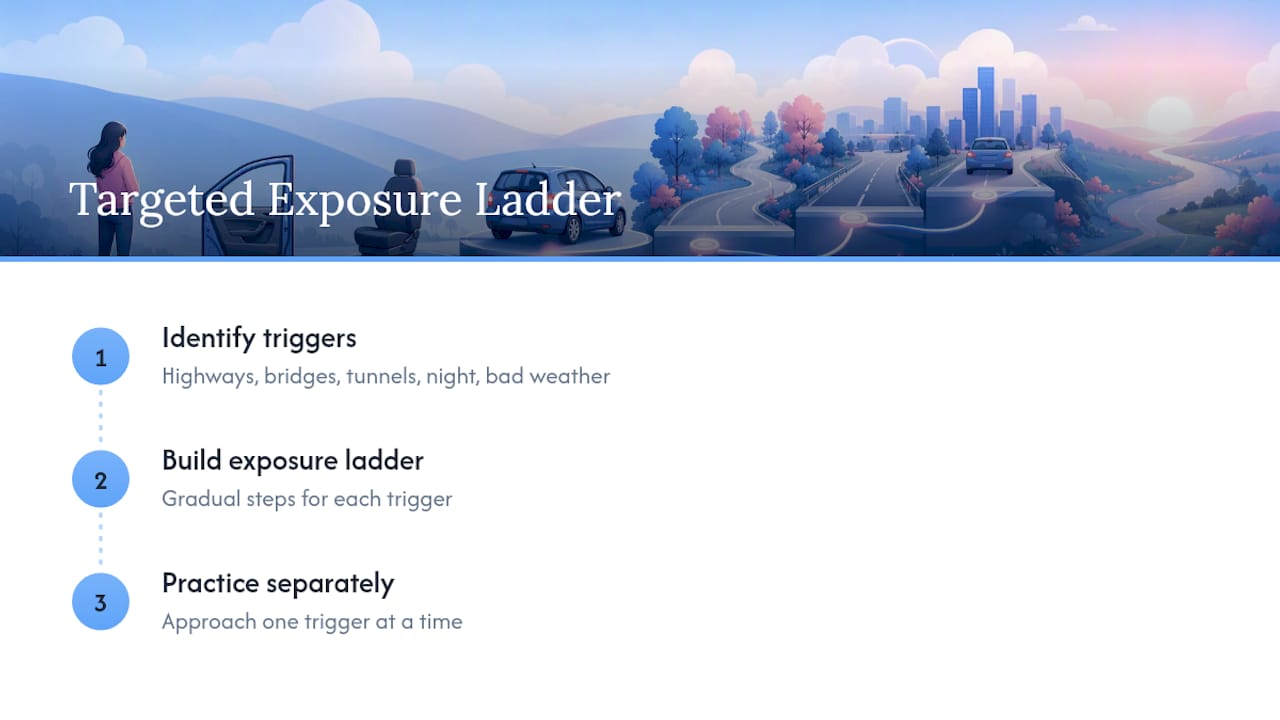
It’s also worth naming a distinction the RAC Drive advisory makes clear: most people with driving anxiety fear specific situations rather than driving as a whole. Highways, bridges, tunnels, night driving, and bad weather are the most commonly named triggers, not driving in general. That’s actually good news for treatment, because a fear with specific triggers is far easier to target with a tailored exposure ladder than a vague, all-encompassing dread.
What Happens If You Never Address It, Versus If You Do?
Left untreated, driving fear rarely stays the same size. It tends to generalize. Someone who starts out avoiding one specific highway often ends up avoiding highways generally within a couple of years, then avoiding unfamiliar routes altogether, then eventually limiting driving to only the most well-worn, predictable paths. The world gets smaller in slow motion, and because it happens gradually, people often don’t notice the scope of the shrinkage until someone else points it out.
With treatment, the trajectory looks very different. Exposure-based psychotherapy shows strong rates of improvement for specific phobias, and driving anxiety responds particularly well because, unlike some phobias, you can practice it in genuinely controlled, repeatable, low-stakes conditions: empty parking lots, quiet residential streets, familiar routes at quiet times. That controllability is a real advantage compared to phobias that are harder to approach gradually.
The goal worth keeping in mind isn’t reaching a day when driving produces zero anxiety. It’s reaching a point where anxiety no longer decides where you go. Most people who commit to a structured exposure process get there within weeks to a few months, not years, particularly when they work with a therapist or use a consistent, self-directed ladder like the one outlined earlier in this piece.
What’s the Best Way to Support Someone Who’s Afraid to Drive?
If someone you care about is dealing with driving anxiety, the instinct to just take over the driving permanently is understandable and almost always counterproductive. It removes the discomfort in the short term while reinforcing the exact avoidance pattern that keeps the fear alive.
A few things genuinely help. Offer to be the passenger during practice drives rather than the permanent chauffeur; your calm presence in the car, without taking the wheel, is worth far more than convenience. Avoid minimizing the fear with lines like “it’s just driving” or “there’s nothing to be scared of.” That kind of reassurance, however well-meant, tells the person their fear is irrational rather than manageable, and it tends to shut down conversation rather than open it.
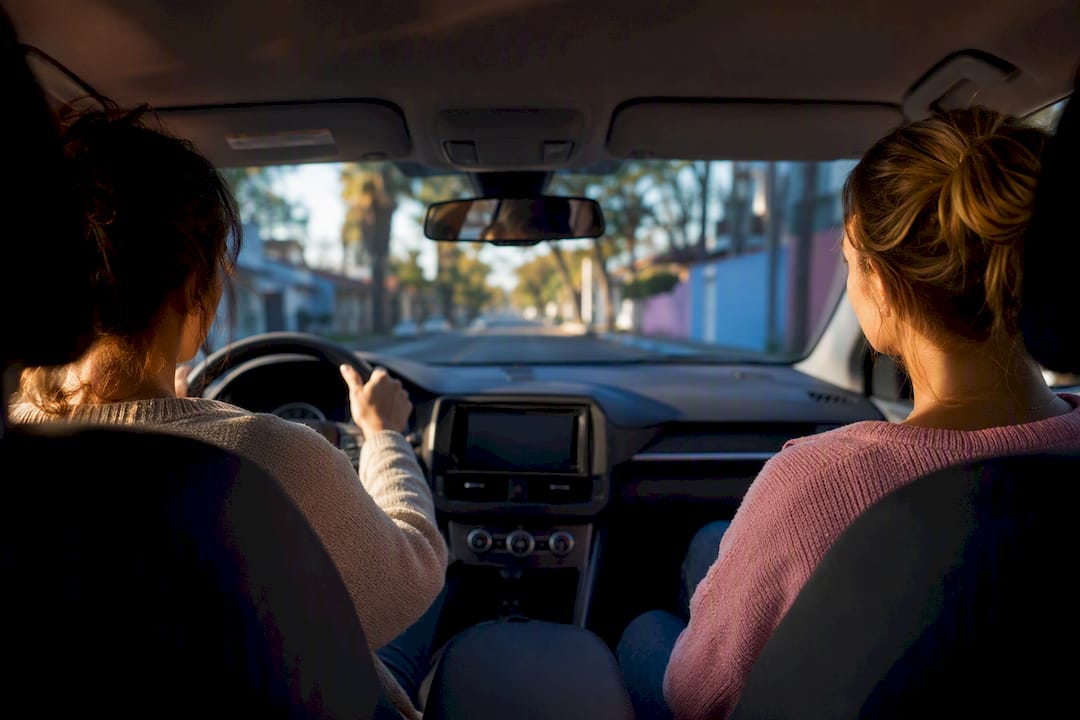
Ask what would actually help instead of guessing. Some people want a passenger who talks to distract them; others want silence. Some want encouragement after a hard rep; others find praise for small steps patronizing and prefer a simple “good job” and moving on. Let them set the pace of the exposure ladder, even when it feels frustratingly slow from the outside. A ladder rushed by an impatient helper tends to trigger a bigger setback than a ladder that moves at what looks like a crawl.
Celebrate the small stuff without making it a big deal. A five-minute drive to the mailbox is a genuine win on someone’s exposure ladder, even if it looks unremarkable from the outside.
Why Most Advice on Driving Anxiety Undersells the Boring Part
The internet’s advice on fear of driving tends to overweight the dramatic techniques, breathing exercises, affirmations, and underweight the genuinely boring mechanism that does the real work: repetition of a fixed, small step until it stops producing a spike. Breathing helps you tolerate a rep. It doesn’t replace doing the rep fifteen times.
The conventional advice also tends to treat “feeling calm” as the finish line. That’s the wrong target. The finish line is functioning despite some residual anxiety, driving to the appointment even though your palms are a little sweaty. Chasing zero anxiety before attempting a drive keeps people stuck far longer than necessary.
If there’s one thing worth prioritizing above all the tactics in this piece, it’s consistency over intensity. A five-minute rep done four times a week beats one heroic hour-long highway attempt done once and never repeated. Small, trackable, repeated wins are what rewire the fear response, not willpower spent in a single high-stakes attempt.
— Ryan
A Practical Complement: The Conquer Fear App
Building an exposure ladder on paper is one thing. Sticking with it on a Tuesday when motivation is nowhere to be found is another. That consistency gap is exactly what a structured, gamified daily practice tool is built to close, and it’s the single sharpest advantage over trying to track a ladder in your head or a scattered notes app.

The Conquer Fear app breaks a large fear like driving into small, trackable micro-steps, inspired by exposure principles, so a task like “sit in the parked car for five minutes” becomes a concrete, checkable win rather than a vague intention. It logs your reps, marks your progress, and turns each small step into something you can see building over time, which matters more than it sounds when you’re the one trying to stay motivated through the slower rungs of the ladder.
To be clear, this is a self-guided practice tool, not therapy, and it isn’t a replacement for a clinician if your driving fear involves panic attacks, PTSD symptoms, or serious life disruption. For daily practice support alongside your own exposure plan, or a clinician’s, start with Conquer Fear or explore the full toolkit at Lifeisagame. One tiny, doable first step: sit in your parked car for five minutes today, engine off, and log it as a win.
Sources
FAQ
Does driving anxiety go away on its own?
It can fade slightly with time for some people, but for most, it improves reliably only with active practice, specifically graded exposure, rather than simply waiting it out.
How do I overcome fear while I’m actually driving?
Use paced breathing before you start, keep sensory distractions low, and if panic spikes mid-drive, pull over when it’s safe, breathe, and wait; panic peaks and fades within minutes even though it feels endless.
I have driving anxiety. What’s the first real step to overcome it?
Start with zero movement: sit in your parked car for a few minutes at a time until that feels boring, then build a personal exposure ladder from there, one small rung at a time.
Is fear of driving considered a mental illness?
When it persists for six months or longer and meaningfully disrupts work, relationships, or independence, clinicians classify it as a specific phobia, a diagnosable and treatable anxiety condition, not a personal failing.