Three Tiny Steps to Ease Fear of Leaving Home, Start in 60 Seconds
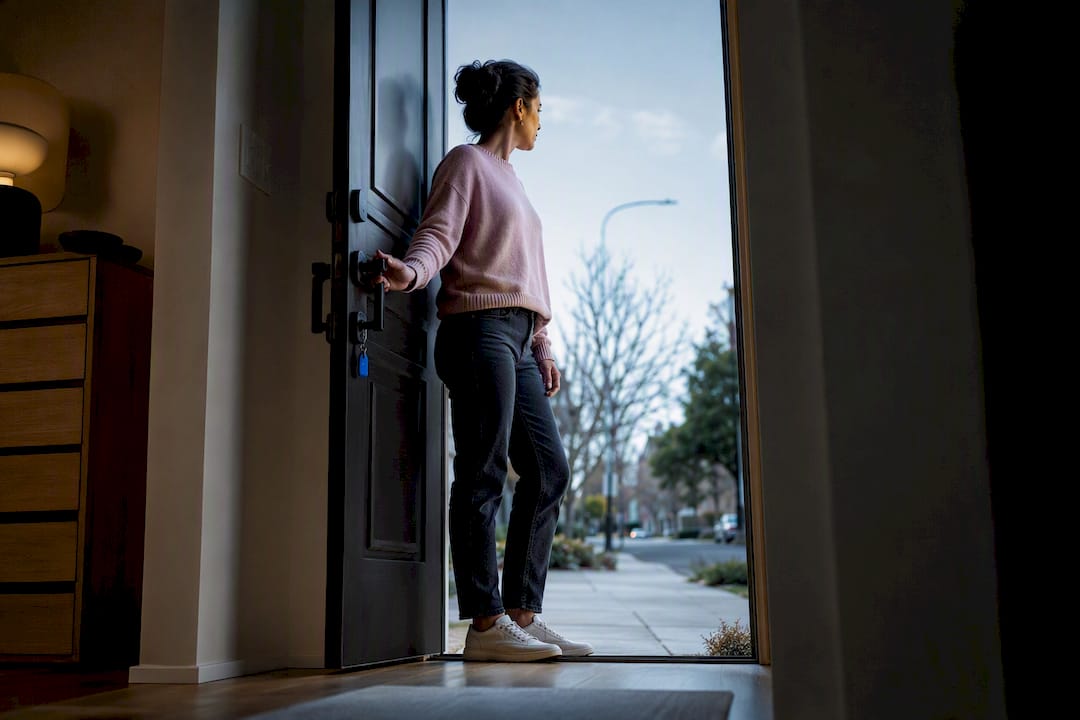
A persistent, avoidant fear of leaving the house can meet the clinical definition of agoraphobia, particularly when it lasts for an extended period and involves at least two specific types of situations, per DSM-5-TR criteria. It is not automatically a diagnosis, but it is a real, well-documented pattern, not a personal failing. The first move is small: stand at your open front door, or step onto the porch, for sixty seconds. That single minute tells you more than another hour of worrying will.
TL;DR:
- Avoidance behaviors, such as relying on safety companions and restricting routes, reinforce the fear by preventing the brain from learning that it can be safe alone.
- The first step in treatment is gradually facing small, manageable situations like standing on the porch or walking solo to the mailbox to build confidence.
- Cognitive behavioral therapy with graded exposure is the most effective approach, often combined with medication like SSRIs or SNRIs when appropriate.
- Self-guided programs and tracking tools can support small, consistent steps but are not substitutes for professional care in severe cases.
- Recovery emphasizes widening the physical and mental distance from feared situations rather than eliminating the fear entirely, with ongoing support reducing relapse risk.
Table of Contents
- What Does a Fear of Leaving the House Feel Like?
- What Causes This Fear, and What Triggers It?
- When Should You See a Doctor About This?
- Why Does Avoiding the Outside Make the Fear Worse?
- What Treatments Actually Work for Agoraphobia?
- Three Tiny Steps You Can Try This Week
- What Does Recovery From This Fear Actually Look Like?
- A Personal Note on Small Steps
- A Self-Guided Option for Practicing These Steps
- Where to Go for Clinical Detail
- Sources
- FAQ
What Does a Fear of Leaving the House Feel Like?
Agoraphobia symptoms rarely show up as one thing. Clinicians tend to sort them into three buckets, and most people recognize themselves in all three at once.
Physically, the body reacts as if danger is imminent: a racing heart, shortness of breath, dizziness, sweating, or a wave of nausea right as you reach for the door handle. Cognitively, the mind runs worst-case scripts, fear of fainting, losing control, or being unable to escape a checkout line or a crowded bus. Behaviorally, the pattern shows up as avoidance: canceling plans, ordering groceries online instead of shopping, refusing to leave without a partner, or narrowing your world to a few “safe” streets.
- Physical: heart palpitations, breathlessness, trembling, tight chest, dizziness
- Cognitive: fear of losing control, catastrophic “what if” thinking, hyperawareness of exits
- Behavioral: avoidance, needing a companion, housebound stretches, over-reliance on delivery apps
The NHS notes that these three categories, physical, cognitive, and behavioral, form the backbone of how agoraphobia gets assessed. Severity varies widely. Some people manage a modified life, driving instead of walking, shopping only at off-hours. Others become fully housebound. The overlap with panic disorder and generalized anxiety is common enough that a clinician, not a symptom checklist, should sort out which label actually fits.
What Causes This Fear, and What Triggers It?
Most agoraphobia does not appear out of nowhere. It usually follows one or more panic attacks, and the fear that develops is less about the outside world and more about being trapped somewhere help can’t reach you, according to Mayo Clinic.
Common triggers and contributing factors include:
- A panic attack in a public place, grocery store, highway, elevator, that gets mentally linked to that location
- Major life stress: a death, job loss, divorce, or health scare
- A prior anxiety disorder or depression that primed the nervous system to overreact
- A frightening health event, chest pain, a fainting spell, that convinced you your body might fail in public
Agoraphobia differs from social anxiety in a key way: social anxiety fears judgment, agoraphobia fears entrapment or being unable to get help if something goes wrong, per StatPearls. It also differs from depressive withdrawal, which stems from low motivation and flat mood rather than acute physical fear. Knowing which one you’re dealing with changes the treatment plan.
When Should You See a Doctor About This?
DSM-5-TR sets a clear bar: marked fear or anxiety about at least two of five situation types, public transportation, open spaces, enclosed spaces, crowds or lines, or being outside the home alone, with symptoms persisting over time.
A typical clinical visit is less intimidating than most people expect. Here’s roughly what happens:
- A clinician asks about onset: when did this start, and was there a panic attack involved?
- They screen for related conditions, panic disorder, depression, other phobias, since these often travel together.
- They assess functional impact: are you missing work, skipping medical care, or relying entirely on others to leave the house?
Some signs mean you shouldn’t wait for a scheduled appointment. Seek help sooner if you notice suicidal thoughts, an inability to manage basic self-care (eating, hygiene, medication), or a rapid decline in functioning over just a few weeks. Agoraphobia is treatable, but a sharp downward spiral deserves faster attention than a routine booking.
Why Does Avoiding the Outside Make the Fear Worse?
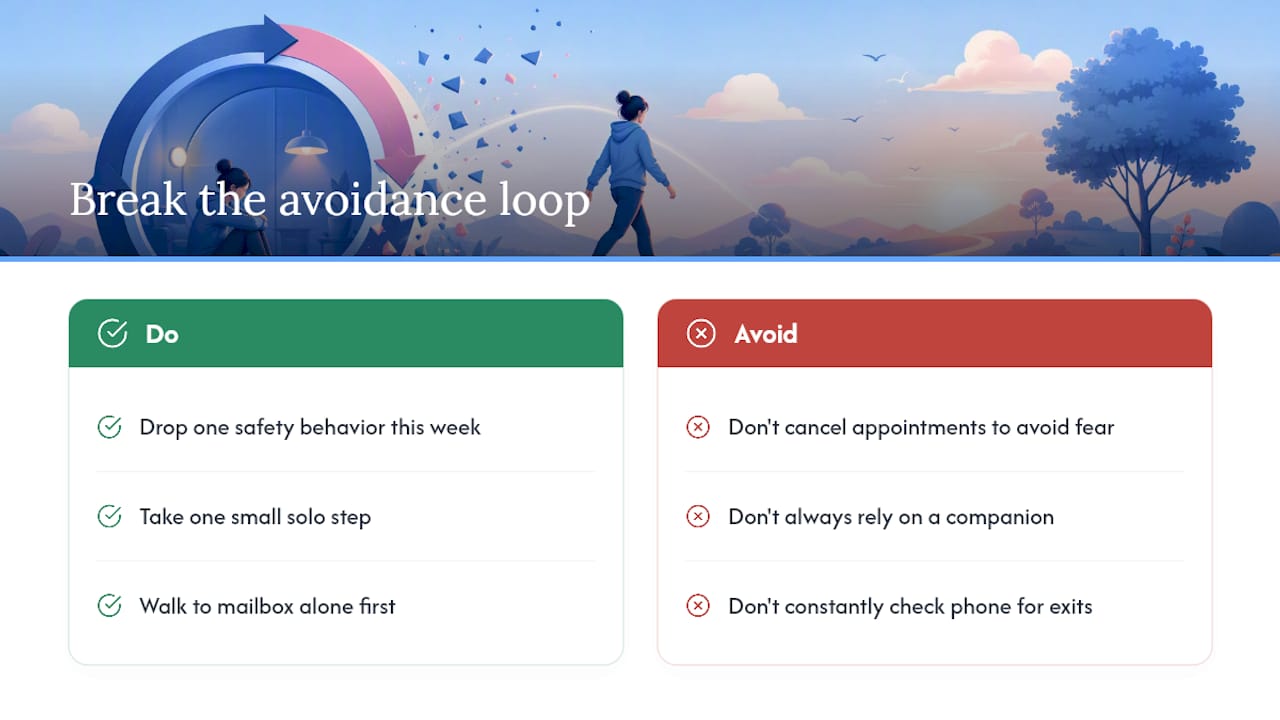
Every time you skip the walk, cancel the appointment, or ask someone to run the errand for you, the fear feels smaller for about ten minutes. Then it grows back, usually larger. That’s the avoidance loop: short-term relief that reinforces long-term fear.
Safety behaviors are the loop’s fuel. Always bringing a companion, sticking to one “approved” route, carrying anti-anxiety medication you never take just in case, checking your phone constantly for an exit plan. Research on safety-seeking behavior shows these habits block the corrective learning your brain needs to realize the danger never actually materializes.
Here’s a concrete example. If you only ever leave the house with your partner, your brain never gets the data point “I did this alone and survived.” Dropping that one safety behavior, walking to the mailbox solo instead of waiting for company, gives your nervous system proof it can’t get any other way.
Pro Tip: Pick ONE safety behavior to drop this week, not all of them. Trying to quit every crutch at once usually backfires and confirms the fear instead of disproving it.
What Treatments Actually Work for Agoraphobia?
Cognitive behavioral therapy, specifically graded exposure, is the first-line approach clinicians reach for, and for good reason: it directly targets the avoidance loop instead of just managing symptoms. Graded exposure means facing feared situations in a deliberate order, smallest first, with enough repetition that your nervous system updates its risk assessment.
Medication has a role too. SSRIs and SNRIs are the medication classes most commonly used alongside therapy, though a prescriber needs to weigh your specific history, other conditions, and side effect tolerance before recommending one. Medication decisions shouldn’t happen without a conversation with someone qualified to make that call.
Beyond formal treatment, several self-help techniques pair well with clinical care:
- Slow breathing: four seconds in, six seconds out, to counter hyperventilation during a panic spike
- Interoceptive exposure: deliberately inducing mild versions of scary sensations (spinning in a chair, brief stair-climbing) so your body gets used to a racing heart without panic attached
- Activity scheduling: planning one small outing per day rather than waiting to “feel ready”
Clinical guidance is consistent on one point: tiny, doable steps work better than one dramatic attempt to “push through.” A structured CBT program with a therapist remains the gold standard, but self-guided exposure tools can serve as a useful adjunct when they’re paced correctly and you know your own limits. If you want a plain-English rundown of how exposure and cognitive reframing work together, this explainer on CBT for anxiety breaks it down without the jargon. Low-intensity practices like at-home yoga for anxiety can also help regulate the nervous system between exposure sessions, though it’s not a replacement for exposure work itself.
Three Tiny Steps You Can Try This Week
You don’t need a grand plan. You need three stages, done in order, at your own pace.
- Doorstep, 60 seconds. Stand at your open front door or on your porch for one full minute. Notice what actually happens (usually nothing) versus what you predicted would happen.
- Short walk. Once the doorstep feels boring rather than terrifying, walk to the end of your block and back. Repeat it for a few days before extending it.
- Solo quick errand. Pick something low-stakes, mailing a letter, buying one item, and do it without a companion.
Pace matters more than speed. If a stage feels easy for three days straight, move to the next one. If it doesn’t, stay there longer, there’s no penalty for repeating a step.
Tracking these small wins matters, because the brain that fears leaving the house tends to forget its own progress fast. A structured, self-guided program like the Fear of Leaving the House app turns each stage into a trackable step with small rewards for showing up, inspired by exposure principles rather than clinical treatment. It’s a tool for structure and consistency, not a substitute for professional care. If your fear is severe or tied to panic attacks that feel unmanageable, talk to a clinician before building your own exposure ladder.
What Does Recovery From This Fear Actually Look Like?
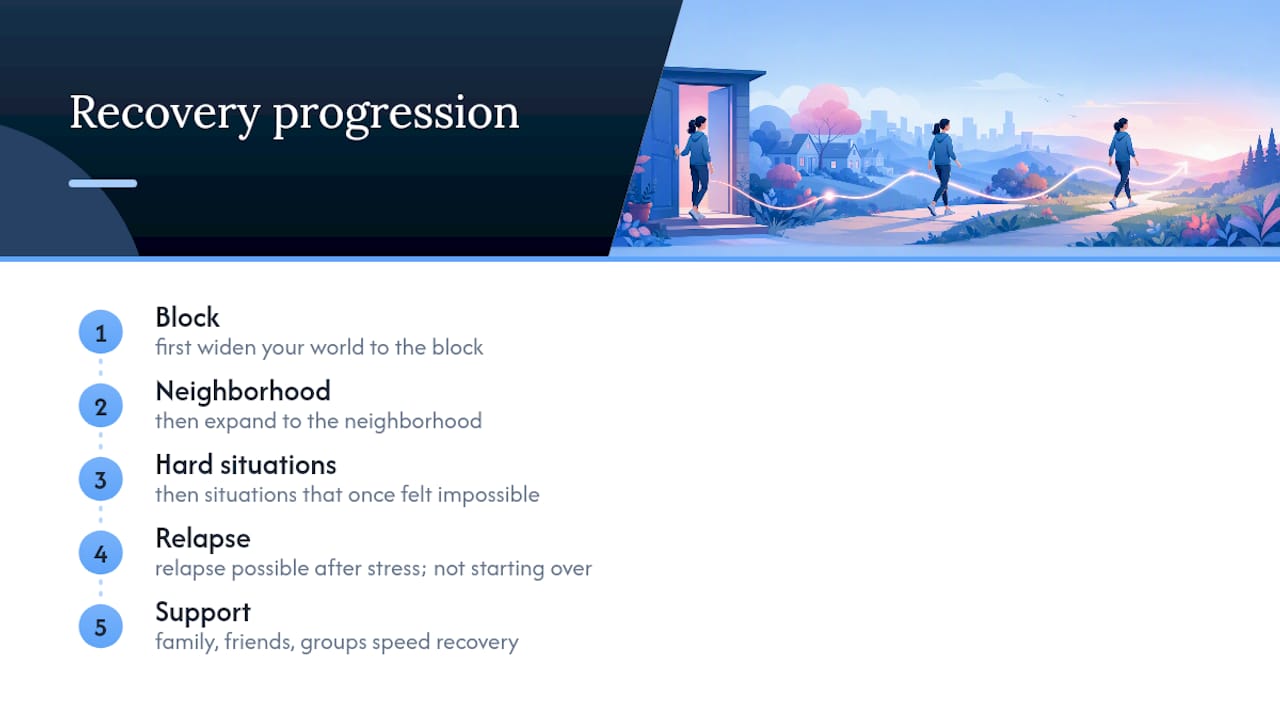
Recovery rarely means the fear vanishes completely. It means the fear stops running your schedule. Most people who work through agoraphobia with CBT and graded exposure describe a gradual widening of their world, first the block, then the neighborhood, then situations that once felt impossible, rather than a single breakthrough moment.
Relapse risk is real, especially after a stressful life event, but it doesn’t mean starting from zero. Someone who has done exposure work before typically has faster access to their coping skills the second time around, even if a bad week temporarily narrows their range again. Reframing agoraphobia away from “fear of open spaces” and toward “difficulty tolerating the feeling of being unable to escape” makes the recovery goal clearer: you’re not trying to stop being afraid of parking lots, you’re building tolerance for uncertainty.
Support systems speed this up considerably. Family and friends who understand the avoidance loop can help by not doing everything for you, encouraging solo attempts instead of automatically stepping in as the companion. Support groups and online communities, whether formal or just a friend who’s been through it, provide accountability that’s hard to generate alone. The people who recover fastest are usually the ones who stopped treating small setbacks as proof the whole effort failed.
A Personal Note on Small Steps
Anyone who has stood at their own front door, hand on the handle, heart pounding for no visible reason, knows this fear doesn’t respond to logic or willpower alone. What actually moves the needle is absurdly small: one minute on the porch, one solo walk to the mailbox, repeated enough times that your nervous system quietly updates its risk math. The programs and frameworks matter less than the repetition. If there’s one thing worth pushing back on, it’s the idea that you need to feel ready before you try. You won’t. Try anyway, at a size so small it feels almost pointless, and let the evidence build from there.
— Ryan
A Self-Guided Option for Practicing These Steps
Life is a Game’s Fear of Leaving the House program turns the doorstep-to-errand progression into a structured, self-guided plan you can work through at your own pace. It’s built for the exact gap most people hit after reading advice like this: knowing what to do but having no way to track whether you’re actually improving. The app breaks exposure into small, repeatable stages and marks each win, however minor, so progress becomes visible instead of something you have to take on faith. It’s inspired by exposure principles, not a clinical treatment, and it isn’t a substitute for therapy if your symptoms are severe or tied to unmanageable panic. For milder, day-to-day avoidance, it gives you a way to practice consistently without needing to build your own exposure ladder from scratch. If you want to start somewhere lower-stakes tonight, open the app and log tomorrow’s plan: sixty seconds on the doorstep, nothing more.
Where to Go for Clinical Detail
These sources cover the clinical background referenced throughout this article. They’re background reading, not endorsements of any single product.
- StatPearls on agoraphobia: full DSM-5-TR diagnostic criteria and differential diagnosis
- NHS overview: symptoms, causes, and typical UK treatment pathway
- Mayo Clinic: causes, risk factors, and panic disorder connection
- Cleveland Clinic: treatment options including CBT and medication classes
Sources
- Agoraphobia - StatPearls - NCBI Bookshelf
- Agoraphobia symptoms - NHS
- Agoraphobia - Symptoms and causes - Mayo Clinic
- Agoraphobia - Better Health Victoria
- Agoraphobia: What It Is, Symptoms & Treatment - Cleveland Clinic
FAQ
Why am I so afraid to leave the house?
It’s often the result of one or more panic attacks that got mentally linked to being outside or trapped somewhere help isn’t easily reached, a pattern Mayo Clinic describes as central to agoraphobia’s development.
What is the best treatment for agoraphobia?
Cognitive behavioral therapy with graded exposure is the first-line approach, sometimes paired with SSRI or SNRI medication prescribed after evaluation, according to Cleveland Clinic. Self-guided tools like Life is a Game’s exposure-based program can complement this work between sessions.
Why do I feel anxious as soon as I try to leave home?
The anxiety usually spikes from anticipatory fear, your brain predicting a panic attack or entrapment before anything has actually happened, which triggers the same physical symptoms as a real threat.
Is there a connection between ADHD and agoraphobia?
There’s no established direct causal link between ADHD and agoraphobia, but both conditions can involve anxiety, and someone managing ADHD alongside untreated anxiety may find avoidance patterns harder to interrupt without structured support.