
Focus Training Exercises That Actually Build Attention

Do three things daily and your attention will sharpen within weeks: single-task reading with timed check-ins, short Pomodoro-style focus blocks, and a brief ATT-style auditory drill. Harvard neuropsychologists specifically recommend 30 minutes of single-task reading with a timer ringing every five minutes to catch mind-wandering before it takes over.
Here’s your one-line prescription: two 15 to 30 minute focused sessions plus one short micro-practice, every day. Most people notice their attention holding steadier within two to four weeks.
- Single-task reading: a session with periodic 5-minute check-ins
- Pomodoro blocks: work periods with breaks in between
- ATT-style drill: 12-minute audio combining selective attention, switching, and divided attention
A randomized controlled trial found that attention flexibility training predicted symptom improvement that was maintained long-term — proof that this isn’t just a feel-good habit. Apps like Life is a Game’s Signal not Noise can help you log these sessions so the habit actually sticks.
Key Takeaways
Focus improves through structured, progressive practice that trains attention flexibility, not through passive brain games or willpower alone.
| Point | Details |
|---|---|
| Top three exercises | Single-task reading with 5-minute checks, Pomodoro focus blocks, and a 12-minute ATT-style audio drill. |
| Daily prescription | Two 15 to 30 minute sessions plus one short micro-practice, with visible change in two to four weeks. |
| Progression matters | Increase duration or difficulty gradually, never both at once, and vary tasks to encourage transfer. |
| Evidence base | RCT data links attention flexibility gains to lasting symptom improvement at six months. |
| Track it with Life is a Game | Signal not Noise breaks practice into three daily tasks so sessions get logged instead of forgotten. |
This article is general information, not a substitute for advice from a qualified doctor. Consult a qualified healthcare professional about your own circumstances before acting on anything here.
Table of Contents
- Focus Training Exercises You Can Start Today
- How to Build a Progressive Focus Practice
- What the Research Actually Shows
- Common Mistakes That Stall Focus Training
- A Note on Why Structure Beats Willpower
- Track Your Practice Without the Mental Overhead
- Sources
Focus Training Exercises You Can Start Today
Attention isn’t one skill. It’s several: staying locked on one thing (sustained focus), filtering out noise (selective focus), jumping between tasks (alternating focus), and juggling two things at once (divided focus). The exercises below hit different combinations of these, so pick based on what your day actually demands.
1. Single-task reading with attention checks
Grab a physical book or a printed article, not a screen. Set a timer for 30 minutes with a chime every 5 minutes. When it rings, ask yourself: did my mind wander? If yes, note where it drifted and gently bring it back to the page. This isn’t about punishing yourself for wandering. It’s about building the muscle that notices wandering in the first place, which is the real skill behind sustained attention.
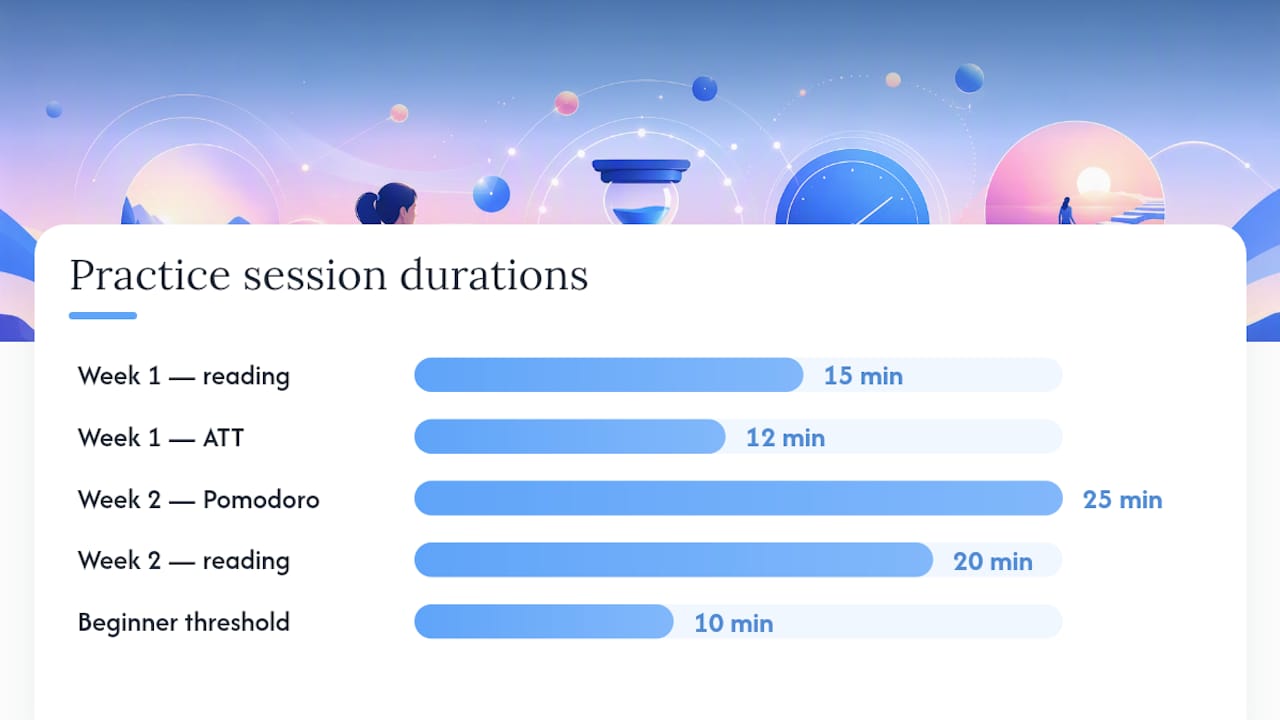
Start with 15 minutes if 30 feels brutal. Scale up by 5 minutes each week once the check-ins feel routine rather than jarring.
2. Pomodoro and focus-block variations
The classic 25-minute work, 5-minute break cycle suits tasks with lots of small decisions, like editing or email triage. Switch to 50 minutes on, 10 minutes off for deep work that needs momentum, like writing or coding. Combine the two: use Pomodoro blocks for your actual work, and single-task reading sessions as separate “attention gym” time, since they train different muscles.
3. The Attention Training Technique (ATT)
ATT is a structured audio exercise developed for clinical use, and it’s one of the more rigorously tested attention drills around. The MCT Institute’s canonical version runs about 12 minutes: 5 minutes of selective attention (focusing on one sound among several), 5 minutes of rapid switching between sounds, and 1 to 2 minutes of divided attention (holding two sounds in awareness at once).
Practice it seated, eyes open, using authorized recordings rather than casual imitations, since the MCT Institute notes that unlicensed versions often miss the structural cues that make the exercise work. Twice-daily practice during the first few weeks produces the most reliable gains.
Pro Tip: Do your ATT session at the same time each day, right after a fixed habit like brushing your teeth. The consistency matters more than the time of day.
4. Mindful breathing and sensory grounding
When you need a reset in under two minutes: pick five things you can see, four you can hear, three you can touch, two you can smell, one you can taste. This 5-4-3-2-1 method yanks your attention out of rumination and into the present moment. A slower option: breathe in for four counts, hold for four, out for six, repeated six times.

5. Pre-performance focus cues
Athletes and public speakers use a fixed physical cue, a specific stretch, a phrase, a breath pattern, right before they need peak focus. Repetition wires the cue to a mental state, so the ritual itself starts triggering readiness.
6. Micro-practices for work and commuting
- Practice attentive listening in one conversation a day: no phone, no planning your response, just tracking what’s said.
- State your task’s purpose out loud before starting (“I’m writing this email to get a decision by Friday”).
- Take a 90-second movement break every 90 minutes, even just standing and stretching.
How to Build a Progressive Focus Practice
Week one: one 15-minute single-task reading session and one 12-minute ATT session daily. Week two: add a 25-minute Pomodoro block for actual work, and stretch reading to 20 minutes. From there, increase duration or difficulty by small increments, never both at once.
Train at a level that’s slightly challenging, not exhausting. Progressive overload with varied tasks beats long, sporadic sessions for building skills that transfer to real work.
Your environment matters as much as the exercises. Turn on phone downtime settings, clear your desk to just what the task needs, and tell someone your focus-block hours so they don’t interrupt.
- Track subjective ease: does refocusing after distraction feel less effortful week to week?
- Track objective markers: are you finishing timed reading sessions without checking your phone?
- Note completion rates on Pomodoro blocks over two weeks.
Pro Tip: If you consistently can’t sit through even 10 minutes, or you suspect sleep problems, medication side effects, or an attention disorder are behind it, talk to a clinician before pushing harder on exercises alone.
What the Research Actually Shows
The case for these exercises isn’t just intuition. A controlled trial comparing ATT against Mindful Self-Compassion found both reduced anxiety and depression symptoms, but the improvement in attention flexibility specifically predicted who got better, and that effect held at six-month follow-up.
Attention flexibility, the capacity to shift and reorient focus on demand, appears to be the mechanism linking structured practice to real symptom and performance gains, not just time spent training.
Separate behavioral studies found ATT practice led to faster attentional disengagement compared to control conditions, and a later fMRI trial linked that faster disengagement to reduced activation in the anterior cingulate cortex, a brain region tied to conflict monitoring.
- Structured, repeated practice beats one-off sessions.
- Attention flexibility mediates benefits more than raw time-on-task.
- Computerized brain games show mixed transfer results; real-world, progressive tasks perform better.
The honest caveat: not every “brain training” app delivers what it promises. The exercises above work because they push the same attentional skills you use in daily life, not because they’re novel or gamified for their own sake.
Common Mistakes That Stall Focus Training
Playing isolated brain games without increasing difficulty rarely transfers to real tasks. If mind-wandering feels constant, shrink your sessions to 5 minutes and build up, rather than forcing 30 minutes of frustration.
- Fix extreme distraction with a note-and-return habit: jot the intrusive thought on paper, then refocus.
- Poor sleep or certain medications can blunt any attention gains, so address those first.
- Put your phone in another room during focus blocks and calendar-block your practice times.
Pro Tip: Missing a day isn’t failure. Missing a week usually means the schedule doesn’t fit your life, so adjust the time slot before you quit entirely.
A Note on Why Structure Beats Willpower
What surprised me most going through this research wasn’t that ATT works. It’s how much adherence, not raw exercise quality, decides whether people actually improve. In early user testing, breaking practice into small, trackable daily wins kept people showing up far longer than open-ended “meditate more” advice ever did. Gamified structure isn’t a gimmick here. It’s the scaffolding that turns a good exercise into a habit.
— Ryan
Track Your Practice Without the Mental Overhead
Life is a Game is built for exactly this problem: knowing what to practice is only half the battle, showing up daily is the other half. Signal not Noise breaks your day into three focused tasks instead of an overwhelming list, which maps directly onto the practice plan above: one reading session, one ATT drill, one Pomodoro block, tracked and checked off rather than left to memory.
If you want the habit-building side handled too, so your focus practice doesn’t quietly disappear after week two, Habit Forge applies the same small-steps approach to long-term consistency. Start by adding your first focus session to Signal not Noise today and see how it feels to check off a real, completed practice.
Sources
- Tips to improve concentration — Harvard Health Publishing
- A randomized controlled trial comparing the Attention Training Technique and Mindful Self-Compassion for students with symptoms of depression and anxiety — PMC
- Attention training technique studies — Frontiers in Psychology (2019)