
How to Conquer Fear: A Science-Backed Plan That Works

The fastest way to start conquering a fear is to pair a short exposure plan with simple calming skills and a few minutes of CBT-style thought work. That combination is the closest thing psychology has to a formula: cognitive behavioral therapy (CBT) is considered the most effective short-term psychotherapy for anxiety and fear-based disorders, and it works largely because it forces gradual, structured contact with the thing you’re avoiding.
Here’s the two-line version you can start using in the next ten minutes. Right now: name the specific fear in one sentence, rate how anxious it makes you on a scale of 0 to 100, and try one calming technique (box breathing works fine) for two minutes. Next: block 20 minutes this week to build a full fear hierarchy and schedule your first low-intensity exposure.
Three things worth knowing before you go further. Graded exposure using a ranked hierarchy is the backbone of nearly every evidence-based fear treatment. Physical symptoms (racing heart, tight chest, shaky hands) are your nervous system’s alarm bell, not proof of danger. And avoidance, while it feels protective, is the single habit that keeps fear alive longest.
To get moving today:
-
Write down the exact situation you’re avoiding, in one sentence.
-
Rate your fear of it from 0 (no fear) to 100 (worst imaginable).
-
Pick one calming technique and practice it for two minutes, away from the feared situation.
-
List one small, low-stakes version of the fear you could face this week.
Pro Tip: Watch for “safety behaviors” from day one: checking your phone, avoiding eye contact, sitting near an exit, or asking someone to reassure you. These small rituals feel helpful but quietly undermine exposure by never letting your brain fully test whether the fear was justified.
Key Takeaways
Conquering fear works when graded exposure, brief CBT-style thought reframing, and daily calming practice are combined into one consistent, trackable routine.
| Point | Details |
|---|---|
| Start with identification | Name the exact fear, rate it 0-100, and note your physical signs and avoidance patterns before building a plan. |
| Build a fear hierarchy | Rank feared situations from low to high intensity and begin exposures at the bottom, not the top. |
| Pace with the 50% rule | Move to the next hierarchy step only after fear intensity drops by roughly half on the current one. |
| Know when to get help | See a clinician if fear disrupts daily life, raises safety concerns, or doesn’t shift after weeks of self-directed effort. |
| Track daily for momentum | Apps like Life is a Game’s Habit Forge and AI Therapist help turn exposure and thought work into a trackable daily routine. |
Table of Contents
Calming Techniques to Use When Fear Hits
These techniques don’t make fear disappear. They lower your body’s fight-or-flight response enough that exposure practice and rational thinking actually become possible. When your heart is pounding and your thoughts are racing, no amount of logic gets through. Calm the body first, and the mind follows.
Diaphragmatic breathing is the fastest lever you have. Place one hand on your chest and one on your stomach. Inhale through your nose for four counts, feeling your stomach rise more than your chest, hold for two, then exhale slowly for six. Repeat for two to three minutes. This works because slow exhalation activates the vagus nerve, which signals your nervous system to stand down.

Grounding pulls you out of a spiral and back into the present moment. The most common version asks you to name five things you can see, four you can touch, three you can hear, two you can smell, and one you can taste. It sounds almost too simple, but it interrupts catastrophic thinking by giving your attention somewhere concrete to land.
Progressive muscle relaxation works the body from the other direction. Tense a muscle group (start with your shoulders or fists) for five seconds, then release and notice the contrast. Move through your body systematically. This is best done daily, outside of crisis moments, so the relaxed state becomes familiar and easier to access under pressure.
A brief mindfulness anchor rounds things out: focus on the physical sensation of your feet on the floor or your breath moving in and out, without trying to change anything, for sixty seconds. Use it right before an exposure session to settle your nervous system without suppressing the fear itself.
Timing matters. Breathing and grounding work best in the moment, right before or during a feared situation. Progressive muscle relaxation and mindfulness build the most benefit as a daily habit, not a one-time fix. Clinical guidance from the NHS on coping with anxiety points to combining daily calming practice with scheduled exposure sessions as a combination that improves follow-through and reduces avoidance over time.
Pro Tip: Practice these techniques when you’re calm, not just when you’re panicking. A skill you’ve only ever tried during a crisis is a skill you can’t reliably access during a crisis. Rehearse breathing and grounding on ordinary Tuesday afternoons so they’re second nature when you need them.
Pinpointing What You’re Actually Afraid Of
You can’t build an effective exposure plan around a vague feeling of dread. Naming the exact target is the step most people skip, and it’s the reason so many self-help attempts stall. Harvard Health notes that many people struggle to articulate precisely what they fear, which blocks any kind of targeted progress.
A simple four-column worksheet clears this up fast. Write down the situation (the specific trigger, like “speaking up in a meeting”), the automatic thought that runs through your head (“everyone will think I’m incompetent”), the physical signs you notice (sweaty palms, shallow breathing, tight throat), and the avoidance behaviors you use to escape it (staying quiet, leaving early, sending an email instead). Fill this out for three or four recent instances of the fear, and a pattern usually emerges within minutes.
Common signs cluster into three categories:
-
Physical: racing heart, shallow breathing, dizziness, nausea, muscle tension.
-
Cognitive: catastrophizing (“this will go horribly”), mind reading (“they think I’m foolish”), tunnel vision on worst-case outcomes.
-
Behavioral: procrastination, over-preparing, canceling plans, seeking constant reassurance.
Recognizing your specific triggers isn’t just a diagnostic exercise. Harvard Health’s guidance on facing fear treats accurate identification as a prerequisite for treatment targeting: vague fear produces vague, ineffective plans, while a precisely named fear lets you build a hierarchy that actually addresses the problem.
Pro Tip: Look for the small rituals hiding inside your avoidance. Checking your phone obsessively before a presentation, rehearsing an exit line “just in case,” or texting a friend for reassurance before doing something scary. These safety behaviors feel like coping, but they’re often the exact thing keeping your fear intact.
Reframing Fear With CBT-Style Thought Work
Challenging distorted thoughts doesn’t just make you feel better in the moment. It weakens the automatic catastrophizing that fuels avoidance, which makes every exposure session easier to complete. This is the “cognitive” half of cognitive behavioral therapy, and it works on a straightforward three-step process: identify the automatic thought, evaluate the actual evidence for and against it, then generate a more balanced alternative.
Here’s what that looks like written out as a thought record:
| Situation | Automatic Thought | Evidence For/Against | Balanced Alternative |
|---|---|---|---|
| Asked to speak in a team meeting | “I’ll freeze and everyone will judge me” | For: froze once in college. Against: have spoken up dozens of times since with no disaster. | “I might feel nervous, but I’ve handled this before and survived worse.” |
| Invited to a party with strangers | “I won’t know what to say and it’ll be humiliating” | For: felt awkward at one party years ago. Against: most conversations go fine once started. | “Some awkwardness is normal. It doesn’t mean the night is ruined.” |
| Flying for a work trip | “The plane will crash” | For: none, statistically. Against: flying is extremely safe; anxiety isn’t evidence of danger. | “This is anxiety, not a real threat. I can tolerate the discomfort.” |
A few additional tools speed this up. The downward arrow technique asks “and if that happened, what would it mean?” repeatedly until you hit the core fear underneath the surface worry. A quick cost-benefit analysis compares what avoidance actually gets you against what it costs you long-term. And simply labeling cognitive distortions (catastrophizing, mind reading, all-or-nothing thinking) by name takes some of their power away just by making them visible.
Pro Tip: Do your thought work shortly before or after an exposure, not in the middle of peak panic. Trying to reason your way through a distortion while your amygdala is fully activated rarely works. Prep the thought, then act. Debrief the thought, then move on.
Building a Fear Hierarchy That Actually Reduces Fear
Graded exposure using a ranked fear hierarchy is the evidence-backed core of nearly every effective fear treatment, and it’s simpler to build than most people expect. You list every version of the feared situation you can think of, rate each one from 0 to 100 for how much anxiety it triggers, then work your way upstarting from the bottom.
Start low. The NHS’s guidance on facing fears recommends beginning with the lowest-scoring items on your hierarchy rather than jumping to anything intense, because early wins build the confidence and skill you need for harder steps later.
Here’s what a hierarchy looks like for four common fears, using generic step descriptions rather than specific brand programs:
| Fear | Low-intensity step (score ~20-30) | Mid step (score ~50) | High step (score ~80) |
|---|---|---|---|
| Social anxiety | Make small talk with a cashier | Join a small group conversation | Give a short presentation to colleagues |
| Fear of flying | Watch takeoff videos, visit an airport | Book a short flight with a companion | Fly alone on a longer route |
| Fear of dogs | View photos of calm dogs | Stand near a leashed, calm dog | Pet an unfamiliar dog with the owner present |
| Public speaking | Speak up once in a small meeting | Present to a familiar small group | Present to a large or unfamiliar audience |
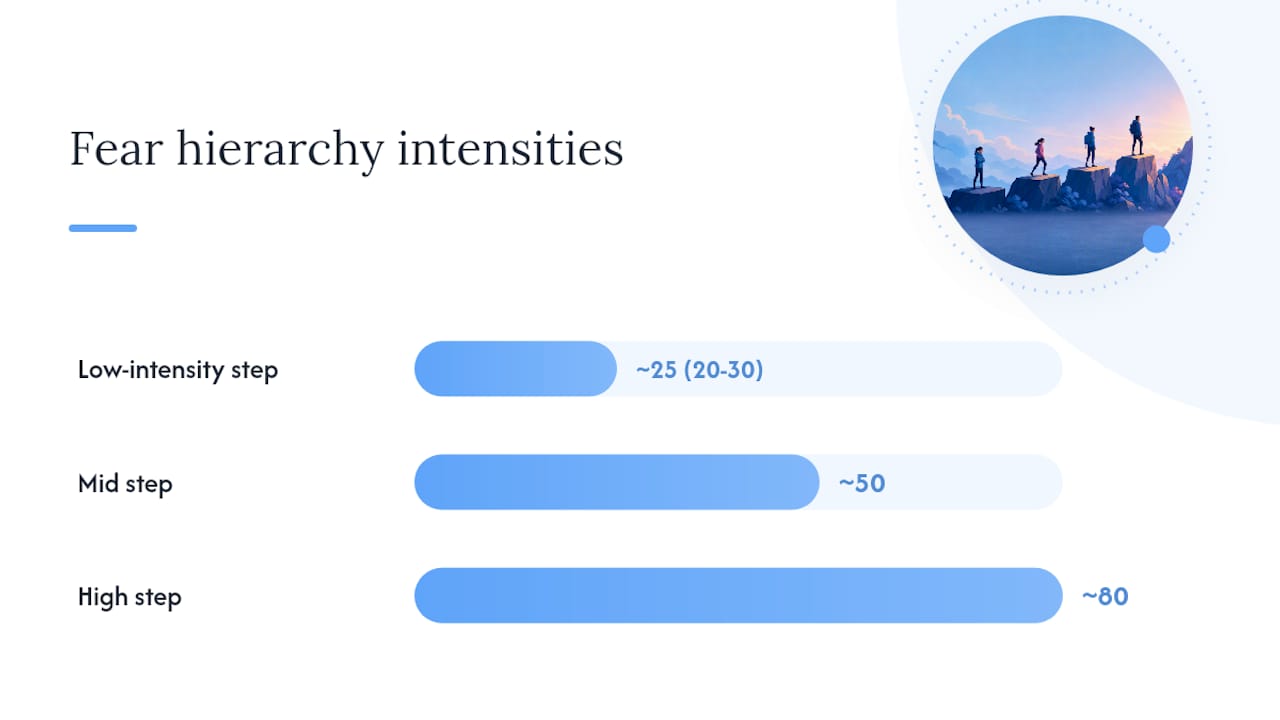
The pacing rule that matters most: aim for roughly a 50% reduction in fear intensity on a step before moving to the next one. Rushing this process risks reinforcing the anxiety instead of reducing it, and clinical research on habituation shows that the fear response fades gradually with repetition, not instantly. Three to four exposure sessions per week, each lasting 20 to 45 minutes, is a reasonable starting cadence for most people working independently.
Eliminate safety behaviors during every exposure. If you’re facing a fear of dogs but keeping six feet of distance “just in case,” you haven’t actually tested whether the fear was accurate. Full exposure means dropping the crutch, not just showing up.
Pro Tip: If progress stalls at the same hierarchy level for more than two or three sessions, the step is probably too big. Break it into a smaller intermediate step rather than forcing repetition of something your nervous system still reads as overwhelming.
Daily Habits That Make Exposure Work Faster
Consistent self-care doesn’t replace exposure and thought work, but it amplifies both. Sleep deprivation and irregular eating leave your nervous system chronically primed for threat detection, which makes every exposure session harder than it needs to be.
-
Protect a consistent sleep and wake time; sleep debt measurably increases baseline anxiety reactivity.
-
Get regular aerobic exercise, even 20 to 30 minutes a few times a week, which lowers overall physiological arousal.
-
Limit caffeine and alcohol, both of which can mimic or worsen anxiety symptoms and disrupt sleep quality.
-
Eat regular, balanced meals; skipped meals and blood sugar crashes often masquerade as anxiety spikes.
-
Schedule a fixed “worry time” of 10 to 15 minutes daily so intrusive worries have a designated outlet instead of bleeding into everything else.
Social support deserves specific attention because most people either overshare their fear with everyone or hide it from everyone, and neither approach helps. Ask one trusted person for a concrete, limited role: not “help me feel better” but “check in with me after my exposure session on Tuesdays.” Finding an accountability partner, even a friend who simply asks how the week’s exposures went, dramatically improves follow-through. Support groups, whether in-person or online, work for the same reason: shared specificity beats vague encouragement.
Habit-building thrives on small daily tasks tied to visible tracking. A tool like Habit Forge can help turn scattered good intentions (sleep better, exercise more, do the exposure) into a trackable daily routine rather than a mental checklist you forget by Wednesday.
Pro Tip: Relapse after a setback is normal, not proof you failed. Stack small wins deliberately. Complete one easy exposure right after a hard day to rebuild momentum, rather than skipping practice until you “feel ready” again.
When Fear Needs Professional Support
Seek professional help when fear meaningfully disrupts daily functioning, creates safety concerns, or hasn’t budged despite weeks of consistent self-directed effort. Self-guided exposure and CBT techniques handle a large share of everyday fears, but some situations call for a trained clinician, and there’s no shame in that threshold being lower than you’d expect.
Treatment options generally fall into three categories. CBT and exposure therapy, delivered by a licensed therapist, remain the most effective short-term psychotherapy for most anxiety and fear-based conditions, often producing meaningful change within 12 to 16 sessions. Medication, typically an SSRI or short-term anti-anxiety prescription, can reduce symptom intensity enough to make exposure work more tolerable, especially for severe cases. Mayo Clinic notes that psychotherapy and medication together are the two primary treatment pathways, and a primary care provider is often the right first stop for a referral.
Clinical guidance consistently frames exposure and habituation as a gradual process. Success is measured by a shrinking fear response across repeated, structured sessions, not by fear vanishing after one attempt.
When you talk to a doctor or therapist, be specific. Describe what situations you avoid, how long the fear has lasted, how it affects work, relationships, or sleep, and what you’ve already tried on your own. At a first appointment, it’s reasonable to ask what treatment approach they recommend, how many sessions a typical course involves, and whether exposure-based work is part of their practice.
Pro Tip: If fear coexists with panic attacks, depression, or a fear so severe you’re restructuring your whole life around avoiding it, ask specifically about combined therapy and medication. Many clinicians find the two work better together for severe cases than either alone, and it’s a reasonable question to raise at a first appointment rather than waiting for it to be offered.
A 4-Week Starter Plan to Begin Facing Your Fear
A short, structured plan beats an open-ended intention every time, mostly because structure creates early wins, and early wins are what keep people going past week one.
-
Week 1: Assessment and skill-building. Identify your specific fear using the situation, thought, physical signs, and avoidance worksheet. Build your 0 to 100 fear hierarchy. Practice diaphragmatic breathing and grounding for five minutes daily. Complete one thought record.
-
Week 2: First exposures. Begin exposure sessions with your two lowest-scoring hierarchy items, three times this week, 20 minutes each. Continue daily calming practice. Complete two thought records tied to specific exposure sessions.
-
Week 3: Build momentum. Move to mid-level hierarchy items once low items show roughly 50% fear reduction. Increase exposure frequency to four sessions if tolerable. Add a weekly check-in with your accountability partner or support person.
-
Week 4: Consolidate and plan ahead. Attempt one higher-intensity hierarchy item if progress supports it. Review your fear ratings across all four weeks to see the trend. Set the next month’s hierarchy goals based on what worked.
A simple weekly tracker keeps the plan honest:
Adjust pace using the 50% rule throughout: if a hierarchy item hasn’t dropped roughly halfway in fear intensity after three or four attempts, don’t push forward, repeat it or break it into a smaller step. Record every win, even small ones like completing an exposure at all, since the habit of noticing progress matters as much as the progress itself.
Pro Tip: Keep exposures on a fixed schedule rather than “whenever you feel ready,” and watch closely for safety behaviors sneaking back in during week three or four, when confidence tempts people to cut corners. An app like Habit Forge can handle the daily tracking automatically, so you’re not relying on memory to notice whether Tuesday’s exposure actually happened.
What People Who Beat Their Fears Have in Common
Recovery stories tend to share the same ingredients: small wins repeated consistently, a routine that doesn’t depend on motivation, some form of outside accountability, and a pace that respects how gradual the process actually is.
One pattern shows up in someone who spent years avoiding highway driving after a minor accident, sticking to back roads even when it tripled a commute. The turning point wasn’t a single dramatic drive. It was parking in an empty lot near an on-ramp for ten minutes, twice a week, until the on-ramp itself stopped triggering panic, then adding one exit at a time.
Another common thread involves public speaking anxiety that had blocked a promotion for two years. The shift started with speaking up once in a five-person meeting, tracked on a simple calendar. Six weeks of that single low-stakes step, repeated deliberately, made a fifteen-minute presentation to forty people feel manageable rather than catastrophic.
A third theme involves fear tangled up with isolation: someone whose social anxiety had shrunk their world to home and work stopped trying to “get over it” all at once and instead texted one friend to grab coffee, once a week, for a month before adding a second person to the mix.
The common thread across all three: none of them waited to feel ready. They picked one small, specific action and repeated it on a schedule.
Pro Tip: Copy the mechanism, not the specific fear. Find your equivalent of “park near the on-ramp” or “speak up once in a small meeting.” It’s the smallest version of the feared thing that you can repeat on a fixed schedule, not the biggest version you can force yourself through once.
How Life is a Game Supports Your Fear-Conquering Plan
Building a fear hierarchy on paper is one thing. Sticking with daily calming practice, tracking exposure sessions, and catching your own thought distortions in real time, week after week, is where most self-directed plans quietly fall apart. Life is a Game turns that ongoing structure into something you actually check in on daily, instead of a plan that lives in a notebook you stop opening by week two.
A few features line up directly with the plan above:
-
Conquer Fear is the main app, that will break down you fear into manageable steps and help you build courage and confidence.
-
AI Therapist offers on-demand, evidence-based coaching for thought work and calming skills when you need them between sessions, not just during a scheduled appointment.
-
Habit Forge turns your exposure schedule and daily calming practice into trackable habits with visible streaks, so momentum builds instead of resetting every time life gets busy.
-
The Conquer Fear Support page answers common questions about using the apps alongside a fear-reduction plan.
If your fear is severe, tied to safety concerns, or hasn’t responded to weeks of consistent effort, these tools support a self-directed plan, they don’t replace a licensed clinician when one is needed. For everyday fears and anxieties, though, Life is a Game’s Groundwork gives you a way to rehearse thought reframing and calming skills on your own schedule, right alongside the exposure work outlined above. Try a session before your next low-intensity exposure this week and see how the two work together.
Pro Tip: Use the app’s tracking to spot your own safety behaviors. If your log shows you’re consistently rating exposures lower on “difficulty” than they should be, or skipping the same step repeatedly, that pattern usually means a safety behavior is quietly doing the work instead of you.
Sources
The clinical guidance behind this plan comes from established mental health authorities, and each source below covers a piece of the picture in more depth than a single article can.
This article offers general information, not a substitute for personalized medical or psychological advice. If your fear is severe or affecting your safety, talk to a doctor or licensed therapist about your specific situation.