Improve Concentration in Two Weeks: Remove Distractions and Sleep Better

The fastest way to improve concentration is to stop relying on willpower and start controlling your environment: put your phone in another room, sleep a consistent and sufficient amount each night, and engage in regular aerobic exercise most days of the week. Harvard and Stanford research both point the same direction, and Life is a Game builds tools around exactly this principle. Everything else is fine-tuning.
TL;DR:
Removing your phone to another room significantly reduces distraction, as proximity alone draws attention even when the screen is off.
Consistent sleep of 7 to 9 hours and engaging in 150 minutes of aerobic exercise weekly are crucial for lasting concentration improvements.
Short, structured work blocks of 25 to 50 minutes, combined with mindful breaks, help restore focus and build sustained attention over time.
Environment-based control, like turning off notifications and using blocking tools, is more effective than resisting temptation in the moment.
Tracking simple metrics and applying habits for two weeks can confirm whether a change has a measurable impact on focus.
Table of Contents
Your Quick Concentration Checklist
You don’t need a personality overhaul to think more clearly today. You need a short list of changes, ranked by how fast they pay off, and the discipline to test each one for a couple of weeks before judging it.
Right now (0 to 5 minutes):
-
Move your phone to another room, not just face down on the desk. Proximity alone pulls at your attention even when the screen is dark.
-
Close every browser tab you’re not actively using. Ten open tabs are ten open invitations to drift.
-
Set a timer for 25 to 50 minutes and commit to one task until it rings.
This hour:
-
Take a five-minute breathing reset or a short walk before you sit down to work. It resets a nervous system that’s already been pulled in six directions since breakfast.
-
Drink a full glass of water. Mild dehydration shows up as fog before it shows up as thirst.
This week:
-
Lock in a consistent bedtime, even on weekends. Inconsistent sleep timing undercuts the benefit of sleep duration alone.
-
Schedule three sessions of 10 to 20 minutes of aerobic movement, brisk walking counts.
-
Try a focus-block app or website blocker for seven straight days before deciding whether it works for you.
Run each change for one to two weeks and track something simple: sessions completed, or a 1 to 5 self-rating of how focused you felt. If a tactic doesn’t move that number after two honest weeks, drop it and try the next one.
What the Research Actually Says About Focus
Most concentration advice fails because it treats attention like a character trait instead of a system you can engineer. The strategies below have real evidence behind them, organized by the part of your routine they touch.
Sleep is the foundation, not a nice-to-have
Skipping sleep to “get more done” is the single most common mistake in this list. During sleep, your brain clears out metabolic waste proteins that accumulate during waking hours, and it consolidates the day’s learning into longer-term memory. Harvard Health recommends 7 to 9 hours nightly as the target for supporting concentration and general cognitive function.
The mechanics matter as much as the total hours. A consistent sleep and wake time, a screen curfew 30 to 60 minutes before bed, and a cool, dark room all support deeper sleep stages. If you’re hitting 8 hours but still feel foggy, don’t assume you need more caffeine. Loud snoring, gasping at night, or persistent daytime drowsiness despite adequate sleep time can point to sleep apnea, which is worth raising with a doctor rather than pushing through.
Exercise works faster than most people expect
The 150-minutes-a-week aerobic guideline isn’t just a heart-health number. It’s tied directly to cognitive performance, and the effect shows up on two timelines. Long term, regular aerobic exercise supports the brain structures involved in memory and attention. Short term, a single brisk walk before a hard task can sharpen focus for the next hour or two.

You don’t need a gym membership. Three 15 to 20 minute walks a week, or two short sessions of interval work, clear the bar. If you work from home, a five-minute walk before an important call functions almost like a reset button.
Nutrition and hydration set your baseline
A Mediterranean-style eating pattern, heavy on vegetables, fish, and whole grains, supports steadier energy than a diet built around refined carbohydrates. Sugar spikes followed by crashes are a direct route to the mid-afternoon fog most people blame on being “just tired.”
Caffeine helps focus in the short term, but timing matters. Caffeine consumed in the late afternoon or evening lingers long enough to fragment the sleep you need to concentrate the next day. And don’t underestimate hydration: even mild dehydration produces measurable lapses in attention and reaction time, which is why the “drink water” item on the checklist above isn’t filler advice.
Mindfulness trains the brain’s monitoring system
Mindfulness isn’t relaxation for its own sake. Kim Willment, it trains the brain’s monitoring system, the part that notices when your mind has wandered so you can bring it back. That’s a different mechanism than simply feeling calmer.

A practical version: read for 30 minutes, but pause every 5 minutes to ask “was I actually absorbing this?” That check-in itself is the training. Harvard Health points to daily practices like this, along with brief sitting meditation, as reliable ways to strengthen sustained attention over weeks, not days.
Your environment beats your willpower
Here’s the finding that should reshape how you think about distraction: Stanford Medicine researchers found that proactive control, physically removing temptation, works better than trying to resist it in the moment. Moving your phone to another room beats leaving it face down next to your keyboard, because willpower is a depletable resource and environment design isn’t.
Apply the same logic to your workspace. Face away from a window with foot traffic. Turn off every notification that isn’t a call from a specific person. Use a full-screen blocker instead of trusting yourself to “just check quickly.”
Time-blocking and breaks aren’t optional extras
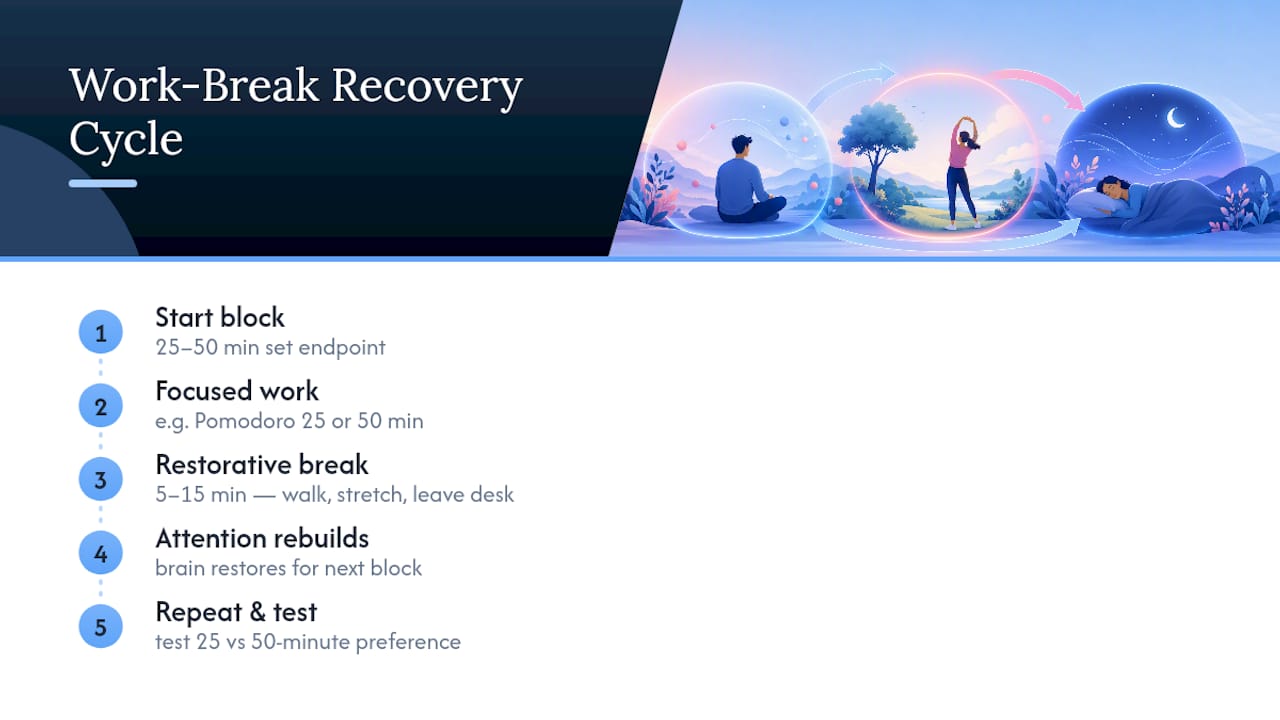
Working in fixed blocks, 25 to 50 minutes is a reasonable starting range, gives your attention a defined endpoint instead of an open-ended slog. The Pomodoro Technique’s classic 25-minutes-on, 5-minutes-off structure works for some people; others do better with 50-minute blocks and 10-minute breaks. Test both.
Breaks aren’t slacking off. Stanford’s research frames short restorative breaks, and good sleep, as part of the same recovery process that lets attention rebuild for the next stretch of work. A five to 15 minute break that actually leaves your desk (a short walk, a stretch, even the mind-muscle focus techniques used in strength training) restores more than one spent scrolling.
Cognitive training and apps: what actually holds up
The research on brain-training games is genuinely mixed. Where gains show up, they tend to come from progressively increasing task difficulty and defining a measurable transfer target before you start, like time-on-task for writing or number of completed study blocks, rather than from the app itself.
Blocking tools have sturdier evidence behind them. One randomized controlled trial found that two weeks of blocking mobile internet access produced a measurable improvement in sustained attention, but only for people who actually stuck with it. That’s the pattern across nearly every focus app on the market: adherence, not features, decides whether the tool helps. Pick the option that removes the most friction for you, an automatic lock rather than an honor-system timer, and pair it with a simple habit scaffold so you don’t need to renegotiate with yourself every morning.
When poor focus signals something medical
Not every concentration problem is a habit problem. Certain medication classes, anticholinergics, sedatives, and some cardiovascular drugs among them, can measurably impair attention as a side effect. Underlying conditions like sleep apnea, depression, and ADHD also show up first as “I just can’t focus anymore.”
If your concentration has dropped suddenly, or the decline is severe enough to interfere with work or safety, Harvard Health’s guidance is clear: review your medications and see a clinician rather than assuming a productivity hack will fix it.
How Life Is a Game Turns Focus Habits Into Daily Practice
Knowing what works and actually doing it on a Tuesday afternoon are two different problems. Most people don’t fail at concentration advice because the advice is wrong. They fail because nothing holds them accountable to it once the novelty wears off.
That’s the gap Life is a Game’s Signal not Noise app is built around. It strips your to-do list down to three tasks a day, which forces the kind of prioritization decision most people avoid making for themselves. Habit Forge works alongside it, turning a single focus tactic, say, a daily 25-minute block, into a tracked streak instead of a good intention that fades by Thursday.
-
Use Signal not Noise before a work session to pick the one task that actually deserves your next block.
-
Use Habit Forge to track a specific behavior (phone out of room, three walks a week) until it holds without a reminder.
-
Neither app diagnoses or treats anything. They’re self-guided scaffolding, not therapy.
Concentration rarely fails because someone lacks information. It fails because the small daily choice, phone in the drawer or on the desk, gets made on autopilot. A structured planning tool interrupts that autopilot long enough for a better choice to happen.
If overwhelm rather than distraction is your core struggle, Life is a Game’s Signal not Noise app is designed specifically for that pattern.
The Bottom Line on Better Focus
Prioritize proactive control first: physically remove the things competing for your attention before you try to out-discipline them. Layer sleep, short bursts of exercise, and structured work blocks on top, and you’ve covered the levers with the strongest evidence behind them.
Pick one strategy and run it for two weeks with a simple tracker, a tick box or a one-line note each day is enough. Then try this right now: put your phone in another room and set a 25-minute timer for one task. That’s the whole first step.
What Most Focus Advice Gets Backwards
Most concentration guides bury the one finding that actually matters: environment beats willpower, every time, for every person. The internet is full of breathing exercises and “just focus” mantras, but the Stanford research is blunt about it. Resisting temptation in the moment is a losing strategy compared to never putting the temptation in the room.
The second thing conventional advice underrates is adherence. People obsess over which focus app has the best features when the research says the opposite matters more, pick the tool with the least friction and the strongest lock, then actually use it for two weeks straight. A mediocre blocker used consistently beats a sophisticated one abandoned after three days.
What should you prioritize first? Not a new app, not a supplement, not a morning routine overhaul. Move your phone to another room and protect your sleep window. Everything else in this guide is optimization on top of that foundation, and optimization without the foundation is just rearranging furniture in a house with no walls.
— Ryan
Build the Habit, Not Just the Willpower
Reading about focus strategies is easy. Sticking with one past day four is where most people quit, usually because there’s no structure holding the habit up once motivation fades. That’s the specific problem Life is a Game was built to solve, not through willpower lectures, but through daily scaffolding that makes the next right action the easiest one to take.
Signal not Noise narrows your day to three tasks, so the “what should I even focus on” question gets answered before you sit down. Habit Forge takes whichever concentration tactic you chose from this guide, the 25-minute block, the phone-in-another-room rule, the three weekly walks, and turns it into a tracked streak with small wins along the way instead of a vague intention you’ll “try to remember.”
Both are self-guided tools, not therapy, and neither claims to treat or cure anything. They’re built for people who know what to do and need something to help them actually do it. If overwhelm and scattered attention are the daily struggle, start with Signal not Noise and set your first three tasks for tomorrow before you close this tab.
Sources
-
Exercise can boost your memory and thinking skills – Harvard Health
-
How to concentrate in an ever-distracted world: Five things to know – Stanford Medicine
FAQ
How do I increase my concentration and focus?
Start with proactive control, remove your phone and other distractions from the room, then add consistent sleep of 7 to 9 hours and roughly 150 minutes of weekly aerobic exercise. Layer in structured work blocks of 25 to 50 minutes once those basics are in place.
Why have I lost my ability to focus?
Poor sleep, chronic stress, dehydration, and constant notification interruptions are the most common everyday causes. Certain medications and conditions like sleep apnea, depression, or ADHD can also impair concentration, so a sudden or severe decline is worth discussing with a doctor.
How can I increase focus in 2 minutes?
A brief breathing reset, a short walk to another room, or a glass of water can produce a fast, noticeable improvement in attention. These micro-interventions won’t replace sleep or exercise, but they work well as a bridge before a focus block.
How can I fix my lack of concentration?
Test one change at a time for two weeks: consistent sleep timing, a moved phone, or a focus-blocking app used daily. Track a simple metric, like a 1 to 5 focus rating, so you know whether the change is actually working before you add another.
Are focus apps worth using?
Blocking tools have real evidence behind them, one trial found two weeks of blocked mobile internet access measurably improved sustained attention for people who stuck with it. The tool matters less than whether you actually use it every day, which is why pairing an app like Life is a Game’s Habit Forge with a specific tactic tends to outperform downloading an app and hoping.