
Relationship Check-In Questions for a 15-Minute Weekly Ritual

A relationship check-in that works is short: several questions, about fifteen minutes, once a week. One partner talks while the other listens without jumping in, then you switch. That structure alone stops small annoyances from turning into resentment, because you’re naming them before they calcify.
Here’s the agenda. First minutes: each partner names one thing they appreciated this week. Next few minutes: one partner answers key questions while the other listens. Then switch roles. Afterwards, agree on one concrete ask for the coming week. Finally, name one thing each is looking forward to together.
The reason this beats occasional marathon talks is simple: a weekly ritual that leads with appreciation and ends with a forward-looking plan keeps small frustrations from piling up into a single overwhelming conversation.
-
Same time every week (Sunday morning, after the kids are asleep, whatever repeats).
-
No phones on the table.
-
Each answer is capped at roughly two minutes.
Pro Tip: If you’ve never done this before, propose it as a four-week trial rather than a permanent commitment. That framing takes the pressure off and makes your partner far more likely to say yes.
Key Takeaways
A fifteen-minute weekly check-in with six timeboxed questions and strict no-rebuttal listening prevents small grievances from becoming major conflicts.
| Point | Details |
|---|---|
| Use the 15-minute ritual | Run six questions across appreciation, needs, and one forward-looking ask, switching speaker roles halfway through. |
| Match format to bandwidth | Use 5-minute check-ins on exhausted weeks, monthly 45 to 60 minute sessions for goals and finances. |
| Log logistics immediately | Turn practical answers into a who, what, by when task recorded outside the conversation. |
| Watch for escalation patterns | Repeated fights or withdrawal signal it’s time for a therapist, not a longer check-in. |
| Track it with Relationship Builder | Life is a Game’s app supplies templates, reminders, and shared notes so decisions from each check-in stick. |
Table of Contents
Quick Alternative Formats If 15 Minutes Feels Like Too Much
You don’t need the full ritual every time. Three formats cover most weeks:
-
The 5-minute version: two questions, no switching roles formally, just a quick “how are we doing” over coffee before work. Good for busy weeks when you still want contact, not depth.
-
The 15-minute weekly check-in: the full six-question agenda above. This is the default, and a 20-minute variant with five timeboxed questions works nearly identically if you want a slightly longer version.
-
The monthly deep dive (45 to 60 minutes): covers goals, finances, and bigger patterns that a weekly check-in doesn’t have room for.
Pick the shorter format when either of you is exhausted, stressed, or mid conflict. Save the monthly version for a genuinely quiet evening, maybe the first Sunday of the month, when neither of you is watching the clock.
Emotional and Mental Check-In Questions
These surface how you’re each actually doing, not just what happened.
-
How full or empty does your emotional tank feel this week?
-
What’s one thing that stressed you out that I might not know about?
-
Did you feel truly heard by me this week?
-
What emotion have you been sitting with the most?
-
Is there anything you’ve been avoiding telling me?
-
What’s one thing I did that made you feel loved?
-
Reflect on how connected you feel to your partner right now.
-
What do you need more of from me emotionally?
Frame answers with “I feel” instead of “you made me feel.” Keep each answer to a minute or two. Save the heaviest questions (avoidance, low connection scores) for weeks when you both have bandwidth, not the night before a big deadline.
Practical and Logistics Check-In Questions
Money, chores, and calendars cause more quiet resentment than almost anything else, so give them their own slot.
-
Is our chore split still feeling fair?
-
What’s coming up on the calendar that we haven’t planned for?
-
Are we on track with our budget this month?
-
Is there a task you’ve been carrying alone?
-
What would make our mornings or evenings run smoother?
Turn answers into commitments with a simple template:
-
Who: name the person taking it on.
-
What: the specific task.
-
By when: a real date, not “soon.”
Log it in a shared note or calendar invite immediately, so it doesn’t evaporate by Wednesday.
Intimacy, Appreciation, and Connection Questions
This is where you actively build the good stuff, not just clear the backlog.
-
What’s something I did recently that made you feel appreciated?
-
Do you feel like we’ve had enough physical closeness lately?
-
What’s one small gesture that would mean a lot to you right now?
-
Is there anything about our intimacy you’d like to talk about?
-
When did you last feel really close to me?
-
What’s a memory from this week you want to hold onto?
-
What’s one thing about you I should compliment more?
Close with “what’s one thing you’re looking forward to with me?” It’s a small ritual, but a check-in built around gratitude and forward planning tends to end on connection instead of a to-do list.
Growth, Goals, and Future-Facing Questions
Save these for the monthly check-in rather than the weekly one.
-
Are we still aligned on our biggest shared goal?
-
Is there a personal goal you need my support on?
-
Are we saving and spending in line with where we want to be in a year?
-
Do our plans for family or living situation still feel right?
Use a mini-template: goal, next step, who owns it, timeline. Revisit quarterly for anything bigger than a month’s work, so long-term plans don’t quietly drift.
Conflict, Needs, and Repair Questions
Some weeks, the honest answer is “this needs more than fifteen minutes.” That’s fine, name it.
-
Is there something small from this week we should clear up now?
-
Is there something that needs a longer conversation later?
-
What do you need from me when we disagree?
-
Did I do anything that hurt you, even unintentionally?
Repair script: pause, validate (“that makes sense”), then schedule the deeper talk for another time instead of forcing it into the check-in window.
Pro Tip: The listener’s only job is to listen, not rebut. Save your response for your turn. Interrupting to defend yourself is the fastest way to turn a check-in into a fight.

How to Run an Effective Check-In Without It Turning Into a Fight
Ground rules matter more than the questions themselves. Setup rules like a consistent time, no phones, and two-minute answers are what actually make a check-in work week after week.
-
Pick a recurring time and protect it like any other appointment.
-
One partner talks, the other listens fully. Then switch.
-
Cap answers at two minutes each.
-
No solving anything mid-check-in. Just name it and, if needed, schedule a separate talk.
-
End with appreciation, even on a hard week.
The listener holding their own reactions without defending in real time is the single biggest thing separating check-ins that work from ones that spiral, according to a non-rebuttal format used in successful relationship rituals.
Pro Tip: If it starts turning into an argument, pause and say “let’s come back to this Thursday” instead of pushing through exhausted. A paused check-in beats a wrecked one.
How Often and How Long Should Check-Ins Be?
Weekly check-ins of about ten to twenty minutes are common maintenance defaults for many couples. Lower-conflict couples can stretch to biweekly or monthly. During an active rough patch, shorter check-ins twice a week tend to work better than one long weekly session, since ten focused minutes is easier to sustain than a heavy hour.
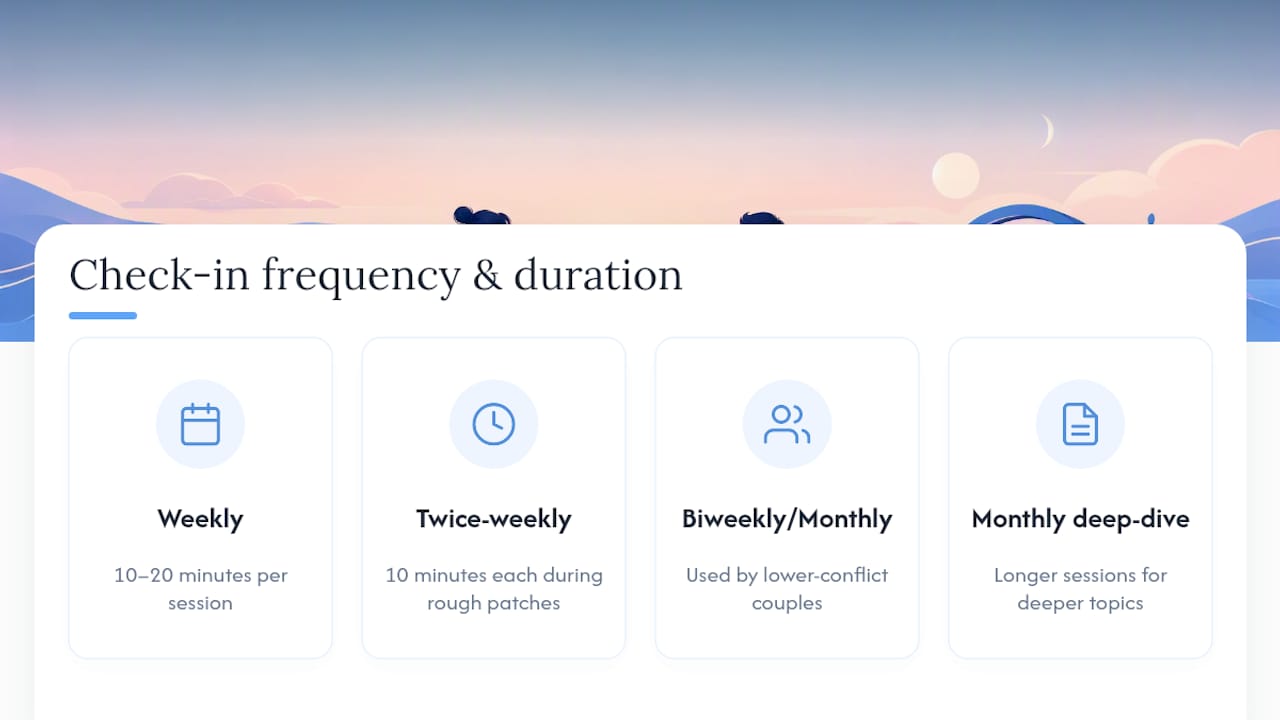
Pick a recurring slot, commit to it for four weeks, then adjust. Monthly deep dives usually last longer sessions for deeper topics.
When a Check-In Isn’t Enough
Watch for repeated escalation, one partner shutting down every time, the same fight resurfacing month after month, or any sign of harm. Recurring patterns that check-ins can’t resolve usually mean it’s time for a therapist or couples coach, not a longer agenda.
A simple way to raise it: “I think we’d both benefit from talking to someone who does this professionally.” It’s okay to pause the ritual and get outside support when the same issue keeps resurfacing.
How Relationship Builder Supports Your Weekly Ritual
Running a check-in from memory works until week three, when someone forgets. The Relationship Builder app gives you a ready-made template, a reminder so the slot doesn’t slip, and a shared note where action items actually get tracked instead of forgotten by Wednesday. Answers you log this week show up again next week, so patterns become visible instead of anecdotal.
Why Small, Regular Check-Ins Beat Occasional Big Talks
Most couples wait until something’s wrong to have “the talk,” which guarantees it’s stressful. A short weekly habit works the way a savings account does: small, consistent deposits that add up faster than a single dramatic conversation ever could. Consistency, not intensity, is what actually protects connection over years.
Try Relationship Builder for Your Weekly Check-Ins
Sticky notes and good intentions only get a couple so far. Life is a Game built Relationship Builder specifically so you’re not reinventing the check-in format every Sunday: it gives you the templates, sends the reminder before you forget, and keeps a shared record of what you both committed to.

The app turns each answer into something trackable rather than a conversation that evaporates by Tuesday, so your “I’ll handle the dishes this week” actually gets checked off instead of quietly dropped. If a check-in surfaces something bigger than logistics, Groundwork offers evidence-based support around the clock, no appointment needed. Visit the Relationship Builder page and start your first check-in this week.
Sources
-
The Weekly Relationship Check-In: A 20-Minute Template | LoveCertain
-
How to Build a Weekly Connection Ritual: 5 Templates and 30 Check-In Questions — Plunge App
-
10 Relationship Check-In Questions to Ask Your Partner | Paired