
Relationship Repair Steps That Actually Rebuild Trust

Repair after a fight follows a specific order: cool down first, then reach out, deliver a complete apology, listen and validate, make amends, and follow through with proof of change. Skipping the cool down or jumping straight to problem solving is why so many “we talked it out” conversations fall apart within a week. Safety and connection come before any attempt to fix what actually went wrong, and the scripts, timing windows, and app-based drills below fill in exactly how.
TL;DR:
Waiting at least 20 to 30 minutes to cool down before initiating repair significantly reduces the risk of escalation.
A complete apology must include specific acknowledgment, impact validation, unconditional accountability, and a concrete commitment to change.
Listening requires open-ended questions, silence, paraphrasing, and feeling validation to genuinely understand and support a partner.
Repeated, consistent behavioral actions and transparency are more effective for rebuilding trust than grand gestures or promises.
Daily micro-repairs like softer tones or brief gestures help prevent conflicts from escalating and strengthen ongoing connection.
Table of Contents
What are the relationship repair steps after a fight?
Here’s the sequence, in order, with rough timing for each stage. Skipping ahead, especially past step one, is the most common reason repair attempts stall out.
-
Cool down first. Wait at least 20 to 30 minutes before attempting any conversation, longer if either of you is still flooded.
-
Reflect on your own contribution. Before you speak, ask what you did, not just what was done to you.
-
Reach out and request a time. A short, low-pressure message works better than ambushing your partner the moment they walk in.
-
Deliver a complete apology. Four parts, covered in detail below, no exceptions and no “buts.”
-
Listen and validate. Let your partner speak fully before you respond to any of it.
-
Negotiate specific amends. Name an action, not a vague promise.
-
Set a follow-up check-in. A few days later, revisit how the repair actually held up.
A few sample scripts help here, because most people freeze when it’s time to actually say the words. If you walked away mid-argument: “I shouldn’t have walked out like that. Can we try again in 20 minutes?” If voices got raised: “I raised my voice and that wasn’t fair to you. I want to hear what you were trying to say.” If the rupture involved betrayal, whether a broken promise or something bigger: “I know what I did hurt you in a way that goes beyond this one moment. I’m not asking you to move past it quickly.”
NPR’s Life Kit lays out a similar five-part process and stresses initiating repair within a day of the rupture. Wait too long and resentment calcifies into the relationship’s operating story instead of a single bad afternoon.
Why cooling off matters before you try to repair
Nervous systems don’t negotiate well. When you’re flooded, your heart rate spikes, your reasoning narrows, and you argue to win rather than to understand. Repair attempts made in that state usually make things worse, not better. That’s why the Connection First Protocol puts safety before connection, connection before cognitive access, and cognitive access before any actual problem solving. Trying to solve the fight before your body has calmed down skips straight to the step that requires the calmest thinking, which is exactly backward.
Fast ways to bring your system down:
-
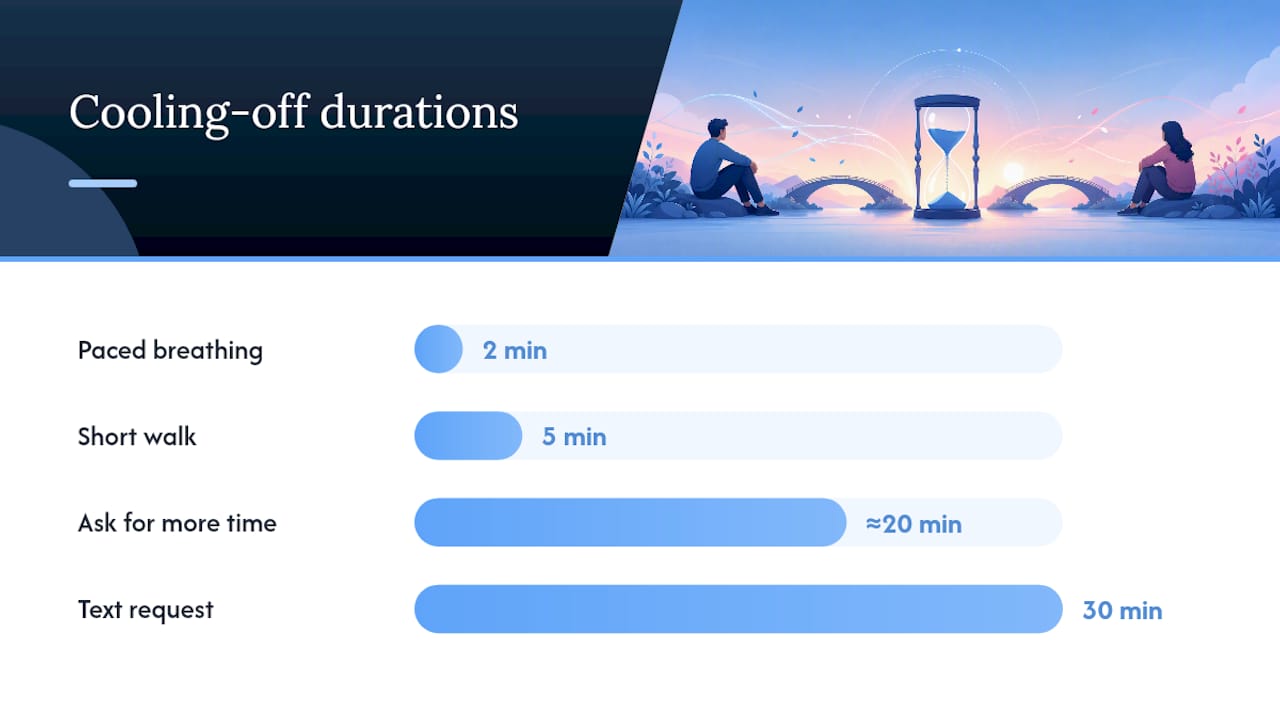
Paced breathing: four seconds in, six seconds out, for about two minutes.
-
A short walk, even five minutes around the block.
-
A time-limited separation with an actual end time, not an open-ended cold shoulder.
-
A no-phone buffer so you’re not rehearsing the fight through someone else’s opinion.
If you need more time than your partner does, say so instead of going silent. “I still need about 20 more minutes before I can talk about this clearly. Can we sit down after that?” keeps the door open without forcing a conversation you’re not ready for.
Pro Tip: Text the request if saying it out loud still feels too raw. “Can we talk in 30? I want to get this right” does more repair work than silence, and it costs you nothing.
How do you apologize the right way after a fight?
Most apologies fail because they’re missing a piece, not because the person didn’t mean it. A complete apology has four parts, and leaving any one out weakens the whole thing.
-
Specific acknowledgment: “I canceled our plans last minute without checking with you first.”
-
Impact validation: “That probably made you feel like your time doesn’t matter to me.”
-
Accountability with no conditions: “That’s on me. Not because I was stressed, just because I didn’t think it through.”
-
A concrete commitment to change: “Next time something comes up, I’ll call you before I cancel, not after.”
Watch for the three ways apologies collapse: vagueness (“sorry if that bothered you”), conditional language (“sorry, but you were also…”), and quietly shifting blame onto the other person’s reaction instead of your own behavior.
Pro Tip: If you catch yourself using the word “but” partway through an apology, stop and cut the sentence there. Everything after “but” usually undoes everything before it.
How can you listen so your partner feels heard?
The apology opens the door. Listening is what actually walks through it. Invite your partner to talk, then stay quiet, genuinely quiet, until they’re done.
-
Ask an open invitation: “What did that feel like on your end?”
-
Resist the urge to interrupt, correct details, or defend yourself mid sentence.
-
Paraphrase back what you heard: “So it felt like I dismissed something you’d already told me mattered.”
-
Validate the feeling, not just the facts: “That makes sense. I’d feel dismissed too.”
-
Close by asking what they need next: “What would help right now?”
Correcting their memory of events or jumping to defend your intentions turns listening into a second round of the same fight. Save that conversation, if it’s needed at all, for later.
How do you rebuild trust after the apology?
Talk is cheap, and both of you know it. Trust rebuilds through repeated, visible action, which is where behavioral consistency matters more than any single grand gesture.
Design amends that are specific and measurable, not aspirational. “I’ll be more present” is unfalsifiable. “I’ll put my phone in the other room during dinner for the next two weeks” is something you can both track.
-
Transparency practices: sharing your calendar or location when trust around whereabouts was the issue.
-
Small daily rituals: a two-minute check-in each evening instead of one long weekly summit.
-
A two-week tracker: mark each day the agreed behavior happened, then review it together.
Set a brief follow-up check-in, five to ten minutes, about a week out. Success looks like both partners naming one thing that improved and one thing that still needs work, not a declaration that everything’s fixed.
What are micro-repairs and why do they matter daily?
A micro-repair is a small bid to reconnect before a disagreement escalates: a softened tone, a hand briefly on an arm, a quick “sorry, that came out sharper than I meant.” Gottman’s research on repair attempts found that couples who stay together lean on these constantly, not on occasional big fixes.
-
Soften your tone mid-sentence: “Actually, let me say that again more calmly.”
-
A brief physical gesture, if that’s part of how you two connect.
-
A well-timed light joke that breaks tension without dismissing the issue.
-
A quick verbal check: “Are we okay right now?”
Nonverbal repair works well for small friction. Verbal repair, the fuller kind with acknowledgment and accountability, is still required after anything that caused real hurt. A joke or a shoulder squeeze is not a substitute for accountability. Using micro-repairs to dodge a conversation you owe your partner is avoidance dressed up as effort.
When should you seek professional help for repair?
Some patterns don’t resolve with better scripts. Watch for repeated cycles with no real change, contempt in how you speak to each other, intimidation, controlling behavior, threats, or repeated betrayals that keep happening despite promises. Those call for a therapist, not another attempt at a home conversation.
Couples therapy typically starts with an intake session mapping the pattern before any repair work begins. Individual therapy can help if one partner keeps repeating the same behavior despite wanting to change. If you feel unsafe at any point, that’s not a repair conversation to have alone. Organizations like the Safety Behind the Wheel Foundation offer guidance on recognizing when recurring conflict has crossed into something that needs outside support immediately.
Practicing repair steps with structured exercises

Repair is a skill, and skills need reps. Therapist frameworks like PACER treat each rupture as a chance to pause, take accountability, collaborate, and reset, which is closer to practice than performance.
That’s the logic behind gamified drills: rehearsing a four-part apology script before you need it live, running a habit tracker on the two-week amends plan, or getting a nudge for a check-in before it slips your mind. Small, repeated reps beat one perfect speech you gave once and never revisited.
Repair is a practice, not a performance
The best repair attempts I’ve studied aren’t eloquent. They’re clumsy, a little late, and offered anyway. What separates couples who recover from ones who don’t isn’t better words, it’s whether they keep showing up with the attempt at all. Track the small wins. A consistent, imperfect check-in beats a flawless apology you only manage once a year.
— Ryan
Practice repair steps before you need them
Reading the steps is one thing. Having the words ready when you’re standing in a hallway with your heart still pounding is another. Relationship Builder gives you a place to rehearse before the next rupture instead of during it.

Inside the app, you’ll find short script drills for the four-part apology, so the language feels familiar instead of stiff when you actually need it. A built-in habit tracker handles the two-week amends plan without you having to remember to check in on yourself. Reminders nudge you toward the follow-up conversation you’d otherwise let slide. If daily connection habits, not just crisis repair, are what you’re after, Signal not Noise keeps you focused on three small, meaningful actions a day instead of a sprawling to-do list. Open Relationship Builder and start with the apology script drill. It takes less time than the fight you’re recovering from.