
Talk to Strangers: Break Safety Behaviors in One Week (Life is a Game)

Safety behaviors are the small things you do to feel less anxious in a feared situation, like gripping your phone at a party or rehearsing every sentence before you say it out loud. They work in the moment, but they teach your brain that the situation was only survivable because of what you did, which quietly reinforces the anxiety you’re trying to escape. The steps below help you spot yours and start dropping them one at a time.
TL;DR:
- Safety behaviors are driven by the desire to reduce anxiety and often involve repetitive or avoidance actions that feel reasonable but reinforce fear.
- Common safety behaviors include avoiding eye contact, rehearsing scripts, checking for exits, and using props like phones or water bottles, especially in social situations.
- These behaviors prevent learning that feared situations are survivable and block evidence that could disprove anxiety predictions, increasing overall anxiety.
- Systematic removal of safety behaviors during exposure, through graded testing and logging, leads to better long-term anxiety reduction than simply avoiding or ignoring them.
- Not all cautious actions are safety behaviors; behaviors tied to real risks, like wearing a helmet or checking a stove, are adaptive, while behaviors driven solely by fear are counterproductive.
Table of Contents
- What Counts as a Safety Behavior in Anxiety
- Safety Behaviors Examples Across Different Anxiety Types
- How Safety Behaviors Keep Anxiety Alive
- How to Spot Your Own Safety Behaviors
- When a Safety Behavior Is Actually Just Being Careful
- Evidence-Based Ways to Reduce Safety Behaviors
- A Behavioral Experiment You Can Run This Week
- How Life is a Game Fits Into This Process
- What I’d Actually Tell You to Do First
- Try a Self-Guided Approach to Practicing Exposure
- Sources
- FAQ
What Counts as a Safety Behavior in Anxiety
A safety behavior isn’t defined by what the action looks like. It’s defined by why you’re doing it. Two people can do the exact same thing, holding a coffee cup at a networking event, and only one of them is performing a safety behavior. If she’s holding it because she likes coffee, that’s just a drink. If she’s holding it because an empty hand feels exposed and she needs something to grip, that’s anxiety management dressed up as normal behavior.
This is the intention-based definition that clinicians use, and it’s the reason generic advice like “just stop doing X” often misses the point. The action isn’t the problem. The function is.
The diagnostic question worth memorizing is one used in clinical consumer materials from the Centre for Clinical Interventions: “How anxious would I be if I couldn’t do this?” If the honest answer is “a lot more anxious,” you’ve found a safety behavior. If the answer is “not really, I’d just do it slightly differently,” it’s probably a neutral habit.
A few quick tests to run against your own behaviors:
- Texting a friend before walking into a party to feel “not alone.” Remove it and imagine walking in cold. If your anxiety spikes at the thought, that’s a safety behavior.
- Wearing sunglasses indoors to avoid eye contact. Ask whether you’d wear them if no one could see your eyes matter to you socially.
- Standing near the exit at every event. Would you panic if seated in the middle of the room instead?
- Over-preparing a script for small talk. Would you feel unable to function without it, or just slightly less polished?
Notice that none of these behaviors are objectively strange or harmful. That’s what makes them so hard to catch. They feel like reasonable precautions, not symptoms.
Safety Behaviors Examples Across Different Anxiety Types
Safety behaviors sort into five broad categories, and once you know the categories, you start noticing them everywhere in your own routine.
Avoidance is the most obvious form: skipping the party, taking the stairs to dodge small talk in the elevator, declining the presentation and letting a coworker take it. Checking shows up as repeatedly glancing in a mirror before a meeting or scanning a room for the nearest exit the moment you walk in. Mental maneuvers are invisible to everyone but you: rehearsing sentences word for word, silently counting to calm down, or replaying a conversation afterward to grade your own performance. Safety aids are physical props, like a water bottle to sip during a pause, a phone to glance at, or a friend brought along purely as a buffer. Reassurance-seeking means repeatedly asking others “Did that sound okay?” or “Do you think they noticed?”
If public speaking or talking to strangers is your specific struggle, here’s where it usually shows up:
- Avoiding eye contact or fixing your gaze on notes instead of the audience
- Clutching a prop like a pen, phone, or drink for the entire interaction
- Rehearsing your opening line dozens of times so you never have to improvise
- Positioning yourself near a door “just in case” you need to leave
- Asking a friend to stand next to you so you’re never approached alone
- Talking faster than necessary to end the interaction sooner
The same mechanics show up in other anxiety disorders, just with different content. Someone with panic disorder might always carry medication they never actually take, using its presence as reassurance. Someone with OCD might perform a mental “undo” ritual after touching a doorknob. Someone with PTSD might scan every room for exits before they can relax. The research on safety behaviors in social anxiety finds this two-factor pattern, avoidance-based and impression-management-based, holds up consistently across age groups and samples, which suggests the underlying mechanism is the same regardless of what specific fear triggers it.
How Safety Behaviors Keep Anxiety Alive
Safety behaviors work through three connected mechanisms, and understanding them is what makes the whole concept click.
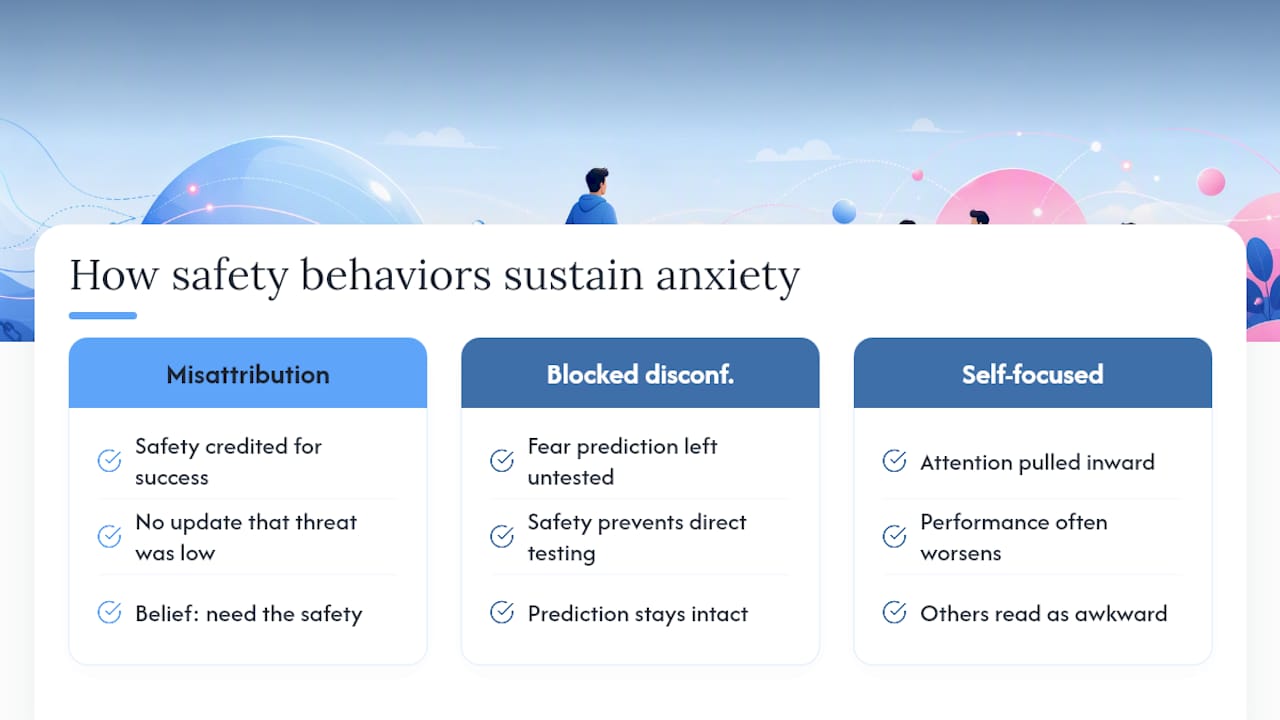
The first is misattribution. When you survive a feared situation, your brain looks for a reason why it went okay. If you were gripping your phone the entire time, your brain credits the phone, not the fact that the situation was never as dangerous as you predicted. You walk away having learned “I need my phone to survive parties,” not “parties are survivable.”
The second is blocked threat disconfirmation. Your anxious brain holds specific fear predictions, “if I make eye contact, they’ll think I’m weird,” and the only way to update that prediction is to test it directly and watch it fail to come true. A safety behavior interferes with the test. If you never make eye contact, you never gather evidence that eye contact is fine, so the fear prediction stays intact indefinitely.
The third is self-focused attention. Rehearsing sentences, monitoring your own voice, and scanning for exits all pull attention inward, away from the actual interaction. Ironically, this often makes performance worse, not better, because you’re mentally busy instead of present. Reduced presence tends to read to others as distracted or awkward, which can create exactly the negative impression you were trying to prevent.
An older but instructive experiment from anxiety researcher Michael Telch’s lab found that participants instructed to perform frequent safety behaviors over a short period showed higher anxiety afterward than a control group given no such instructions, direct evidence that the behaviors themselves, not just the underlying fear, drive anxiety upward.
The mechanism in one line: every time a safety behavior “saves” you, it steals a chance for your brain to learn the truth: you didn’t need saving.
This is also why treatment approaches that specifically target safety behaviors, including False Safety Behavior Elimination Therapy (F-SET), tend to outperform exposure alone. A review of safety behaviors in adult social anxiety concludes that exposure combined with active removal of safety behaviors produces greater symptom reduction than exposure where the behaviors are left in place.
How to Spot Your Own Safety Behaviors
Most people can’t list their safety behaviors off the top of their head, because the whole point of a safety behavior is that it feels automatic and reasonable. Finding yours takes a bit of structured observation.
- Pick one recurring feared situation you can watch closely over the next week, like team meetings, ordering food, or texting someone back.
- After each instance, ask the diagnostic question: “What did I do to get through that, and how anxious would I have been without it?”
- Log it on paper or your phone using five columns: the situation, the behavior, why you think you did it, your distress rating on a 0 to 10 scale (SUDS), and what actually happened.
- Track frequency across a week, not just once. A behavior you do occasionally might be habit; one you do every single time is very likely a safety behavior.
- Map behaviors to situations. You’ll often find one dominant behavior, like a phone prop, showing up across several unrelated fears, which tells you it’s worth targeting first.
Subtle, partial safety behaviors are the hardest to catch, as explored in this ADHD sensory overload plan for managing subtle safety behaviors in neurodivergent readers. Standing slightly angled toward the door instead of fully facing it, giving shorter answers so a conversation ends sooner, or laughing a beat early to fill silence all count, even though none of them look like “avoidance” from the outside. One clinical perspective on this pattern notes that partial safety behaviors are often the last to go precisely because they’re disguised as normal social polish rather than obvious avoidance.
Pro Tip: Log the behavior before you know whether the situation went well or badly. If you wait until afterward, you’ll unconsciously edit your list to match the outcome, which defeats the point of tracking.
When a Safety Behavior Is Actually Just Being Careful
Not everything that reduces anxiety is a problem. Wearing a seatbelt lowers anxiety about crashing and is also just objectively correct. The difference between adaptive caution and a false crutch comes down to whether the behavior is proportionate to real risk or proportionate to fear.
Clearly adaptive behaviors include things like carrying an EpiPen for a genuine allergy, checking a stove before leaving the house once, or wearing a helmet while cycling. These reduce real, measurable risk regardless of how anxious you feel.
Red flags that a behavior has crossed into anxiety territory:
- You do it even in situations where the actual risk is close to zero
- Doing it more than once provides no additional safety, only additional relief
- You feel disproportionate distress at the thought of skipping it
- Other people don’t understand why you need it
The goal isn’t to strip away every precaution in your life. It’s to keep the ones tied to real risk and gradually test the ones tied only to fear, one at a time, in situations you choose rather than ones that ambush you.
Evidence-Based Ways to Reduce Safety Behaviors
Three approaches dominate the clinical literature on this, and they build on each other rather than competing.
Exposure therapy puts you in the feared situation on purpose, repeatedly, until your anxiety naturally comes down. Behavioral experiments are a more targeted cousin: you form a specific prediction (“if I don’t check my phone, I’ll be ignored the whole time”), test it directly, and record what actually happened. False Safety Behavior Elimination Therapy (F-SET) is a protocol built specifically around identifying and systematically removing safety behaviors during exposure, rather than treating exposure and safety-behavior removal as separate steps.
The reason removal matters so much during exposure comes back to the learning mechanism covered earlier: if you keep the crutch, you never get clean evidence that the situation was survivable on its own. A treatment outcome review found that exposure sessions with safety behaviors actively removed produced stronger reductions in social anxiety symptoms than exposure sessions where behaviors stayed in place.
That said, the evidence isn’t perfectly one-sided. Some research suggests limited, early-stage use of a safety behavior can help a person tolerate their very first exposure attempts, making them more likely to stick with treatment rather than avoid it entirely. The practical takeaway is graded reduction: start exposures with the training wheels on if you genuinely need them to begin at all, then remove them methodically over subsequent attempts rather than leaning on them indefinitely.
A workable graded-reduction sequence looks like this:
- Attempt the feared situation with your usual safety behavior in place, and rate your distress
- Attempt it again, removing one small piece of the behavior (shorter phone glance, less rehearsed script)
- Attempt it a third time with the behavior fully removed
- Compare your predicted outcome against what actually happened each time
Pro Tip: If your anxiety climbs above roughly 8 out of 10 SUDS and stays there without dropping, or you’re dealing with panic attacks, self-harm thoughts, or trauma-related flashbacks, that’s the point to loop in a therapist rather than push through solo. Self-guided practice works well for everyday social and performance anxiety; it isn’t a substitute for professional care when symptoms are severe.
A Behavioral Experiment You Can Run This Week
The structure clinicians use for behavioral experiments is simple enough to run without any special training: plan, predict, test, record, reflect.
- Plan a specific, low-stakes situation involving your feared behavior, such as attending a small meetup without your phone as a social prop.
- Predict what you think will happen and rate your anticipated distress from 0 to 10 (SUDS) before you go.
- Test it by actually attending and doing your best to leave the safety behavior out.
- Record what actually happened immediately afterward, including your real SUDS rating at the peak and at the end.
- Reflect by comparing your prediction to the outcome. Where were you wrong?
Here’s what that looks like filled in for a real example:
| Step | Entry |
|---|---|
| Situation | Attending a meetup, phone in bag the entire time |
| Prediction | “I’ll have nothing to do with my hands, people will notice I’m awkward, I’ll leave within 10 minutes” |
| Predicted SUDS | rated their distress as relatively high |
| Actual peak SUDS | rated their distress as moderate early on |
| Actual outcome | Stayed the full meeting time, had two full conversations, nobody mentioned my hands |
| Reflection | Distress dropped faster than predicted; the fear was more intense in anticipation than in the room |
Once one experiment goes better than predicted, scale up. Try a longer event, a more unfamiliar crowd, or remove a second safety behavior alongside the first. Keep a running log across several experiments rather than judging yourself on any single attempt. Progress in this kind of work is rarely a straight line. A rougher outing after three good ones doesn’t erase the pattern; it’s just data.
How Life is a Game Fits Into This Process
Running behavioral experiments consistently is where most people fall off, not because the concept is hard but because there’s no structure holding you accountable between attempts. Conquer Fear is built as a self-guided tool inspired by exposure principles, breaking the plan → test → reflect cycle above into small tracked steps instead of one intimidating goal. If talking to strangers is specifically your struggle, the fear of talking to strangers page walks through a similar graded structure.
For the underlying framework, the CBT for anxiety primer explains how thought patterns and behavior loop together. None of this replaces a therapist, and it isn’t therapy: it’s a structured way to practice on your own between the moments when professional support isn’t in front of you.
What I’d Actually Tell You to Do First
Here’s what stands out after working through the research on this: nobody drops a safety behavior because they finally understood the theory. They drop it because one small experiment went better than expected, and that surprised them into trying a second one.
You don’t need to identify every safety behavior you have this week. Pick the one that shows up most often, run it through the plan-predict-test-reflect cycle once, and let the result speak louder than your prediction did. Setbacks are part of the process, not proof it isn’t working.
Your one small step: the next time you’re heading into a situation that makes you anxious, leave one prop behind, on purpose, and just notice what actually happens.
— Ryan
Try a Self-Guided Approach to Practicing Exposure
Reading about behavioral experiments is one thing. Actually running them, tracking your SUDS ratings, and remembering to remove one safety behavior at a time is another, and that’s the gap Life is a Game was built to close. Conquer Fear turns the plan-predict-test-reflect structure above into small tracked steps you can work through at your own pace, whether your fear centers on talking to strangers, presentations, or something else entirely.
It’s inspired by exposure principles, not a replacement for therapy, and it works best as a companion to the kind of practice this article describes: pick one situation, remove one prop, log what happens. If you want to see how it maps to a specific fear first, check the support and FAQ page for details on getting started, or head straight to Life is a Game to try it for yourself.
Sources
- Safety behaviours in social anxiety: an examination across adolescence
- Safety Behaviors in Adults With Social Anxiety: Review and Future Directions
- Safety behavior handout (Telch et al.)
- Stepping out of social anxiety — Module 5: Safety behaviours (CCI WA)
FAQ
What Is the 3-3-3 Rule for Anxiety?
The 3-3-3 rule is a grounding technique where you name three things you see, three sounds you hear, and move three parts of your body to interrupt a spike of anxiety. It’s a coping tool for in-the-moment distress, not a treatment for the safety behaviors that maintain anxiety long term.
What Are Some Examples of Safety Behaviors?
Common examples include avoiding eye contact, gripping a phone or drink as a prop, rehearsing sentences before saying them, seeking reassurance from others, and positioning yourself near an exit. Any action counts if removing it would sharply raise your anxiety at that moment.
What Is the Worst Habit for Anxiety?
Chronic avoidance is generally considered the most damaging pattern, since it prevents any opportunity to learn that a feared situation is survivable. Combined with reassurance-seeking and mental rehearsal, it forms a loop that keeps threat predictions intact indefinitely, as the social anxiety literature documents.
What Are Some Safety Considerations for People With Anxiety?
Self-guided exposure practice works well for everyday social and performance fears, but distress that consistently peaks near the top of the scale, or involves panic attacks, self-harm thoughts, or trauma flashbacks, calls for a therapist rather than solo practice. Tools like Conquer Fear are designed as self-guided companions inspired by exposure principles, not a substitute for professional treatment.
Are Safety Behaviors the Same as Coping Strategies?
Not quite. A coping strategy like deep breathing can be used flexibly without becoming a crutch, while a safety behavior specifically functions to avoid the anxiety a situation would otherwise trigger, which is why the intention behind the action matters more than the action itself.