
0 to 10 or 0 to 100: How Therapists Use SUDS to Track Anxiety
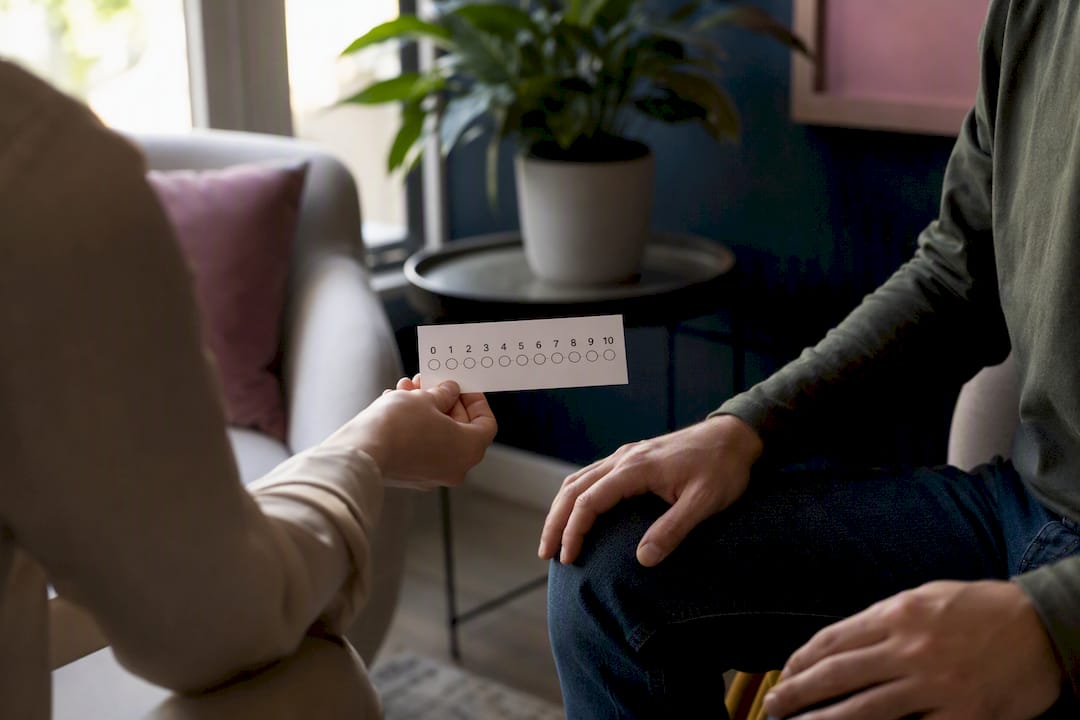
The Subjective Units of Distress Scale, or SUDS, is a simple self-report tool, usually rated 0 to 10 or 0 to 100, that clinicians use to track how much anxiety or distress you feel right now. Therapists lean on it during exposure work, CBT, and EMDR to decide when to push forward and when to pull back. It’s not a diagnostic instrument. It’s a subjective, in-the-moment snapshot, and it only works when you rate the feeling as it is, not as you think it should be.
TL;DR:
The subjective nature of SUDS means individuals must define and consistently reference their own baseline levels in each session to track real progress.
SUDS ratings are most useful when logged at specific trigger points during exposure, with trends over repeated attempts indicating habituation or the need to adjust the hierarchy.
While the scale offers rapid, in-the-moment insights, it has limitations in capturing the precise nature of distress due to its single-number format.
Combining SUDS with structured assessments enhances understanding of long-term anxiety or PTSD, as the scale alone cannot distinguish between different emotional states.
Practicing regular, consistent SUDS ratings outside sessions with tools like self-guided apps can help build awareness and complement professional treatment.
Table of Contents
What Is the SUDS Scale and Where Did It Come From?
Psychiatrist Joseph Wolpe developed SUDS in the 1960s to give clients a fast way to communicate distress during systematic desensitization, one of the earliest forms of exposure therapy. Before SUDS, therapists had to guess how scared someone actually felt in the room. Wolpe wanted a number, not a paragraph.
The scale comes in two common formats. The 0 to 10 version is faster and easier for most people to use on the fly, especially mid-exposure when you don’t have the bandwidth for nuance. The 0 to 100 version gives finer resolution, which matters if you tend to cluster your ratings around “5” out of habit rather than genuine reflection. ISTSS clinical guidance frames the 0 to 100 version as a “distress thermometer,” useful precisely because it forces you to notice shades of gray instead of defaulting to round numbers.
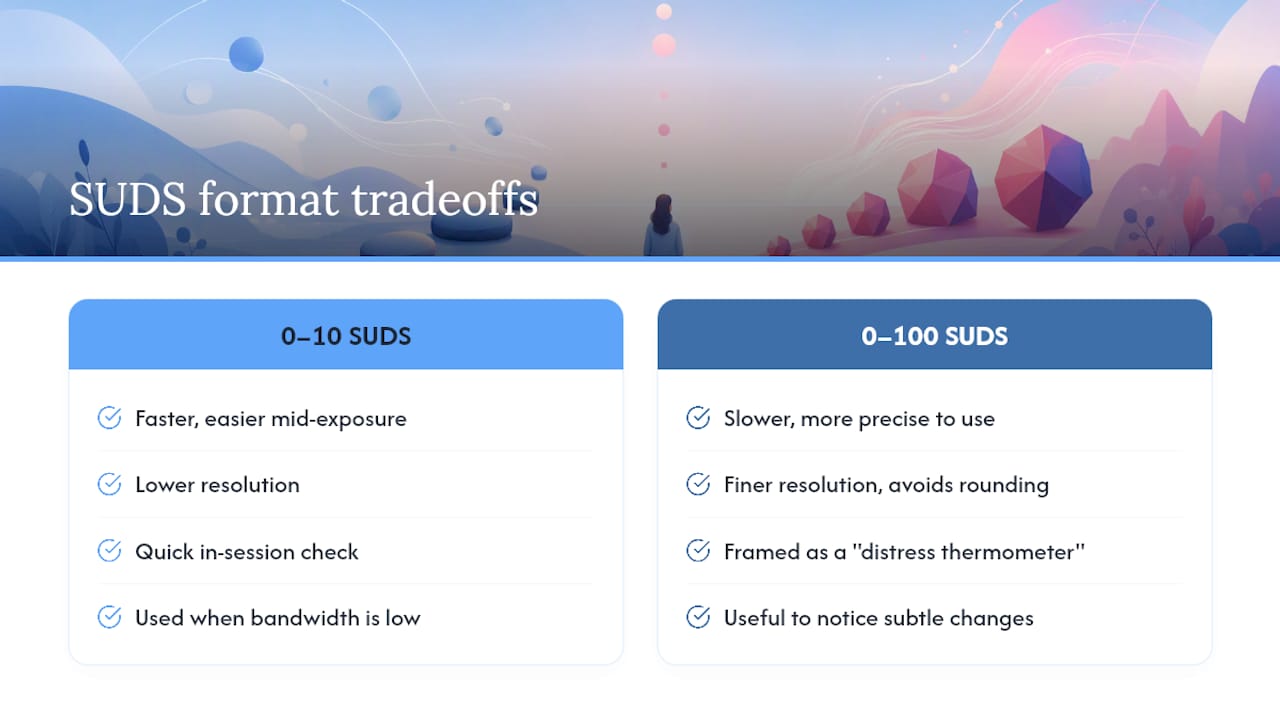
Both formats need anchors. Zero typically means complete calm, no distress at all. The top of the scale, whether that’s 10 or 100, represents the worst distress you can imagine, the kind that would make you bolt from the room. What sits in between is entirely personal. A 6 for you driving on a highway might feel nothing like a 6 for someone else giving a toast at a wedding. That’s the point. SUDS was never built to compare people against each other. It’s built to track you against your own baseline, session over session.
This is where the subjectivity that skeptics criticize is actually the feature, not the bug. A generic anxiety scale asks about your week. SUDS asks about the next sixty seconds. Different job, different tool. Your job, if you’re using it, is to define your own personal 8 once and then hold yourself to that same reference point every time you rate.
When and How Do Therapists Use SUDS in Sessions?
SUDS shows up most in the therapies built around graduated exposure: cognitive behavioral therapy (CBT), exposure and response prevention (ERP) for OCD, dialectical behavior therapy (DBT), and EMDR. Each uses it slightly differently, but the underlying logic is the same. Research on exposure-based treatment shows SUDS ratings shifting session by session, and clinicians use that shift to decide how hard to push.
A typical exposure session follows a rhythm. First, a baseline rating before anything happens, just to know where you’re starting. Then the exposure task itself, whether that’s sitting in a stopped car, holding a doorknob you consider contaminated, or standing at a podium. During the task, a good therapist checks in every minute or two, asking for a fresh number. After the task ends, a post rating captures where you landed once the pressure lifted.

Those in-task numbers are what actually drive clinical decisions. If your SUDS climbs and then plateaus without dropping, a therapist might extend the exposure, because habituation, your nervous system’s natural cooling off, hasn’t happened yet. If it drops fast, that’s often a cue to either hold steady or escalate to the next item on your fear hierarchy.
One common heuristic in exposure work is watching for a substantial drop in SUDS from peak before ending the exercise. It’s a useful rule of thumb, not a law. The same MDPI review that validates SUDS as a fast communication tool also cautions against treating any fixed percentage as gospel. Some people habituate slower. Some sessions end before a clean drop shows up, and that’s still useful data, not a failure.
EMDR uses SUDS a bit differently, often pairing it with the Validity of Cognition scale to track both distress and belief change together. For PTSD work specifically, SUDS tends to run alongside, not instead of, more structured diagnostic tools, since a single number can’t capture everything a trauma history involves.
How to Rate Your SUDS: A Step-by-Step Guide
Rating your own distress sounds simple until you actually try it under pressure. Your brain wants to round to a familiar number, second-guess itself, or rate how you think you should feel instead of how you actually feel. Here’s a repeatable process that keeps the rating honest.
-
Pause and breathe once before you rate. Don’t rate mid-thought. Take one breath, then ask the question.
-
Focus on right now, not five minutes ago or five minutes from now. SUDS is a snapshot, not a memory or a prediction.
-
Scan your body before you scan your thoughts. Notice your chest, your hands, your stomach, your breathing rate. Practitioner guidance points out that physical sensations often reveal intensity your cognitive brain tries to talk down.
-
Let the body signal anchor the number. Sweaty palms and a racing heart usually mean the number is higher than your first instinct.
-
Compare against your own fixed anchors, not anyone else’s. If your personal 8 is “I want to leave the room,” check against that specific memory, not an abstract idea of “very anxious.”
-
Say or write the number immediately. Don’t deliberate. A three-second answer is usually more accurate than a thirty-second one, because deliberation invites editing.
-
Log it with a timestamp or task label. “7, right after merging onto the highway” is more useful later than a lone “7.”
The most common mistake is rating retrospectively, telling your therapist “it was probably an 8” after the moment has passed. Distress fades in memory faster than you’d think, and retrospective ratings tend to flatten toward the middle. The second most common mistake is comparing your number to someone else’s story you heard, which defeats the entire purpose of a self-anchored scale.
Pro Tip: Pick three fixed reference points before you ever need them: a real memory for your 2, your 5, and your 9. When you’re mid-exposure and your mind goes blank, you’ll have something concrete to check against instead of guessing cold.
SUDS in Action: A Driving Anxiety Example
Here’s how this plays out with a specific fear, driving anxiety, which is one of the more common reasons people first encounter SUDS outside a general therapy context.
A client sits in the driver’s seat, engine off, in an empty parking lot. Baseline SUDS: 3, mostly anticipatory. She starts the engine. SUDS: 5. She pulls forward ten feet. SUDS: 6, hands tight on the wheel. She circles the lot for two minutes. SUDS: 7, then it holds at 7 for another ninety seconds. Then it drops to 5. That plateau-then-drop pattern is what habituation looks like in real numbers, and it’s the signal a therapist watches for before ending the exercise.
Two smaller scenarios show the range clinicians deal with regularly:
-
A first-time exposure to merging onto a highway on-ramp jumps from a baseline 4 to a peak 9, stays at 8 or 9 for nearly three minutes, then only eases to 7 before time runs out. That’s not a failure. It suggests the jump was too large for one session and the next exposure should target a smaller step, maybe a slower road first.
-
A repeat exposure to the same on-ramp a week later starts at baseline 5, peaks at 6, and drops to 3 within ninety seconds. That faster, lower peak is the trend that tells a therapist it’s time to move to the next fear hierarchy item.
The number by itself doesn’t mean much. The trend across repeated attempts at the same task is where the real signal lives.
What the Research Says About SUDS’ Strengths and Limits
SUDS earns its place in therapy rooms for one simple reason: speed. It takes two seconds to ask “what’s your number” and get something usable back, which is exactly why it’s survived more than sixty years of clinical use across CBT, ERP, DBT, and EMDR. No paperwork, no scoring key, no waiting room questionnaire. It works with kids, adults, and anyone mid-panic who can’t fill out a form.
But speed comes at a cost, and recent psychometric work is direct about what that cost is.
Recent evaluations point to construct underrepresentation and structural limitations in SUDS, meaning the single number can blur together fear, shame, sadness, and general unease without telling you which one you’re actually measuring. The recommendation isn’t to abandon the scale. It’s to treat SUDS as a flexible communication aid rather than a precise, standalone measure of anxiety over time.
That framing comes from a 2025 MDPI review of SUDS validity and clinical utility, and it lines up with something clinicians have suspected for years without a formal name for it: a rated “8” during a driving exposure and an “8” during a health scare might not reflect the same internal experience, even though the number looks identical on paper.
The practical fix isn’t complicated. Clinicians who want more than a moment-to-moment gauge pair SUDS with a validated instrument like the GAD-7 or PHQ-9 to catch the broader clinical picture SUDS alone can’t. SUDS tells you what’s happening in the next sixty seconds. A structured screener tells you what’s happening across your week. You need both if you’re tracking something as complicated as chronic anxiety or PTSD.
For everyday use, that means one thing: keep your anchors consistent, log your numbers instead of trying to remember them, and don’t treat a single SUDS score as a diagnosis. It’s a compass reading, not a lab result.
Building a SUDS Habit Between Sessions
A SUDS rating you only think about once a week in your therapist’s office is a lot less useful than one you check reflexively during real moments of anxiety. The habit is what makes the number mean something.
-
Rate SUDS at the same trigger points every time, not randomly. If driving is your fear, rate at ignition, at merge, and at arrival, every drive, so your data actually compares across sessions.
-
Keep your personal anchor phrases visible somewhere you’ll actually see them, a note app, a sticky note, whatever you’ll open in the moment rather than after the fact.
-
Use the same body-scan order every time (chest, hands, stomach, breath) so your rating process stays consistent even when your anxiety isn’t.
-
Bring your logged numbers, not your memory of them, to your next session. A written “6, 7, 5” trend is far more useful to a therapist than “it was pretty bad, I think.”
-
If a number surprises you, either much higher or lower than expected, flag it and mention why during your next check-in instead of dismissing it.
If you’re working on driving anxiety specifically and want a low-pressure way to build this rating habit outside formal sessions, Life is a Game’s Conquer Fear app is a self-guided tool inspired by exposure principles that helps you break practice into small, trackable steps. It’s not therapy and it doesn’t replace a clinician. It’s a practice space for the moments between sessions.
How Life is a Game Thinks About Self-Monitoring
Most people who try to track their own anxiety give up within a week, not because the concept fails but because raw numbers in a notebook get boring fast. That’s the actual problem worth solving: distress tracking dies from friction, not from lack of insight.
Life is a Game builds around that reality. Instead of asking someone to maintain a spreadsheet of SUDS scores, the approach breaks a large fear into small, gamified steps, the kind that make a single logged number feel like progress rather than paperwork. Celebrating a small win, a lower number today than yesterday’s equivalent moment, does more to keep someone tracking consistently than any amount of clinical explanation about why tracking matters.
None of that makes the apps a substitute for a therapist. They’re self-guided tools inspired by exposure principles, built for the practice reps between sessions or for someone not yet ready to sit across from a clinician. They don’t treat, cure, or diagnose anything, and no responsible mental health product should claim otherwise. What they can do is make the habit of noticing your own distress feel less like a chore and more like something you’d actually stick with.
— Ryan
A Practice Tool for the Moments Between Sessions
If driving anxiety, phone calls, or public speaking is the specific fear at pulling your SUDS numbers up, having somewhere to practice small exposures outside a therapy session matters. Life is a Game’s Conquer Fear is a self-guided app inspired by exposure principles, built to break a big fear into small steps you can log and revisit, the same way you’d track a SUDS number after a real-world exposure.
It’s not a replacement for a therapist, and it doesn’t diagnose or treat anything. It’s a practice space for the reps between appointments.
| Use case | What it helps with |
|---|---|
| Driving anxiety | Small, gradual practice steps outside the car |
| Public speaking dread | Short exposure drills you can repeat before the real event |
| General fear tracking | A simple way to log how a specific fear shifts over time |
If one specific fear are the reasons SUDS matters to you in the first place, visit lifeisagame.ai/conquer-fear and start with the smallest step it offers today.
Sources
A few sources shaped the clinical picture covered here, each contributing something different.
The 2025 MDPI review of SUDS validity and clinical utility is the sharpest psychometric critique available, useful if you want the research-backed case for why SUDS should complement, not replace, structured screeners.
The ISTSS distress scale guidance offers the clearest professional framing of the 0 to 100 “distress thermometer” approach and how to build the rating habit.
The PMC article on exposure therapy and SUDS documents how ratings actually shift session by session in real exposure work.
The Wikipedia entry on the Subjective Units of Distress Scale is the fastest place to check the scale’s origin and basic mechanics at a glance.
FAQ
What does a SUDS rating of 1 to 10 represent?
A SUDS rating on the 1 to 10 scale represents your level of momentary distress, with 0 or 1 meaning complete calm and 10 meaning the worst distress you can imagine. The number is personal; a 7 for one person’s fear may not match a 7 for someone else’s.
How do I rate my SUDS accurately?
Pause, take one breath, then check your body for tension or a racing heart before you check your thoughts, and give the first number that comes to mind rather than deliberating. Compare that number against fixed personal anchors you’ve defined ahead of time, not against how you think you should feel.
What is SUDS used for in EMDR therapy?
In EMDR, SUDS tracks how distressing a target memory feels before and after each set of processing, often paired with the Validity of Cognition scale to track belief change alongside distress. A drop in SUDS across sets is one signal a memory is becoming less charged.
Is the SUDS scale used to diagnose PTSD?
No. SUDS is a real-time distress gauge, not a diagnostic instrument, and it’s typically used alongside structured PTSD assessments rather than in place of them. Clinicians use it during exposure work to pace sessions, not to establish a diagnosis on its own.
Can I use SUDS outside of therapy sessions?
Yes, self-tracking SUDS between sessions can build useful data for your therapist and help you notice patterns in your own triggers. Tools like Life is a Game’s Conquer Fear app, a self-guided app inspired by exposure principles, can make that logging habit easier to maintain, though it isn’t a substitute for professional care.