
How to Track Anxiety Progress and Actually See Results

Start a daily quick symptom log plus a weekly GAD-7 check. That is the simplest, clinically meaningful way to track anxiety progress without turning it into a second job.
Each daily entry needs four things and nothing more:
-
Date and time
-
Intensity, rated 0 to 10
-
The trigger, in a few words
-
What helped, even if the answer is “nothing yet”
Then once a week, take the same standardized scale, like the GAD-7, and log the total score. Pick your method today, whether that’s a notes app, a paper notebook, or a dedicated tracker, and set a recurring reminder for the same day and time each week. Consistency beats complexity here.
Pro Tip: Set your weekly GAD-7 reminder for a low-stress moment, like Sunday morning coffee, not right before bed when anxiety tends to spike anyway and can skew your rating.
Key Takeaways
The most reliable way to track anxiety progress is pairing a 30-second daily log with a consistent weekly validated scale, then judging change by weekly trends instead of single-day scores.
| Point | Details |
|---|---|
| Log the essentials daily | Record date, intensity (0 to 10), trigger, and one coping response in under 30 seconds. |
| Pick one validated scale | Use the same version of GAD-7 or a comparable measure every week, never switching mid-course. |
| Judge trends, not spikes | Use weekly averages and ignore single bad days when assessing real progress. |
| Tie goals to numbers | Set milestones like moving GAD-7 from moderate to mild range within eight weeks. |
| Use Life is a Game for workflow | Signal not Noise handles daily logs, AI Therapist hosts weekly check-ins, and Conquer Fear tracks exposure steps. |
Table of Contents
-
Why Tracking Helps You Measure Anxiety Progress More Accurately
-
Track Your Progress With Tools Built for This Exact Workflow
Why Tracking Helps You Measure Anxiety Progress More Accurately
Anxiety shows up in two different forms, and mixing them up is why so many people quit tracking after two weeks. State anxiety is what you feel right now, in this moment, triggered by a specific situation. Trait anxiety is your longer-term baseline tendency toward worry, the pattern that shows up across weeks and months.
Daily logs capture state. They’re noisy by nature; a bad Tuesday doesn’t mean treatment failed. Weekly standardized measures capture trait-level trend, and that’s where real progress or regression becomes visible.
A systematic review of anxiety measures found that state-focused subscales respond faster to short-term change than trait measures do, which is exactly why the daily-plus-weekly combination works better than either alone.
Tracking this way gives you three concrete payoffs:
-
Clear pattern recognition on which triggers actually drive your worst days
-
Sharper, more specific conversations with a therapist or doctor instead of “I’ve been anxious”
-
Visible proof of progress on weeks when it doesn’t feel like anything is improving
What to Record Every Time You Log an Episode
Your log only works if it’s fast enough to survive a bad week. Build it around a minimal core, then add detail only if you’re the type who sticks with extras.
-
Date and time of the entry or episode.
-
Intensity, rated 0 to 10, with 10 being the worst anxiety you’ve experienced.
-
Main trigger, described in five words or fewer (deadline, argument, health worry).
-
One coping response you tried, and whether it helped, didn’t help, or you’re not sure yet.
That’s the entire minimal template. It takes under 30 seconds per entry, which matters more than people expect, because a log that takes two minutes gets abandoned by week three.
If you want more resolution, layer in optional fields: duration of the episode, physical symptoms (racing heart, tight chest, nausea), sleep hours the night before, caffeine intake, medication changes, and exposure steps completed if you’re doing exposure work.

The rule of thumb: use the minimal template on hard days and the extended one on calmer days when you have bandwidth. A tracker you actually fill out beats a perfect one you abandon.
Which Validated Scales Actually Show Meaningful Change?
Standardized scales matter because they turn “I feel a bit better” into a number you can compare week over week. A few are worth knowing:
-
GAD-7: A 7-item screener, scored 0 to 21, with bands at 0 to 4 (minimal), 5 to 9 (mild), 10 to 14 (moderate), and 15 to 21 (severe), per ADAA guidance. Fast enough for weekly use.
-
APA Severity Measure for GAD: A 10-item tool built specifically for repeated use, with scoring and prorating guidance designed to monitor change between visits.
-
STAI, BAI, HADS-A: All validated options, though a PMC review notes their responsiveness to short-term change varies, with state-focused portions typically more sensitive than trait portions.
-
PHQ-9: Not an anxiety scale, but useful for monitoring depression symptoms that often overlap with anxiety.
The rule that matters most: pick one scale and use the exact same version every time. Switching between GAD-7 one week and STAI the next makes your data uninterpretable, since different scales use different thresholds that don’t translate directly into each other. Weekly is usually the right cadence; biweekly works if weekly feels like too much friction. A one or two point GAD-7 shift week to week is normal noise. A sustained five-point drop over a month is signal.
Choosing a Tracking Method That Fits Your Life
The best tracker is the one you’ll actually use in three months, not the one with the most features today. Each format has real trade-offs.
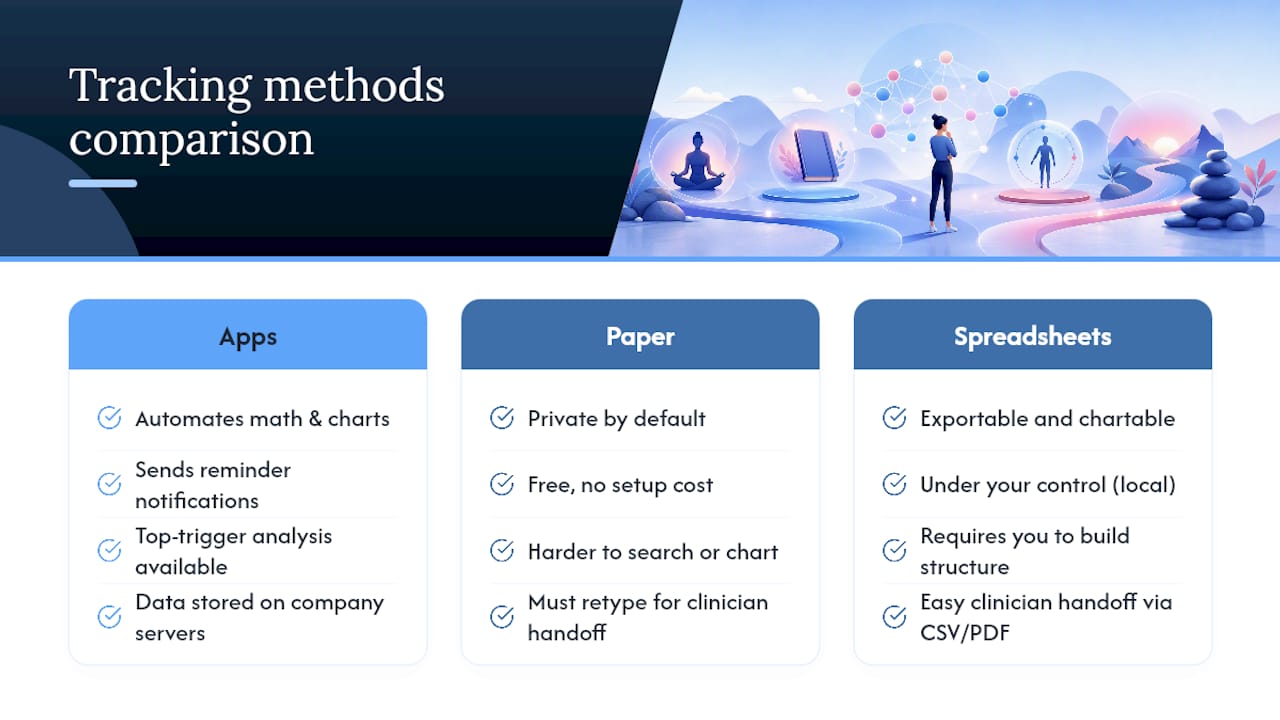
Apps automate the math, chart your trends automatically, and send reminders you don’t have to remember yourself. Some tools, like the tracker features described by Tembrica, surface top-trigger analysis so you can see which coping strategies actually correlate with lower intensity. The downside is data lives on a company’s servers, so privacy policies matter.
Paper journals are private by default, cost nothing, and remove the temptation to fiddle with settings instead of logging. They’re harder to search, chart, or hand to a clinician without retyping everything.
Spreadsheets sit in between: exportable, chartable, and under your control, but you have to build the structure yourself.
A hybrid workflow solves most of the friction: quick daily entries in an app for speed, then a five-minute weekly export or summary into a spreadsheet or PDF for your clinician.
Pro Tip: Before choosing an app, check whether it lets you export a plain PDF or CSV. A tool that locks your data inside its own dashboard makes clinician conversations harder, not easier.
How Do You Turn Weekly Logs Into Useful Insights?
Raw daily numbers lie to you if you read them one at a time. A 7-day moving average smooths out the noise and shows the actual direction of travel, a technique ADAA’s guidance recommends over judging single-day spikes.
Ignore any one bad day when assessing progress. Instead, look for repeated correlations: does poor sleep consistently precede higher intensity scores? Do certain triggers cluster around specific weekdays or events?
-
Compare this week’s average intensity to last week’s, not today to yesterday
-
Group triggers into three or four categories and watch which one shrinks over time
-
Flag any week where GAD-7 shifts by five or more points for discussion at your next appointment
A one-page clinician summary should include your baseline score, a simple trend line, notable events like medication changes or exposure milestones, and a short note on what you think helped.
| Element | What to Include |
|---|---|
| Baseline | First GAD-7 score and the date it was taken |
| Trend | Weekly averages plotted over 4 to 8 weeks |
| Notable events | Medication changes, exposure exercises, major stressors |
| Proposed adjustment | One sentence on what you’d like to change next |
Setting Goals You Can Actually Measure Against Your Data
Vague goals like “feel less anxious” don’t give your tracker anything to measure. Tie every goal to a number you’re already logging.
-
Reduce average weekly intensity from a 7 to a 5 over six weeks, tracked from your daily 0 to 10 log.
-
Drop GAD-7 score from moderate (10 to 14) into mild range (5 to 9) within eight weeks.
-
Complete four exposure steps per week without avoidance, tracked in your exposure log.
-
Cut avoidance behaviors in half, measured by how often you note “avoided” as a coping response.
Review progress every four to eight weeks, not every few days. Short review cycles make normal variance look like failure or false success.
If your trend line stays flat or worsens across two full review cycles, that’s the signal to bring it to a clinician, not a single rough week. CAMH’s guidance is clear that these scores should inform, not replace, a real clinical evaluation.
Pro Tip: Write your milestone date on a calendar before you start, not after. A deadline you set in advance keeps you from moving the goalpost when progress feels slow.
Building Habits That Keep Your Tracking Consistent
The tracker that works is the one that survives your worst week, not your best one. A few tactics make that more likely:
-
Stack logging onto an existing habit, like brushing your teeth or making coffee
-
Cap daily entries at 30 seconds; save detail for a five-minute weekly review
-
Batch your weekly GAD-7 and summary into one sitting instead of scattering it
-
Tell one person, a partner or friend, that you’re tracking, for light accountability
One guardrail worth naming: if checking your score multiple times a day starts feeding anxiety instead of managing it, that’s a sign to scale back, not a sign you need more data.
How Life is a Game Fits Into Your Tracking Routine
Building this workflow from scratch with a notebook and a stopwatch works, but it’s more friction than most people sustain past week three. Life is a Game’s apps map directly onto each piece of the system above.
-
Signal not Noise handles the daily quick capture, limiting you to three tasks a day so logging your intensity, trigger, and coping response never turns into a chore.
-
Groundwork can host your weekly validated self-assessment and keep a running history you can pull up before an appointment.
-
Habit Forge reinforces the consistency piece, the habit stacking and reminder cadence that keeps tracking alive past the honeymoon phase.
-
Conquer Fear is built specifically for logging exposure steps, which matters if avoidance reduction is one of your tracked goals.
Together, these apps turn a scattered self-management effort into a single connected workflow, one that produces a clinician-ready summary without a separate spreadsheet project every Sunday night.
Keeping Your Anxiety Data Private and Secure
Anxiety logs are sensitive by nature. You’re recording triggers, medication notes, and intensity scores tied to specific dates, which together can paint a detailed picture of your mental health history. That’s worth protecting deliberately, not as an afterthought.

Before choosing any app, check whether it uses encryption for data both on your device and in transit, and whether your entries are tied to an identifiable account or stored anonymously. A tracker’s privacy policy should say plainly whether your data is ever sold, shared with advertisers, or used to train unrelated products; if that language is missing or vague, treat it as a red flag rather than an oversight.
Paper logs sidestep digital privacy risk entirely but come with their own exposure: anyone who finds the notebook can read it. If you keep a physical journal, store it somewhere private, and consider using shorthand for sensitive triggers rather than full detail.
For clinician sharing, export only what’s needed, typically your scale scores and a brief summary, rather than handing over a raw, unfiltered log. Most people don’t need to share every daily entry; a weekly summary protects both your privacy and your clinician’s time.
If you use a family device or a shared computer, enable app-level lock screens or biometric locks where available. Mental health data deserves the same caution you’d give financial records, not less.
Authoritative Measures Worth Consulting
For deeper reading, the GAD-7 scoring guide from ADAA, the APA’s Severity Measure for GAD, the PMC review of anxiety measures, and MHANational’s free screening tool all offer solid grounding for anyone building a tracking routine.
What Most Advice on Anxiety Tracking Gets Wrong
Most guides push readers toward tracking everything: mood, sleep, diet, exercise, weather, caffeine, all logged in exhaustive detail from day one. That advice sounds thorough. It also explains why so many trackers die within two weeks. Detail is not the same thing as usefulness, and a log nobody keeps up with is worth less than a sparse one that survives six months.
The evidence actually points the other way. A short daily capture paired with one consistent weekly scale beats an elaborate multi-field system that collapses under its own weight. The GAD-7’s entire design philosophy, seven items, a few minutes, is proof that brevity and clinical usefulness aren’t in conflict.
What gets overlooked most is the interpretation step. People track diligently for a month, see a rough week, and conclude nothing is working. Progress in anxiety treatment is rarely a straight line down. Trust the trend, not the day.
If there’s one thing to prioritize first, it’s picking your one scale and your one daily habit, then protecting the habit’s simplicity fiercely. Everything else, charts, correlations, exposure logs, can be added once the base habit survives a full month without you forcing it.
— Ryan
Track Your Progress With Tools Built for This Exact Workflow
Life is a Game turns the daily log plus weekly scale system described above into something you don’t have to build yourself. Instead of juggling a notebook, a separate scale printout, and a spreadsheet for your clinician, one connected set of apps handles each piece.
If daily capture is your bottleneck, Signal not Noise limits your day to three tasks so logging intensity and triggers never competes with everything else on your plate. If you need somewhere to run your weekly validated check-in and keep a searchable history for appointments, Groundwork hosts that conversation and keeps your scores organized without a separate app. And if avoidance reduction is part of your goals, Conquer Fear support resources walk you through logging exposure steps consistently.
Download Signal not Noise today and set your first three-task day, then add a weekly check-in through AI Therapist once the daily habit feels automatic.
This article is general information, not a substitute for advice from a qualified doctor. Consult a qualified healthcare professional about your own circumstances before acting on anything here.