Five Ready CBT Homework Worksheets With Therapist Tested Tactics
Try these CBT homework assignments now: thought records, behavioral experiments, activity scheduling, exposure hierarchies, and brief relaxation practice. Each targets a different piece of anxiety and low mood, and research links consistent completion to meaningfully better therapy outcomes. Below you’ll find how to fill out each worksheet, plus the specific adherence tactics that turn “I’ll try” into “I actually did it.”
TL;DR:
- Clear instructions and small, manageable steps significantly increase the likelihood of homework adherence in CBT.
- Homework tasks should be tailored to the specific disorder and client’s current ability, with gradual progression and measurable outcomes.
- Privacy and confidentiality are critical when storing or sharing sensitive homework data, especially with digital tools.
- Routine review, explicit rationale, and in-session rehearsal from therapists help clients follow through on assignments.
- Partial completion of homework still provides valuable information and contributes to progress, even if the task is not fully finished.
Table of Contents
- What Are the Main Types of CBT Homework Worksheets?
- How Do You Fill Out a Thought Record Correctly?
- How Do You Design a Behavioral Experiment?
- How Do You Build an Exposure Ladder and Schedule Activities?
- What Actually Increases CBT Homework Completion?
- How Gamified Tools Support Homework Between Sessions
- Does Homework Need to Match the Diagnosis?
- What Ethical Issues Come Up With CBT Homework?
- A Therapist’s Homework Doesn’t Work Until It’s Small Enough
- Try Signal Not Noise for This Week’s Homework Practice
- Sources
- FAQ
What Are the Main Types of CBT Homework Worksheets?
Cognitive behavioral therapy tasks fall into a handful of standard categories, and once you know the shape of each one, you can build your own or find a printable version in minutes.
- Thought records. Columns for the situation, automatic thought, belief rating (0 to 100), evidence for and against, an alternative thought, and a re-rated mood. Use one whenever a feeling spikes hard and fast.
- Behavioral experiments. A short template that pairs a specific prediction with an actual test and the real result. Best for anxious “what if” thinking that hasn’t been checked against reality.
- Activity scheduling. A weekly grid with two or three planned activities per day and a mood rating logged before and after each one. This one is for low motivation and depressive withdrawal.
- Exposure hierarchies. A ranked list of feared situations with a SUDS (Subjective Units of Distress Scale) score, the date attempted, and space for notes on what happened.
- Relaxation practice sheets. A simple log of technique used, duration, and tension level before and after, usually paired with breathing or progressive muscle relaxation.
Standard CBT homework assignments map directly onto these five formats, which is why most CBT worksheets you’ll find online look similar no matter the source. Keep a stack in a folder, on your phone’s notes app, or in a shared document with your therapist. One habit matters more than the format: rehearse the first entry together in session so you’re not guessing at the instructions alone later that night.
How Do You Fill Out a Thought Record Correctly?
A thought record only works if you catch the thought close to when it happens, not hours later when your memory has already softened or exaggerated it.
- Write down the situation the moment it happens or as soon after as you can manage.
- Note the automatic thought, word for word if possible, and rate how much you believe it (0 to 100).
- List evidence for the thought, then evidence against it. Be specific. “I always fail” needs actual counterexamples.
- Draft an alternative, more balanced thought based on that evidence.
- Re-rate your mood or belief in the original thought. A drop of even 15 to 20 points is a real signal that the exercise worked.
Keep each entry short and time-limited. Five to ten minutes is enough. Longer than that and people tend to spiral or overthink the “correct” answer instead of recording an honest one. Bring at least one completed sheet to your next session so you and your therapist can review it together rather than starting from scratch.
Pro Tip: Set a phone timer for 90 seconds and write down the very first thought that shows up. Don’t edit it into something more reasonable first. The raw, unfiltered thought is the one worth examining.
How Do You Design a Behavioral Experiment?
A behavioral experiment turns an anxious prediction into a testable claim, which is what separates it from simple worry.
Start by writing a specific prediction: “If I ask a stranger for directions, they’ll get annoyed and walk away.” Then choose a measurable test, something small enough to actually attempt this week. Record what happened in plain terms, then compare it against the original prediction and note what you learned.
- Frame the prediction with a number or clear outcome attached, not a vague feeling.
- Pick a low-risk version of the test first. You can raise the stakes later once you have a few results behind you.
- Repeat the same experiment two or three times. One data point is easy to dismiss as luck.
- Troubleshoot obstacles before you leave the session. If the plan is “talk to a coworker,” figure out which coworker and when, right then.
A basic template needs four fields: prediction, test, result, and learning. That’s it. Overcomplicating this worksheet is the fastest way to make someone avoid doing it at all.
How Do You Build an Exposure Ladder and Schedule Activities?
Not “brave enough.” Ninety percent doable, so the first win is close to guarantee.
For each step on the ladder, record four things:
- The date attempted
- SUDS score right before and right after
- What actually happened, in a sentence or two
- The next step, chosen only after the current one feels routine
Activity scheduling works on a parallel track for low mood. Plan two or three small activities for the week, ideally a mix of something necessary (laundry, a phone call) and something enjoyable (a short walk, calling a friend). Log your mood before and after each one on a simple 0 to 10 scale. Most people are surprised by how much the “before” number overestimates the dread and underestimates how they’ll actually feel afterward.
Pro Tip: If a step feels stuck at the same SUDS score for three attempts in a row, the step is probably too big. Break it into something smaller rather than pushing through.
One safety note: self-guided exposure work is inspired by exposure principles, not a replacement for a therapist’s judgment, especially with a fear that involves real physical risk (driving, medical procedures) or a trauma history. If a step feels unsafe or the distress isn’t dropping at all after repeated attempts, loop in a therapist before continuing.
What Actually Increases CBT Homework Completion?
A meta-analysis of 23 studies covering more than 2,100 patients found a small-to-medium relationship between homework compliance and treatment outcome, with an effect size of r = .26. That’s not a massive number on its own, but in therapy research, it’s a meaningful and consistent one. Homework noncompliance in CBT is common enough that most clinicians build troubleshooting into every session rather than treating it as a rare problem.
What actually moves the needle isn’t willpower. It’s structure. Research on therapist behavior found that clinicians who gave a clear rationale for the task, spent real time explaining it, asked for the client’s reaction, and troubleshot likely obstacles in advance saw noticeably better follow-through afterward. In-session rehearsal of the first step also reduces confusion that would otherwise sink the assignment before it starts.
On the client side, a few tactics consistently help:
- Start absurdly small. A task you’re 90% sure you’ll finish beats an ambitious one you’ll skip.
- Schedule the task at a specific time rather than “sometime this week.”
- Set a phone reminder or sticky note. Relying on memory alone is a common failure point.
- Attach the task to an existing routine, like right after brushing your teeth or during a commute.
- Treat partial completion as useful data, not failure. Half a thought record still tells you something.
Quick checklist: Clear rationale given? Task written down? Obstacles discussed? First attempt rehearsed in session? Review time booked for next session? If you can check four of five, adherence tends to follow. Partners in behavioral training fields use similar structures. The compliance and adherence framework used in rule-based coaching runs on the same logic: measurable steps, written down, reviewed on a schedule.
How Gamified Tools Support Homework Between Sessions
Graded exposure and activity scheduling both depend on the same three ingredients: small steps, a rating before and after, and something recording your progress so it doesn’t rely purely on memory. That’s essentially what a gamified structure does, just with a progress bar instead of a paper grid. Breaking a fear into tiny, sequential steps and tracking each attempt mirrors exactly what a well-built exposure hierarchy worksheet is trying to accomplish on paper.
If your homework involves a specific fear like driving, Conquer Fear breaks that fear into a step ladder with SUDS-style ratings before and after each attempt, which lines up naturally with the exposure worksheets described above. It’s worth saying plainly: this is a self-guided tool inspired by exposure principles, not therapy, and it doesn’t diagnose or replace a clinician. A tiny first step counts here too. Open the app, look at the first suggested step, and just read it. That’s the whole assignment for today.
Does Homework Need to Match the Diagnosis?
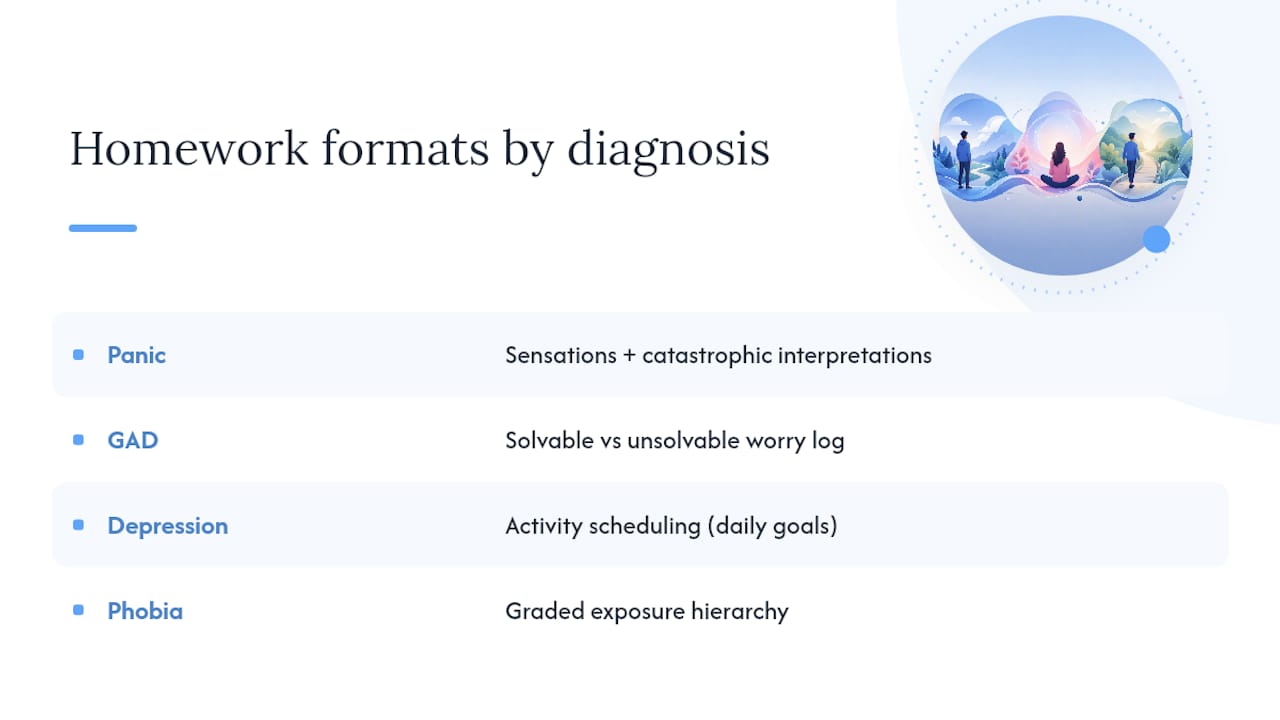
A thought record built for generalized worry looks different from one built for panic, and an exposure ladder for a phobia looks nothing like activity scheduling for depression. Cognitive therapy exercises work better when the format fits the actual problem rather than being applied as a one-size-fits-all handout.
For panic disorder, the useful worksheet tracks physical sensations and catastrophic interpretations side by side, since the core issue is usually misreading a racing heart as danger rather than distorted thinking about the future. For generalized anxiety, a “worry time” log that separates solvable worries from unsolvable ones often does more than a standard thought record. For depression, activity scheduling tends to outperform cognitive worksheets early in treatment, because behavior often needs to shift before thinking does. For specific phobias like needles or flying, an exposure hierarchy with tightly graded steps matters more than any written reflection.
Age and severity change the picture too. A teenager might need a one-line mood check instead of a five-column thought record. Someone in a severe depressive episode might only be able to manage one scheduled activity a day, not three. A person with a trauma history attempting exposure work needs a much slower ladder with smaller SUDS increments between steps, plus closer therapist involvement.
This is where collaboration matters more than the worksheet itself. The task has to feel relevant to the client’s actual goal, not just clinically appropriate on paper. A barriers-to-homework framework identifies exactly this: motivation drops fast when a task feels disconnected from what the person actually cares about, even if it’s technically the “right” intervention. The fix is almost always the same. Sit down together, adjust the task until it fits, and write it down in the client’s own words instead of clinical language.
What Ethical Issues Come Up With CBT Homework?
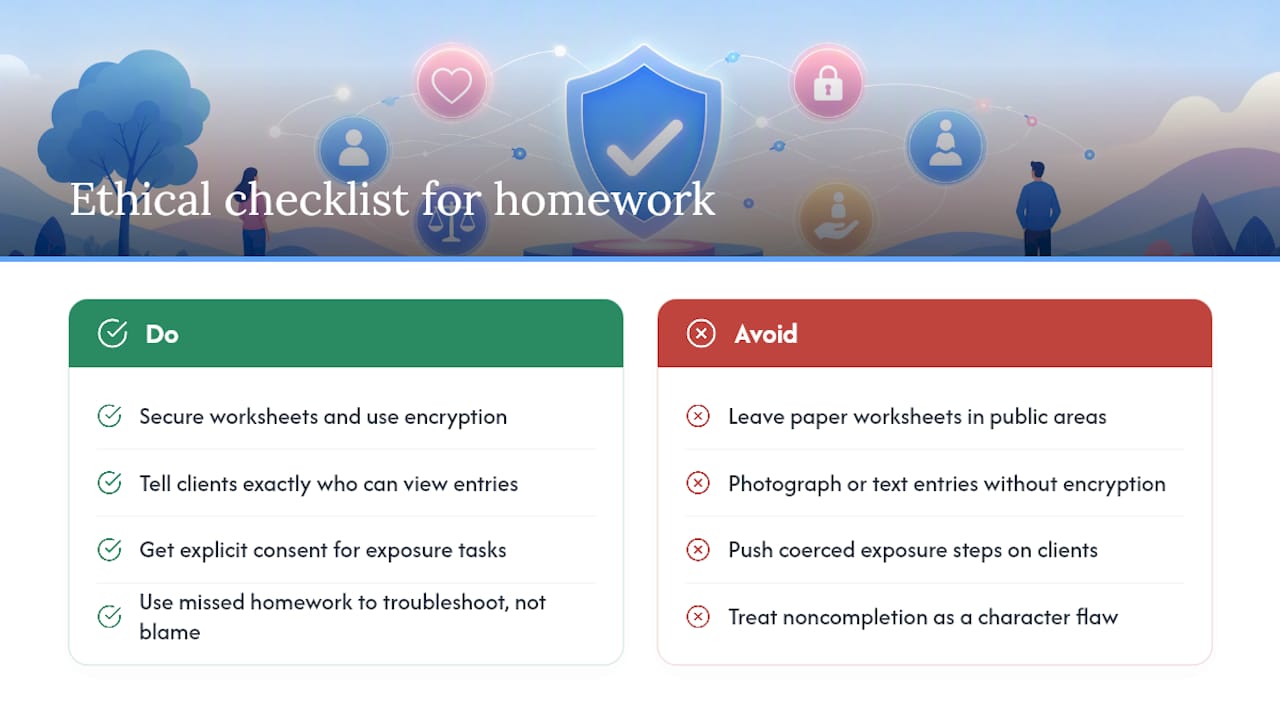
Homework sheets often contain a client’s most private thoughts, written in their own handwriting, sometimes including things they haven’t said out loud yet. That makes storage and review a real confidentiality issue, not a minor administrative detail.
Paper worksheets left in waiting rooms, photographed and texted without encryption, or stored in an unsecured shared drive all create genuine risk. Any digital tool used to track homework, whether that’s a shared document or an app, needs the same privacy standard applied to session notes. Clients should know upfront exactly who sees their entries, whether that’s only their individual therapist, a supervising clinician, or nobody but themselves in a self-guided context.
Consent matters just as much as storage. A client should understand and agree to the specific homework being assigned, not simply comply because a clinician suggested it. This is especially true for exposure work, where pushing a step that feels coerced rather than chosen can damage trust and stall progress. Written informed consent isn’t usually required for a standard thought record, but it becomes more important for higher-intensity exposure work, especially when a fear touches on trauma.
There’s also a quieter issue worth naming directly: homework should never become a test of a client’s worth or effort. Missed assignments get treated as clinical information about barriers, not evidence of laziness or resistance. A therapist who frames noncompletion as a character flaw rather than useful data is working against the exact research showing that troubleshooting, not judgment, is what predicts better adherence going forward.
A Therapist’s Homework Doesn’t Work Until It’s Small Enough
Here’s what gets missed constantly: the most sophisticated worksheet in the world fails against a task that’s too big for where someone actually is that week. Take driving avoidance. The tempting first assignment is “drive to work.” The realistic first assignment is “sit in the driver’s seat in the driveway for five minutes with the engine off.” That’s not a weaker version of exposure work. It’s the version that actually gets attempted.
Completion doesn’t have to be perfect to count. A half-finished thought record or a driving exercise that only reaches step one on the ladder still generates real information, and real information is what moves treatment forward, not a flawless week.
— Ryan
Try Signal Not Noise for This Week’s Homework Practice
You can use a concrete way to run this week’s homework without relying on a stack of paper or your memory alone. If your practice this week is more about staying with a task, sitting with focus, and tracking small wins instead of avoiding a specific fear, Signal not Noise breaks that work into short, trackable sessions with visible progress instead of a vague goal to “concentrate better.”
The app structure mirrors what a good CBT worksheet is trying to do on paper: break a task into a small, specific step, log a before-and-after rating, and celebrate the small win instead of waiting for a big one. It’s a self-guided tool inspired by exposure and behavioral principles, not a replacement for therapy, and it doesn’t diagnose or treat anything on its own. For the full suite of tools, including options built around specific fears, Life is a Game lays out every app by the struggle it targets. Pick one focus session today, set it for five minutes, and see how the first log entry actually feels once it’s done instead of just planned.
This article is general information, not a substitute for advice from a qualified doctor. Consult a qualified healthcare professional about your own circumstances before acting on anything here.
Sources
- The Relationship Between Homework Compliance and Therapy Outcomes: An Updated Meta-Analysis
- Therapist behaviors predicting homework adherence in CBT (adolescent depression study)
FAQ
What are some examples of CBT homework?
Common examples include thought records, behavioral experiments, activity scheduling, exposure hierarchies, and relaxation practice logs. Each targets a different symptom pattern, from distorted thinking to avoidance to low motivation.
What are some examples of CBT-based worksheets?
A thought record worksheet tracks the situation, automatic thought, evidence, and a re-rated mood. An exposure hierarchy worksheet ranks feared situations by SUDS score alongside dates and outcomes.
Do CBT therapists give homework?
Yes, homework is a core part of standard CBT practice, and research consistently links completing it to better treatment outcomes. Most CBT sessions end with a specific task assigned and reviewed at the start of the next one.
Can you give me some examples of homework assignments for therapy?
A person with driving anxiety might sit in a parked car for five minutes as a first exposure step. A person with low mood might schedule one enjoyable activity and rate their mood before and after completing it.
Why do people skip their CBT homework?
Noncompliance usually comes down to motivation, unclear instructions, or a task that felt too difficult or irrelevant. Written instructions and collaboratively adjusted tasks measurably improve follow-through.