
Stop Avoiding: Gamified 4 Week Social Anxiety Exposures for Adults

Graded exposure exercises reliably reduce social anxiety avoidance when practiced repeatedly and safely, and that’s true whether the fear is phone calls, public speaking, or ordering coffee without rehearsing a script first. The method is well established in clinical guidance, not a self-help trend. What follows is a specific ladder, a four-week plan, and honest limits on when to bring in a professional.
TL;DR:
Repeated, gradual exposure to social situations promotes habituation, reducing avoidance and allowing the nervous system to update its threat predictions.
Building a SMART goal-based fear ladder, rated by distress levels, and progressing only when distress drops by about 30 percent improves training effectiveness.
Incorporating mindfulness and cognitive restructuring helps handle anxiety better and tests negative predictions during exposure without relying on safety behaviors.
Consistent practice over three to five sessions weekly, tracking progress with logs, and adjusting the ladder based on distress patterns optimizes results and prevents plateauing.
Self-guided tools like Conquer Fear support adherence and motivation, but severe or chronic anxiety symptoms require professional therapy or medication for sustained improvement.
Table of Contents
What Social Anxiety Exposures Are and Why They Work
Social anxiety exposures work by putting you in contact with the exact situations you avoid, in a deliberate order, until your nervous system stops treating them as threats. This isn’t willpower. It’s learning. The National Institute of Mental Health describes exposure as an active, “bottom-up” process: understanding your anxiety intellectually helps, but the real change happens through repeated, direct contact with feared situations, not through thinking your way out of them.
The mechanism has a name: habituation and inhibitory learning. Stay in a feared situation long enough without escaping, and your brain updates its prediction. It expected disaster; disaster didn’t come. Do that enough times across enough situations, and the anxious prediction itself weakens. A peer-reviewed analysis of social mishap exposures found this is exactly how targeted exercises work: they confront the exaggerated belief that a social slip will be catastrophic by making patients actually experience the slip and see the real, usually mild, consequence.
CBT with exposure is considered first-line treatment for adults with social anxiety disorder, and NICE guidance recommends around 14 to 16 therapist-led sessions over roughly four months, or about 9 sessions if you’re using a supported self-help format. That’s a meaningful time investment, but it’s also a realistic one. Progress usually looks like a return to function, not the disappearance of nervousness altogether. You can still feel a flutter before a presentation and count it as a win if you gave the presentation.
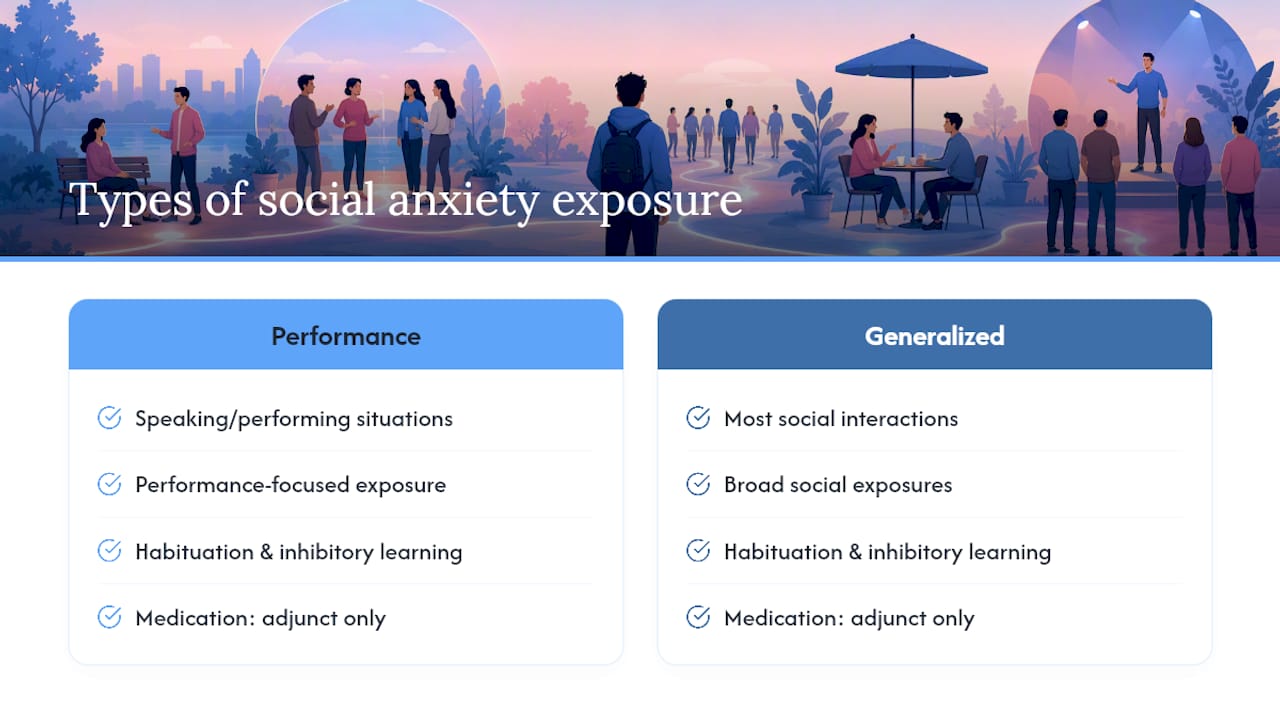
Two variants matter here. Performance-only social anxiety (freezing up specifically when speaking or performing in front of others) responds differently than generalized social anxiety, which touches most interactions. Medication sometimes supports either type, but it’s an adjunct to exposure, not a replacement for it.
How to Build a Fear Ladder for Your Specific Social Fear
A fear ladder, also called a graded exposure hierarchy, turns a vague dread into a sequence of doable steps. Skip this step and most people either avoid exposure entirely or jump straight to the hardest version of their fear, get overwhelmed, and quit. Here’s how to build one that actually holds up.
-
Pick one end goal and make it SMART. Not “get less anxious around people.” Try “hold a 10-minute conversation with a coworker at the break room without leaving early, twice a week, by the end of next month.” Specific, measurable, achievable, relevant, timebound. Vague goals produce vague progress.
-
List every situation you currently avoid related to that goal. Be exhaustive here. If the goal is phone calls, that might include voicemail, texting instead of calling, calling businesses during off-hours to avoid a live person, and asking someone else to make calls for you.
-
Rate each item’s distress level. Use a 0 to 100 scale, sometimes called SUDS (Subjective Units of Distress Scale), or a simpler 0 to 10 if that’s easier to track. Clinical worksheets recommend this because it turns “this feels unbearable” into a number you can watch drop over time.
-
Order the list from the lowest distress to highest. This is your ladder. Don’t start at the top. The point of grading exposures is that step three should feel almost boringly manageable by the time you’ve mastered step two.
-
Define objective completion criteria for each rung. Not “feel less nervous,” but “stay on the call for the full three minutes” or “make eye contact and ask one follow-up question.” Vague endpoints leave you guessing about whether you succeeded, and that ambiguity itself feeds anxiety.
-
Repeat each step until your distress rating drops meaningfully, then move up. There’s no fixed number of reps that works for everyone. Some steps take two tries, others take ten.
-
Build in stepbacks. If a rung turns out to be too big a jump, don’t abandon the ladder. Add an in-between step. Struggling on rung five doesn’t mean the method failed; it means the ladder needs a rung 4.5.
Pro Tip: Write your ladder down somewhere you’ll actually see it again, a notes app, a notebook, or a structured tool. A mental list of “things I should probably try” evaporates by Tuesday. A written ladder with dates next to completed rungs becomes evidence you can point to on hard days.
Exposure Ideas for Common Social Fears
You don’t have to invent your ladder from scratch. Most social fears cluster into a handful of patterns, and each has a well-worn set of graded steps. Adapt these to your own life rather than copying them exactly.
Phone call anxiety tends to ladder well from listening to a voicemail without deleting it, to calling a friend who already expects your call, to calling a business during business hours with a scripted question, to cold-calling a small business (a hair salon, a pizza place) with no script prepared.
Small talk and approaching strangers usually starts smaller than people expect: smiling at someone in passing, then adding a verbal greeting, then asking a short question (“Do you know what time it closes?”), then holding a five-minute conversation with a cashier or a neighbor.
Eating in public or using public restrooms (a common but rarely discussed fear related to paruresis) can start with imagining the scenario in detail, move to eating a snack alone in a quiet public space, then a full meal at a busy restaurant counter, then eating with acquaintances present.
Public speaking often ladders from a short toast at a small gathering, to a three-minute prepared talk in front of two or three trusted people, to a presentation at a small work meeting, to speaking in front of a larger, less familiar group.
Conflict and assertiveness builds from a scripted “small no” (declining a minor request), to a brief assertive statement of a preference, to a longer boundary-setting conversation with someone who matters to you.
Whatever ladder you build, watch for safety behaviors that quietly undercut the exercise:
-
Drinking alcohol before a social event to “take the edge off”
-
Holding your phone as a shield to avoid eye contact or conversation openings
-
Over-rehearsing scripts to the point of sounding robotic instead of present
-
Bringing a friend along specifically so you never have to talk alone
Mayo Clinic notes that performance-only anxiety sometimes benefits from situational tactics, including short-term beta-blockers prescribed for acute performance situations, but that’s a conversation for a prescriber, not a self-directed workaround.
A 4-Week Exposure Schedule You Can Start This Week
Structure beats intensity. A steady, moderate pace of exposure practice outperforms sporadic bursts of intense effort, mainly because consistency is what actually builds new learning.
-
Set your frequency. Aim for three to five short exposure sessions a week, each lasting anywhere from five to thirty minutes depending on the task. Consistency matters more than duration.
-
Repeat each ladder rung two to four times before deciding whether to progress. One success can be a fluke; a pattern is data.
-
Use your distress ratings to decide when to move up. A workable rule: progress to the next rung once your average SUDS score across three attempts has dropped by roughly 30% from your first attempt at that step.
-
Log every session. A simple format works: date, ladder step, distress rating before, distress rating after, duration, and one line of notes. This log becomes your evidence when your brain insists you’re not improving.
-
Track behavioral milestones alongside distress, not just feelings. Number of unscripted sentences spoken, minutes stayed in the situation, whether you made eye contact. Feelings lag behind behavior; behavior changes first.
-
Expect deviations and treat them as data, not failure. Someone joins the conversation unexpectedly, the call goes to a different department, the meeting runs long. Mayo Clinic’s guidance points out that these unplanned moments are often the most valuable learning opportunities in the entire exercise, because they prove you can handle the situation not going according to script.
Pro Tip: If week two feels harder than week one, that’s not a sign you’re getting worse. Anxiety curves aren’t linear. Check your log before you trust your mood.
When Self-Guided Exposure Isn’t Enough
Most people with social anxiety can make real progress with a self-directed ladder. Some situations call for a therapist instead of, or alongside, self-guided practice. Watch for these signals:
-
You’re housebound or unable to leave the house for anxiety-related reasons
-
You experience persistent panic attacks that don’t respond to gradual practice
-
You’ve had thoughts of suicide or self-harm
-
You use alcohol or drugs specifically to get through social situations
-
Anxiety is significantly interfering with work, relationships, or daily functioning
Established CBT models, particularly the Clark and Wells model and the Heimberg model, structure exposures within a broader therapy framework, typically across the 14 to 16 session range NICE recommends for adults. If medication comes up in that conversation, SSRIs are the more common option for generalized social anxiety, while beta-blockers are sometimes used for performance-specific anxiety. Either decision belongs with a prescriber, not a self-directed guess. Looking for a therapist who explicitly lists exposure-based CBT as part of their practice is a reasonable filter, and a first appointment usually involves mapping out your specific avoidance patterns before any exposure work begins.
How Conquer Fear Supports Your Exposure Practice
Building and sticking to a ladder is where most people lose momentum, not in understanding the theory. Conquer Fear from Life is a Game breaks your exposure goals into small, trackable steps, logs your progress automatically, and uses light game mechanics to make showing up for rung three of your ladder feel less like a chore and more like a streak worth keeping.
It’s a self-guided tool inspired by exposure principles, not a therapy replacement, a treatment, or a diagnostic service. It won’t tell you if you have social anxiety disorder or manage a crisis. What it does well is give structure to the practice you’ve already decided to do, especially on days when motivation alone won’t cut it. If you want the underlying theory first, the CBT primer covers how exposure fits inside a broader CBT framework, and the science-backed fear-facing plan walks through the stepwise approach in more depth.
Mindfulness and Cognitive Restructuring Alongside Exposure
Exposure does the heavy lifting, but it works better paired with two supporting skills: mindfulness and cognitive restructuring. Neither replaces exposure. Both make it more tolerable.
Mindfulness, in this context, isn’t about relaxing away the anxiety. It’s about staying present in the exposure instead of mentally escaping through rumination or replaying the interaction in your head while it’s still happening. Anxious minds tend to time travel, either rehearsing disaster before an event or dissecting perceived failures after it. Noticing that drift and returning attention to the actual conversation in front of you keeps the exposure “live,” which matters because the learning only happens when you’re genuinely present for the corrected prediction.
Cognitive restructuring works on the thoughts that fuel the avoidance in the first place: “everyone will notice,” “I’ll say something stupid and they’ll remember it forever.” You don’t need to argue yourself into believing the opposite. You need to treat those thoughts as testable predictions and then test them in the exposure itself. That’s the real bridge between cognitive work and exposure work: the thought generates a hypothesis, and the exposure is the experiment. A helpful sequence is jotting the specific feared outcome down before an exposure, then comparing it against what actually happened afterward. The gap between the two, almost always large, becomes its own piece of evidence over time.
Preventing Safety Behaviors From Undermining Exposures
A safety behavior is anything you do to make an exposure feel less risky that also, quietly, prevents you from learning it wasn’t risky in the first place. This is the most common way well-intentioned exposure practice fails to produce results.
The trap is subtle because safety behaviors often look like reasonable coping strategies. Over-rehearsing what you’ll say, staring at your phone between conversational turns, standing near an exit, asking a friend to do the talking, these all reduce anxiety in the moment while blocking the exact learning the exposure was supposed to create. If you rehearse a phone call script so heavily that you’re essentially reading lines, you never learn that you can handle the call without the script.
The fix is to identify your specific safety behaviors before the exposure, not during it. Ask yourself: what am I doing, or planning to do, specifically to feel safer here? Then deliberately drop it for that attempt. If dropping it all at once feels too big a jump, that’s useful information, it likely belongs as its own separate ladder rung. Someone who can’t imagine a phone call without a script might need a rung where they use a partial script, then a bullet-point outline, then nothing at all. The goal isn’t to make exposures maximally uncomfortable. It’s to make sure the discomfort you do feel is actually being resolved by the situation, not artificially muted by a workaround.
Maintaining Gains and Preventing Relapse
Finishing your ladder isn’t the finish line. Social anxiety symptoms have a tendency to creep back in during long stretches without practice, particularly after a stressful period or a genuinely bad social interaction that feels like proof the old fear was right all along.
The most reliable maintenance strategy is scheduled, ongoing contact with situations you used to avoid, even after they stop feeling hard. Once a phone call stops triggering distress, don’t quietly stop making calls. Keep a light rotation going, maybe once every week or two, specifically so the skill doesn’t atrophy. Treat it the way you’d treat physical fitness: gains erode without some ongoing use, even after the hard training phase ends.
It also helps to expect occasional bad interactions and plan your response to them in advance. One awkward conversation after months of progress isn’t relapse, it’s a normal data point in a system that never promised zero bad days. The difference between a setback and a slide is what you do next: if a bad interaction leads to avoiding all interactions for two weeks, that’s the moment to go back to your ladder, find the rung slightly below where you stumbled, and rebuild momentum from there rather than waiting for confidence to return on its own.
Imaginal vs. In Vivo Exposures: When to Use Each
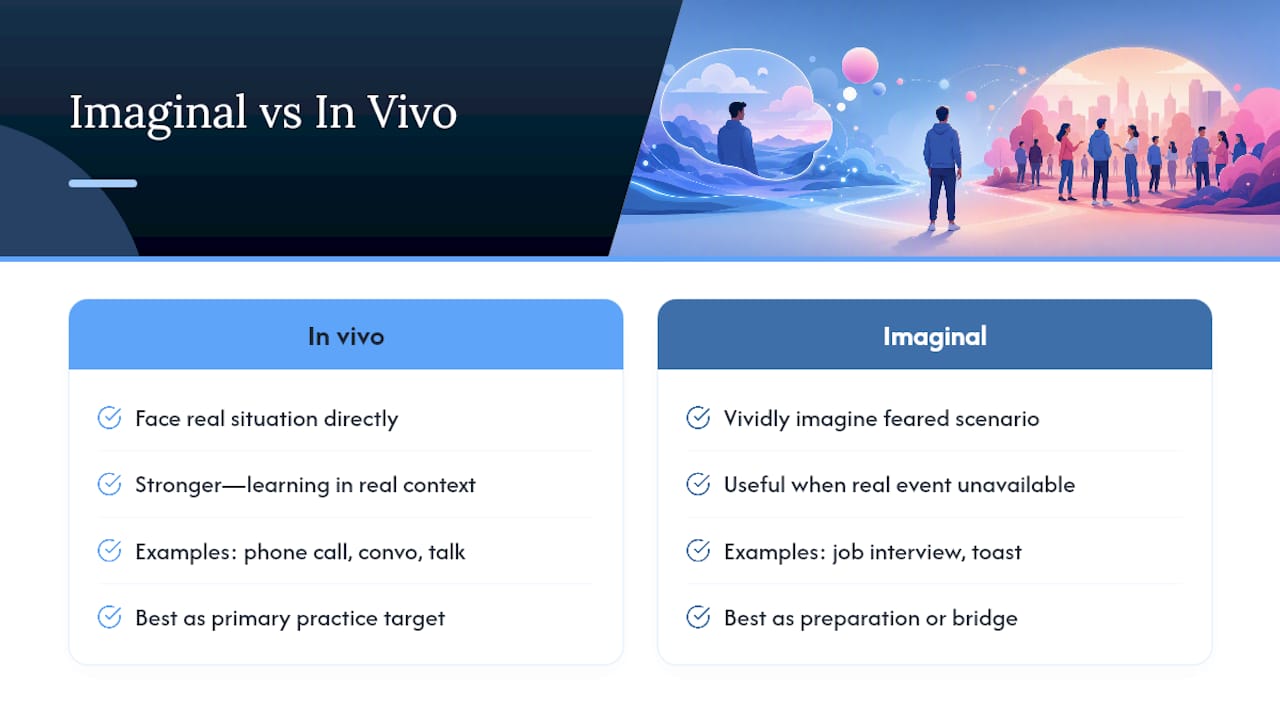
In vivo exposure means facing the real situation directly, the actual phone call, the actual conversation with a stranger. Imaginal exposure means vividly imagining the feared scenario in detail, often used when the real situation isn’t available on demand or feels too big a jump to attempt directly.
In vivo is generally the stronger tool when it’s available, because the learning is happening in the exact context where the fear normally shows up, with all its real sensory and social detail. Most of the ladder items described earlier in this guide, actual phone calls, actual conversations, actual presentations, are in vivo by design.
Imaginal exposure earns its place in a few specific situations. Some feared scenarios simply can’t be scheduled on demand, like a job interview or a wedding toast. Rehearsing the scenario in vivid imagined detail, including the physical sensations of anxiety and the imagined worst-case social reaction, can prime someone for the real version and reduce the shock of the actual event. It’s also useful as a bridge step when a real-world rung feels too far out of reach; imagining the situation in detail first, staying with the discomfort until it eases, can make the in vivo version of that same step feel more approachable when it finally comes up on the ladder.
Neither format should replace the other entirely for social anxiety specifically. Imaginal exposure is best used as preparation or as a stepping stone, with in vivo practice as the actual target.
Tracking Progress and Adjusting Your Exposure Tasks
The log described earlier in the four-week plan isn’t just record-keeping, it’s the tool that tells you when to change the plan itself. Reading it back honestly every week or two reveals patterns a single session never shows.
Watch for a few specific signals. If your distress ratings for a given rung have plateaued across four or five attempts instead of trending down, the step might be miscalibrated, either genuinely too hard for where you are, or vague enough that you can’t tell what success even looks like. Add an in-between rung rather than grinding at the same one indefinitely. If a rung’s ratings dropped fast, in one or two attempts, you may have started too easy; that’s fine, just move up the ladder a little quicker than planned.
Also track which specific elements of a situation spike your distress the most; a stranger’s tone, a pause in conversation, being asked a direct question. Over several sessions, those details often point to a more precise fear than the broad category you started with (“phone calls” might really be “the moment right after I finish talking and I’m waiting for their response”). Once you spot that pattern, you can build a rung that targets it directly instead of practicing the general category and hoping the specific fear fades along with it.
Take the First Step This Week
Setbacks are part of this process, not proof it’s not working. Some weeks your distress ratings won’t budge, and that’s not failure, it’s just where the learning curve happens to sit that week. Progress in exposure work rarely looks like a straight line. It looks like a slightly wobbly upward trend with a few flat stretches and the occasional dip.
Celebrate the small stuff, because the small stuff is the whole method. Making the phone call you’d normally avoid, staying two extra minutes in a conversation, saying “no” to something small without over-explaining yourself, these count as real progress even when they don’t feel dramatic.
Here’s the one thing to do this week: write down one SMART micro-step from your own ladder and put a date on it. Not the goal. Not the whole ladder. One step, one date. Everything else can wait until that’s on your calendar.
— Ryan
Try a Structured Way to Practice Exposures
Building a ladder on paper is a great start, but sticking with it, tracking distress ratings, remembering which rung you’re on, staying motivated after a rough session, is where most self-guided plans quietly stall. Conquer Fear from Life is a Game gives that structure a home: it breaks your exposure goals into small steps, tracks your sessions automatically, and turns showing up for the next rung into something closer to a streak than a chore.
It’s built as a self-guided tool inspired by exposure principles, not a substitute for therapy, and it won’t diagnose or treat anything. What it does is remove the friction between “I know I should practice this” and actually doing it. If you’ve already got a ladder in mind from this guide, the fastest next step is downloading the app and setting up your first micro-challenge, one rung, one session, today. Visit Life is a Game to get started.
Sources
-
Social anxiety disorder: recognition, assessment and treatment | NICE
-
Social anxiety disorder — Diagnosis & treatment | Mayo Clinic
FAQ
What are some good exposures for social anxiety?
Strong starting exposures include short phone calls, brief small talk with a cashier or neighbor, and a short prepared talk in front of one or two trusted people. Choose exposures near the bottom of your personal fear ladder and work upward gradually.
Is social anxiety permanent?
Social anxiety isn’t necessarily permanent; CBT with exposure is a first-line treatment and most people see meaningful improvement in functioning, though some baseline nervousness in certain situations can remain even after successful treatment. Ongoing practice after formal treatment ends helps maintain those gains.
What are the different types of social anxiety disorder?
The two broad presentations are performance-only social anxiety, limited to specific situations like public speaking, and generalized social anxiety, which affects most social interactions. Treatment approaches, including medication choices, sometimes differ between the two.
Can someone with social anxiety be successful?
Yes. Social anxiety affects comfort in social situations, not competence or capability, and many people manage demanding careers and relationships while working through it. Structured exposure practice, sometimes supported by tools like Conquer Fear alongside professional care when needed, helps reduce the avoidance that otherwise limits opportunities.