
How to start answering the phone again when it rings and you freeze
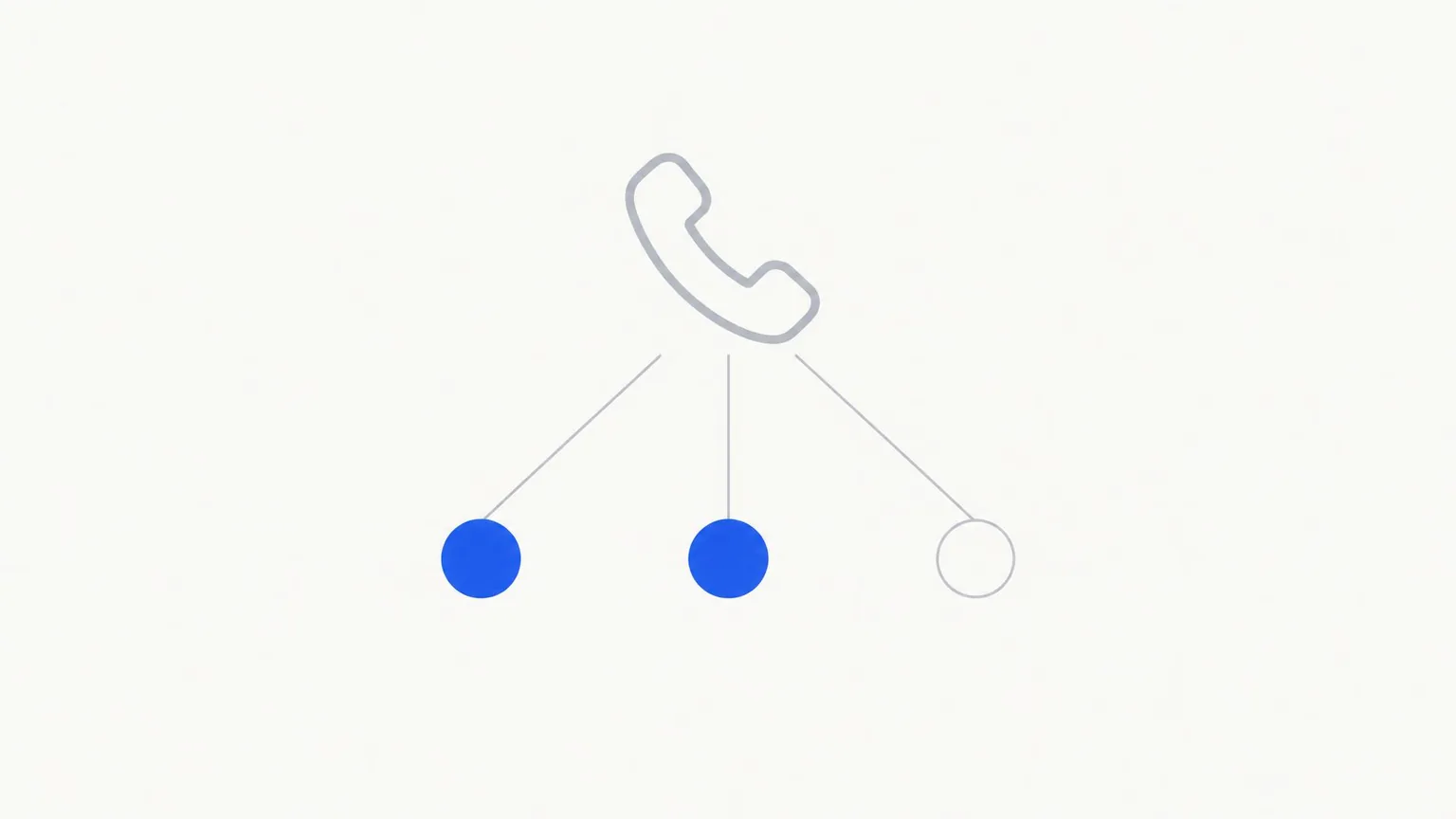
If you freeze when your phone rings, practise answering calls you are sure are safe, in order: first a call you arranged with a friend, then a friend calling at a time you did not set, then expected calls from organisations like your GP surgery or a delivery firm. Keep one line ready to buy time, "Can I call you back in five minutes?", so answering never commits you to the whole call. Leave unknown numbers out of it. Not answering those is sensible, not avoidance.
Answering is a different fear from calling
Most advice on phone anxiety is about making calls. You choose when, you can write down what to say, and you can hang up before it connects. Our phone call anxiety guide covers that side.
Answering takes all of that away. You get a few seconds of ringing, no idea who it is or what they want, and no time to prepare. For a lot of people, the ring itself is the worst part.
You are not unusual. In a Uswitch survey of 2,000 UK adults in April 2024, 23% of 18 to 34 year olds said they never pick up calls, and 56% of that age group said they assume a call out of the blue means bad news. Across everyone surveyed, the most common reasons for not answering were worry about spam or scam calls (63%) and wanting to find out who it is first (50%).
That last pair of reasons matters, because one of them is good sense.
Not answering unknown numbers is fine
Ofcom's advice on scam calls, updated in August 2026, says to hang up if you are unsure about a call you have answered, "or ideally don't answer it at all". It also mentions call screening features like Apple's Screen Unknown Callers, and warns that those warnings "are not always right". If a caller says they are from an organisation, Ofcom says to call back on a number from the organisation's own website or your statement, not the one they gave you.
So the goal here is not to answer everything. It is to stop letting calls ring out from people and places you know are real: your mum, your friend, the surgery, the letting agent, the job you applied for. Sort calls into three groups and only practise on the first two.
- Practise
Someone you know
A friend, family, a colleague.
Answer. Use the holding line if you need time.
- Practise
An organisation you expected
The surgery, a delivery, a recruiter you applied to.
Answer. Ask who is calling before you give any details.
A number you don't know
Anything you are not expecting.
Let it go to voicemail. Call back on an official number if it matters.
Ofcom: if unsure, ideally don't answer.
| Who is calling | Example | What to do |
|---|---|---|
| Someone you know | A friend, family, a colleague | Practise answering |
| An organisation you are expecting | Your GP surgery, a delivery firm, a landlord, a recruiter after you applied | Practise answering, but check before you give any details |
| A number you do not recognise and are not expecting | Anything else | Let it go to voicemail. Call back on an official number if it matters |
Three lines to have ready
Write these in your notes app. You will not need them every time, but knowing they are there makes the ring less of a cliff edge.
- The opener. "Hello, it's [your name]." Saying your name first gives you something automatic to do in the first second.
- The holding line. "Sorry, I'm just in the middle of something. Can I call you back in five minutes?" This is the most useful line in the guide. It means answering only commits you to ten seconds, and you get the five minutes of preparation you would have had if you were the one calling. Then call back, properly, inside those five minutes.
- The check. "Sorry, who's calling?" or "Can you tell me what it's about?" Use it on any call where they have not said, and especially before you give details to anyone who says they are from an organisation.
And rate it. In the second the phone starts ringing, give your fear a number from 0 to 10. Rate again straight after you hang up. Not how it went. How afraid you feel now.
The ladder
These are examples, ordered from smaller to bigger for a typical person. Your ratings decide your order. Repeat a rung until your before rating drops a few points and the ring feels more annoying than scary, then move up.
| Rung | The step | Why it is this high |
|---|---|---|
| 1 | Ask a friend to ring you at a time you both agree. Answer it on the second ring | You know who, when and roughly why |
| 2 | Same friend, but you only agree the day, not the time | You know who, not when |
| 3 | Ask two or three friends or family to each ring you once at a random time this week, about anything | You do not know who or when |
| 4 | Answer a call from someone you know that you were not expecting, without texting first to ask what it is | It is real, not practice |
| 5 | Answer when you are out, in a shop or on a street, rather than waiting to get somewhere quiet | Other people can hear |
| 6 | Answer an expected call from an organisation, such as a delivery or a callback you asked for. Use the check line | A stranger, but one you expected |
| 7 | When you are waiting on a call you need, such as the surgery or a job, answer straight away instead of waiting for the voicemail | It matters, and it could be bad news |
| 8 | Answer a call from someone you know when you have a fair idea it is about something awkward | You cannot use the holding line forever |
Two things to notice. Rung 3 needs other people, and it is worth asking for. "I'm trying to get better at answering the phone. Would you ring me at some point this week, any time, about anything?" is a small favour to ask a friend. And the holding line is allowed on every rung, as long as you actually call back.
How to run a week
- Turn the volume on. If your phone lives on silent so you never have to decide, that is part of what keeps the fear going. Have it ring for the week, at least during the day.
- Pick one rung. The lowest one that feels like a 3 or more.
- Log every call that rings. Answered or not, it goes in the log. A line in your notes app is enough.
| Date | Who was calling | Answered? | Before (0 to 10) | After (0 to 10) | What it was about |
|---|---|---|---|---|---|
- Look at the last column at the end of the week. "Bad news" is usually much rarer in that column than it felt in the second before you answered.
The voicemail habit
Plenty of people answer nothing, listen to the voicemail, then decide whether to ring back. It feels like a sensible compromise, and for unknown numbers it is. For people you know, it keeps the ring itself feeling dangerous, because you never find out that you could have handled it live. While you are on this ladder, try to stop using voicemail as a filter for the people and places in the first two groups.
The same goes for texting "what's up?" before you call back. It is fine sometimes. As a rule, it is the same thing as not answering, just slower.
When to see your GP or a professional
If avoiding calls is costing you appointments, money or work, or a ringing phone sets off panic rather than nerves, talk to your GP. If ringing the surgery is the problem, ask at reception or check whether your practice takes requests online. The NHS says it is a good idea to see a GP about social anxiety, especially if it is having a big impact on your life, and that you can also refer yourself to NHS support without a GP referral. This ladder is something to do alongside that, not instead of it.
If you want the ladder written for you
Conquer Fear, our app, is built around this loop. You name a goal and the fear in the way, for example "answer when my landlord rings" and "not knowing what they want", and it writes a ladder of small real-world steps for that exact goal rather than picking from a fixed list. It shows you one step at a time and asks for your 0 to 10 rating before and after. You log each attempt as completed, partial or not completed, so a call you let ring out still goes in the record and is not wasted. If a rung looks too big, tap "Make it smaller" on that step and it splits it. There is a help chat for when you are stuck. Our phone calls page shows an example ladder.
The free tier gives you one ladder, its first three steps, 20 logged attempts and three help chats. Premium is £9.99 a month, or £49.99 a year with a 7 day free trial on the annual plan. It is on the App Store for iPhone only.
Where it is not the right choice. It cannot ring you, so you still need friends for the practice calls. It has no scripts and no AI caller to rehearse with, so if you mainly freeze because you do not know what to say, a call rehearsal app will help more. It is not on Android, it needs a connection, and it does not teach breathing or relaxation. And the ladder and log above, in a notes app, do the same job for free.
Sources
- Uswitch, "Call me maybe (not): a quarter of young people never answer the phone", 30 April 2024. Survey of 2,000 UK adults, 9 to 12 April 2024: https://www.uswitch.com/media-centre/2024/04/Call-me-maybe-quarter-young-people-never-answer-phone/ (checked 25 October 2026)
- Ofcom, "What to do about a scam call, text or message", updated 24 August 2026: https://www.ofcom.org.uk/phones-and-broadband/scam-calls-and-messages/what-to-do-about-a-scam-call-text-or-message (checked 25 October 2026)
- NHS, Social anxiety (social phobia): https://www.nhs.uk/mental-health/conditions/social-anxiety/ (checked 25 October 2026)
Conquer Fear is a self-help tool inspired by exposure principles. It isn't therapy or medical care, and it is not intended to diagnose, treat, cure or prevent any disease. If fear or anxiety is affecting your daily life, check with your GP or a qualified professional.