
Stop Phone Call Anxiety in 6 Quick Exposure Steps
Phone call anxiety, clinically known as telephobia, is a common and treatable fear rooted in social anxiety. The fastest way to shrink it is repeated, small exposures paired with simple coping tools: paced breathing, short scripts, and a graded practice schedule you actually follow. It rarely disappears overnight, but small, repeated steps reliably reduce avoidance over weeks.
TL;DR:
- Repeated, small exposure practices paired with breathing, scripts, and graded steps can reliably reduce phone call anxiety over weeks.
- Phone anxiety often stems from the absence of visual cues and real-time editing, with conditioned triggers like ringtones increasing fear responses.
- Practice should begin with low-stakes steps such as recording voicemails, then gradually escalate to brief calls, focusing on consistency rather than intensity.
- Using texting and email for preparation can help, but over-reliance may hinder long-term skill development and increase the comfort gap.
- In severe cases where avoidance impacts life, professional therapy and possibly medication are recommended to address underlying social anxiety.
Table of Contents
- What Is Phone Call Anxiety, and How Common Is It?
- What Does Phone Call Anxiety Feel Like?
- Why Do Phone Calls Feel Harder Than Other Conversations?
- How Do You Practice Handling Calls Step by Step?
- When Does Phone Anxiety Need Professional Support?
- Turning Exposure Into Something You’ll Actually Stick With
- Is Phone Anxiety Different From Video Call or In-Person Anxiety?
- Can Texting and Email Actually Help You Manage Call Anxiety?
- How Much Does Phone Anxiety Actually Cost You?
- Sources
- FAQ
What Is Phone Call Anxiety, and How Common Is It?
Telephobia isn’t a standalone diagnosis in the DSM-5-TR. It’s typically a manifestation of social anxiety or a specific phobia, showing up as intense dread before, during, or after phone conversations. That distinction matters for treatment: the tools that work for social anxiety, mainly cognitive behavioral therapy and gradual exposure, tend to work here too.
It’s also far more common than most people assume. A 2024 study found that 42% of undergraduate medical students showed some degree of telephobia, and broader surveys found many millennials feel anxious when the phone rings, more so than baby boomers.
There’s a real line between simple preference and clinically meaningful avoidance, though — if you’re considering broader emotional-support tools, resources like Emotional Support Animals & ESA Letters: Your Rights Guide can offer helpful guidance. Plenty of people just find texting more efficient. Phone call anxiety becomes a problem when avoidance starts costing you appointments, money, or relationships.
What Does Phone Call Anxiety Feel Like?
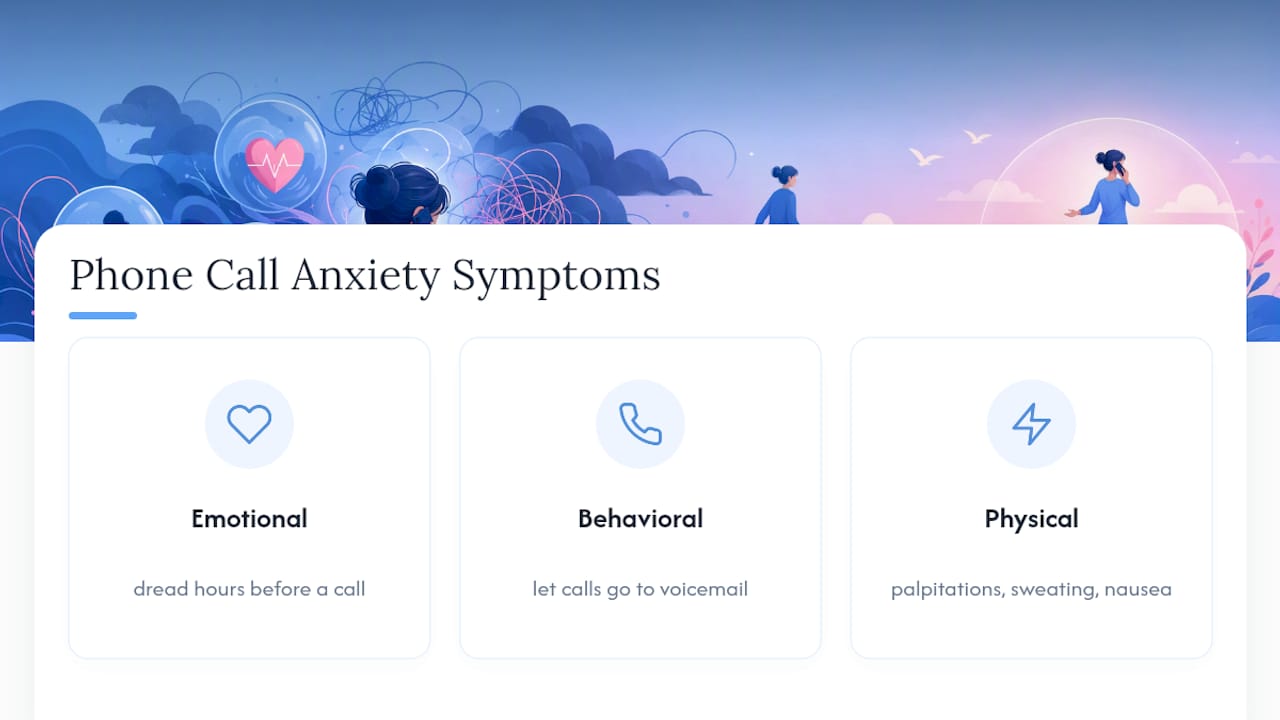
The symptoms cluster into three groups, and most people with telephobia experience all three at once. Verywell Mind’s clinical overview lists avoidance, procrastination, and rumination as core behavioral and emotional patterns, alongside physical signs like a racing heart and nausea.
Emotional: dread building hours before a scheduled call, embarrassment after hanging up, guilt over dodging calls from people you care about.
Behavioral: letting calls go to voicemail, drafting a text instead of dialing, rehearsing what to say and still avoiding the call anyway.
Physical: the ringtone itself can trigger a fight-or-flight response, producing palpitations, sweating, and a knotted stomach before you’ve even answered.
The real damage shows up in the aftermath. Missed doctor’s appointments, unpaid bills because you couldn’t call the billing department, a promotion stalled because you avoided client calls. Then comes the rumination: replaying the conversation, cataloging every awkward pause, feeling guilty for dodging a friend’s call yesterday. That guilt often fuels the next avoidance cycle.
Why Do Phone Calls Feel Harder Than Other Conversations?
Phone calls strip away almost everything that makes conversation feel manageable. No facial expressions, no body language, no visual confirmation that the other person is actually listening. That gap between what you can read in person and what you’re stuck guessing at on a call is sometimes called the “spontaneity gap,” and it’s a big part of why telephone phobia persists even in people who are otherwise socially comfortable.
Live speech also removes your editing button. In a text or email, you draft, reread, and revise before hitting send. On a call, the words leave your mouth in real time, with zero chance to take them back. That performance pressure, the sense that every sentence is being judged as it happens, is often the actual trigger, not the phone itself.
Ringtones compound the problem. If past calls have brought bad news or awkward confrontations, your brain starts treating the sound of ringing as a threat cue, a textbook conditioned response. And because younger adults increasingly rely on texting for daily communication, many simply get less practice with spontaneous verbal exchange than previous generations did. Less practice means the skill feels rustier and scarier every time it’s needed.
How Do You Practice Handling Calls Step by Step?
You don’t fix phone anxiety by white-knuckling through one terrifying call. You fix it the way you’d build any skill: small reps, done often, with a way to calm your body before and during.
In the moment, before you dial or pick up:
- Try the 3-3-3 rule: name 3 things you see, 3 sounds you hear, and move 3 body parts to interrupt the anxiety spiral.
- Use paced breathing: inhale for 4 counts, hold for 4, exhale for 6. The longer exhale slows your heart rate.
- Ground yourself physically: plant both feet on the floor, press your palm against a solid surface, or hold something cold.
Scripts remove a huge chunk of the mental load, because you’re not improvising and managing anxiety at the same time. Keep a note on your phone with lines like:
- Appointments: “Hi, I’d like to reschedule my appointment on [date]. What times do you have open?”
- Family calls: “Hey, I’ve only got about 10 minutes, but I wanted to check in. How’s everything going?”
- Quick business queries: “Hi, I’m calling about [account/order number]. Can you confirm [specific detail] for me?”
Once the basics are in place, work through a graded hierarchy, moving up only when the current step feels merely uncomfortable, not overwhelming:
- Leave yourself a voicemail or record a voice note practicing what you’d say.
- Call a close friend or family member for a short, low-stakes chat.
- Make a brief transactional call, like confirming a restaurant reservation.
- Call a business with a simple scripted question, such as store hours.
- Handle a call with mild unpredictability, like a customer service line.
- Take or make an unexpected call without a script prepared in advance.
Aim for short daily reps rather than one grueling weekly session. Five minutes of practice most days beats one dreaded hour-long call attempt. Pair each rep with a breath before dialing and jot a one-line note afterward: what happened, how anxious you actually felt, whether it matched your prediction.
Pro Tip: Use voicemails and voice notes as your first rung on the ladder. Recording yourself talking, even to no one, rebuilds vocal confidence with zero social risk, and it’s an easy win to reward before you ever have to face a live call.
When Does Phone Anxiety Need Professional Support?
Cognitive behavioral therapy and gradual exposure are considered first-line approaches for phone anxiety, largely because they directly target the avoidance pattern that keeps the fear alive. The Conversation’s reporting on telephobia makes the same point: avoidance reinforces the fear, while practice, even imperfect practice, weakens it over time.
Self-help strategies have limits, though. If phone avoidance is costing you your job, damaging close relationships, or triggering panic-level physical reactions, it’s time to loop in a licensed therapist. The same applies if calls are tangled up with any thoughts of self-harm. A clinician might also discuss medication as an adjunct in certain cases, but that decision belongs to you and a qualified provider, not a self-help guide.
Turning Exposure Into Something You’ll Actually Stick With
Exposure therapy works, but only if you keep doing it, and that’s where most people quit. Life is a Game builds phone-call practice into a gamified structure that tracks your micro-wins instead of demanding perfect performance. It’s a self-guided tool inspired by exposure principles, not a replacement for therapy.
The gamified format maps directly onto the six-step hierarchy above: each completed voicemail, short call, or unexpected pickup becomes a tracked win with a gentle reminder to keep the streak going, rather than a private failure you never revisit. If you want a structured way to work through that ladder, the Conquer Fear app’s phone-calls path walks you through it one small step at a time. For the reasoning behind why exposure and cognitive reframing work together, the CBT for anxiety breakdown is worth a read.
— Ryan
Is Phone Anxiety Different From Video Call or In-Person Anxiety?
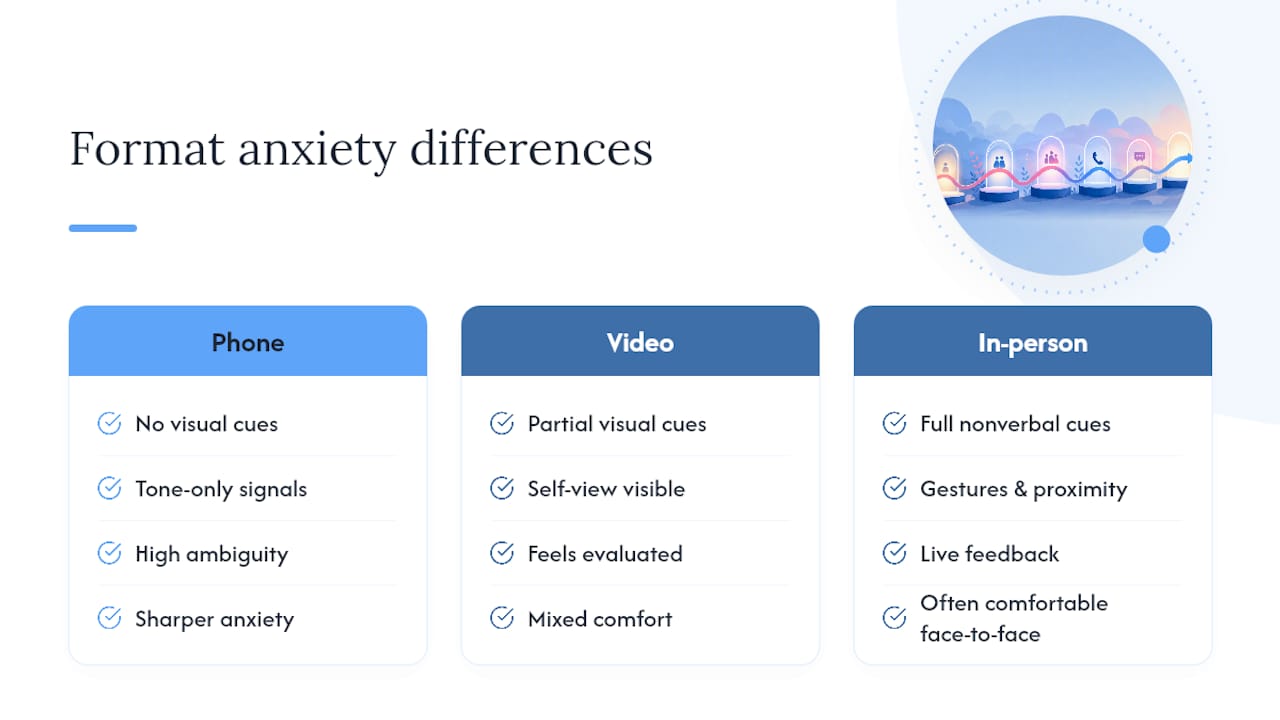
Not entirely, but the mechanisms shift depending on the format. Phone calls strip away visual cues entirely, so you’re reading tone alone, guessing at reactions you’d normally see on someone’s face. That ambiguity is often what makes phone anxiety sharper than in-person anxiety for the same conversation.
Video calls sit somewhere in between. You get facial expressions back, which helps some people, but you also see yourself on screen and know you’re being watched in a way a phone call doesn’t allow. For people whose anxiety centers on being evaluated, video calls can actually feel worse than voice-only ones.
In-person conversations restore the full range of nonverbal feedback: posture, gestures, physical proximity. Many people with phone anxiety are perfectly comfortable face-to-face, which is exactly what makes the phone-specific fear so confusing to them. It isn’t a general social skills problem. It’s the removal of visual information plus the live, uneditable nature of speech, a combination unique to voice calls.
Recognizing which format triggers you most helps target practice efficiently. If video feels manageable but voice-only calls spike your anxiety, prioritize the phone-specific exposure hierarchy rather than assuming all communication anxiety needs the same fix.
Can Texting and Email Actually Help You Manage Call Anxiety?
Used strategically, yes. Texting and email aren’t just avoidance tools, they can be legitimate bridges toward more comfortable phone use, as long as you don’t let them become the permanent substitute.
Drafting a text first, then reading it aloud before a call, rehearses the actual words you’ll need to say. Sending a quick email to confirm details ahead of a call (an appointment time, an order number) cuts down the improvisation required once you’re on the line, which lowers the performance pressure that makes calls feel so exposed.
The risk is using text and email exclusively to sidestep every call indefinitely. That’s where the nearly 70% of 18 to 34 year olds who prefer texting run into trouble: constant text reliance means less practice with spontaneous verbal exchange, which widens the comfort gap over time rather than closing it. Treat written communication as scaffolding for calls you’re building up to, not a permanent replacement for every call you’re avoiding.
A reasonable middle ground: use texting to schedule and prepare, use short scripted calls to practice, and reserve email for anything genuinely complex that benefits from a written record. That way technology supports your exposure practice instead of quietly undermining it.
How Much Does Phone Anxiety Actually Cost You?
The professional toll shows up fastest. Avoided client calls, delegated tasks that should’ve been yours, promotions passed over because a manager assumed you weren’t ready for client-facing work. Job interviews conducted by phone are their own particular dread, since there’s no body language to lean on and every silence feels louder.
Personally, the cost is quieter but just as real. Friends and family notice unanswered calls and unreturned voicemails, and even when they understand, repeated avoidance can strain relationships over time. Practical life admin piles up too: unpaid medical bills because you couldn’t call the office, unresolved insurance claims, appointments you kept meaning to reschedule but never did.
The rumination cycle makes all of this worse. You avoid the call, feel guilty about avoiding it, replay the guilt instead of resolving the task, and the backlog grows. Breaking that cycle isn’t about willpower. It’s about lowering the activation energy required to make one call, which is exactly what scripts, breathing techniques, and graded exposure are built to do.
Sources
Claims in this article draw on the PMC study on telephobia prevalence, Verywell Mind’s clinical overview, and Newsweek’s reporting on generational telephobia trends. For crisis-level distress, Samaritans offers immediate support. For more practice tools, see breathing exercises for anxiety and grounding techniques.
This article is general information, not a substitute for advice from a qualified doctor. Consult a qualified healthcare professional about your own circumstances before acting on anything here.
- PMC article on phone anxiety / telephobia (2024)
- Phone Anxiety: Definition, Symptoms, Treatment, Coping — Verywell Mind
FAQ
Why Do Phone Calls Give Me Anxiety?
Phone calls remove visual cues and give you no chance to edit your words in real time, which creates performance pressure that in-person or written conversation doesn’t. For many people, ringtones themselves become a conditioned trigger tied to past stressful calls.
What Is the 3-3-3 Rule for Anxiety?
The 3-3-3 rule is a grounding technique: name 3 things you can see, 3 sounds you can hear, and move 3 parts of your body. It interrupts an anxiety spiral by pulling your attention into the present moment right before or during a stressful call.
Can ADHD Cause Phone Call Anxiety?
ADHD doesn’t cause phone anxiety directly, but difficulty organizing thoughts on the spot and sensitivity to unpredictability can make live, unscripted calls feel more overwhelming, which often compounds existing social anxiety around calls.
Why Does Gen Z Have Phone Call Anxiety?
Heavy reliance on texting means less everyday practice with spontaneous verbal exchange. Surveys show nearly 70% of 18 to 34 year olds prefer texting and 23% say they never answer incoming calls, which widens the comfort gap with live conversation over time.
Start small tonight: record one voicemail to yourself, just practicing a sentence you’d say on a real call. That’s it. No live call required yet, just one rep toward the next one.