
7 ADHD Focus Strategies for Adults: Set Up Ahead, Gamify Sprints

The fastest way to improve focus with ADHD is to stop trying to force concentration and start engineering it: design your environment first, bound your work into short visible time blocks, and externalize whatever your brain is trying to hold onto. Pair that with body doubling, thought dumps, and pre-staged materials, and the effect compounds. Sleep, movement, and steady blood sugar make every other tactic work better, and none of this requires waiting for motivation to show up.
TL;DR:
Short, visible time blocks with physical timers improve focus and reduce time-blindness better than vague plans or default timers on devices.
Creating a distraction-free workspace, such as removing phones and closing unnecessary tabs, increases the effectiveness of focus strategies.
Pairing work with body doubling, thought dumps, and fidgeting helps lower the executive load required to start and maintain attention.
Building systems in advance, like pre-staging materials and establishing routines, minimizes reliance on motivation during low-energy moments.
Combining behavioral tactics with medication offers the most reliable approach, as they target different aspects of ADHD-related focus difficulties.
Table of Contents
-
2. Building a Focus-Friendly Workspace That Fights Distraction for You
-
3. Time-Bounding Your Work: Pomodoro Variants and Visual Timers
-
4. Behavioral Hacks: Body Doubling, Thought Dumps, and Fidgeting
-
5. Pre-Processing: Setting Up Systems When Your Brain Has the Fuel
-
6. Sleep, Movement, and Fuel: The Baseline Everything Else Depends On
-
Troubleshooting: When a Tactic Isn’t Working, Change One Variable
1. ADHD Focus Strategies to Try in the Next 10 Minutes
-
Shrink the task. Pick a two-minute version of whatever you’re avoiding. Starting is the hard part, not finishing.
-
Set a visible timer for one sprint. A 25-minute block with a physical timer beats a vague plan to “focus for a while.”
-
Do a 60-second thought dump. Write every stray thought on a sticky note or app before you start, so your brain stops rehearsing it.
-
Text someone to body double. A 15-minute video call where you both just work is often enough to anchor attention.
-
Move for two minutes first. Jumping jacks or a lap around the room raises alertness right before you sit down.
These work because they lower the executive load of starting, which is where ADHD attention breaks down most often, not the sustaining part.
2. Building a Focus-Friendly Workspace That Fights Distraction for You
Willpower is the wrong tool for distraction. Removing the distraction is the right one.
-
Put your phone in another room, not just face down on the desk.
-
Close every browser tab except the one you need; open tabs are unfinished decisions your brain keeps tracking.
-
Clear the surface in front of you down to just today’s materials.
-
Test brown noise or lyric-free instrumental beats for a week each and note which one actually holds your attention longer.
-
Use a consistent “start ritual,” like standing up, stretching, then sitting down to hit the timer, so your brain gets a repeated cue that work is beginning.
Pro Tip: Keep a spare charger and a notepad at your desk permanently. Every trip you have to make mid session is a fresh chance to get derailed by something else.
3. Time-Bounding Your Work: Pomodoro Variants and Visual Timers
Time blindness, the difficulty sensing how much time has passed or is left, is one of the most common ADHD executive function struggles. Bounded work blocks fix this by making time visible instead of abstract, and the novelty of a ticking countdown supplies a small dopamine hook that a wide-open afternoon never does.
Start with one ratio and run it for a week before switching:
-
15 minutes on, 5 off for tasks you’re actively avoiding.
-
25 minutes on, 5 off (classic Pomodoro) for routine work.
-
50 minutes on, 10 off once a task has momentum.
A physical, visible timer often works better than a phone timer because it reduces the temptation to check distracting apps and gives an intuitive, glanceable sense of time slipping away rather than a number you have to interpret.
4. Behavioral Hacks: Body Doubling, Thought Dumps, and Fidgeting
Body doubling means working alongside someone, even silently, even over video, purely so their presence keeps you anchored. Set a simple rule before you start: no chit-chat once the timer runs, just parallel work with a check-in at the end.
Thought dumps capture the mental noise that competes for your attention. Keep a single running note titled “Later” and the second an unrelated thought hits, write it down and return to the task. This “parking lot” method is one of the top strategies established ADHD organizations recommend for regaining derailed attention.
Fidgeting deserves less guilt and more strategy. A stress ball, a spinner ring, or even doodling can supply the low-level stimulation some ADHD brains need to keep the rest of the system focused, though in shared spaces, choose something silent.
Pro Tip: If a coworker or roommate is available for only ten minutes, that’s still enough for one full timed sprint. Body doubling doesn’t need to be scheduled far in advance to count.
5. Pre-Processing: Setting Up Systems When Your Brain Has the Fuel
Most focus strategies fail for one reason: they assume your brain can reliably initiate the plan when the moment arrives. It often can’t, which is why the highest-leverage move is building the plan when your energy is high, so low-energy moments require zero decisions.
-
Pre-stage tomorrow’s materials tonight. Laptop open, notebook out, first task already visible.
-
Use one capture system for everything. One app or one notebook, never three half-used ones.
-
Review your day in sixty seconds each morning. Glance at your capture list and pick the top three items.
-
Build checklists for repeat tasks. A written sequence removes the need to reconstruct steps from memory every time.
-
Give tasks an appointment time, not just a due date, since a specific slot on the calendar is far more likely to happen.
6. Sleep, Movement, and Fuel: The Baseline Everything Else Depends On
Behavioral tactics work better on a rested, fed brain, and worse on a depleted one. This isn’t optional wellness advice, it’s the physiological floor under every other strategy on this page.
-
Keep a consistent wake time, even on weekends; it stabilizes the sleep drive more than an early bedtime does.
-
Add a 20 to 30 minute wind-down without screens before bed.
-
Move for 20 to 30 minutes before a demanding task. Moderate aerobic exercise measurably improves prefrontal cortex function and executive control, sometimes for hours afterward.
-
Eat a small protein-rich snack before a focus block instead of relying on caffeine alone; blood sugar crashes mimic ADHD symptoms almost exactly.
-
Keep water within reach. Mild dehydration alone can flatten attention.
7. How This Actually Looks in Practice
A realistic workflow: prepare materials the night before, run one 25-minute sprint with a visible timer, dump every stray thought into a single note the second it appears, then reward the finished sprint with something small, coffee, a walk, five minutes of a favorite song. Ryan, who edits this kind of guidance for Life is a Game, treats the reward step as non-negotiable, not indulgence. If you want that loop gamified with built-in timers and micro-rewards, Signal not Noise is a self-guided tool built around exactly this pattern, not therapy, and not a clinical treatment.
Troubleshooting: When a Tactic Isn’t Working, Change One Variable
Treat every strategy as an experiment, not a verdict on your discipline.
-
Run any new tactic for three to five sessions before judging it; one bad day proves nothing.
-
Change only one variable per test, timer length, noise type, or time of day, so you know what actually moved the needle.
-
If a single tactic feels shaky, stack two together, like a timer plus body doubling, before abandoning either one.
-
If focus stays consistently difficult despite testing multiple combinations over several weeks, that’s a reasonable point to loop in a clinician rather than keep troubleshooting alone.
Managing Emotional Regulation to Protect Your Focus
Frustration, boredom, and shame are focus killers for ADHD brains in a way they often aren’t for neurotypical ones, because emotional and attentional regulation share overlapping circuitry. A single wave of frustration at a slow task can hijack the next twenty minutes entirely.
The practical fix is catching the emotional spike before it snowballs. Name the feeling out loud or in writing the moment it shows up: “I’m frustrated this is taking longer than expected.” That small act of labeling reduces its grip. Build in a mandatory pause between an emotional trigger and your next action, even ten seconds helps, rather than reacting mid-spike by quitting the task or snapping at whoever’s nearby.
Lower the stakes of small failures deliberately. If you miss a Pomodoro sprint, treat it as data, not evidence you’re broken. ADHD brains are prone to all-or-nothing thinking where one dropped ball erases an otherwise good day, and that thought spiral is often more disruptive to focus than the original mistake.
Build a short reset ritual for when frustration peaks, stepping outside for two minutes, splashing cold water on your face, or doing ten pushups. Physical movement interrupts the emotional loop faster than trying to think your way out of it. The goal isn’t eliminating frustration, it’s shortening how long it controls your attention before you’re back on task.
Methods for Improving Working Memory
Working memory, the ability to hold information in mind while using it, is one of the executive functions most consistently affected by ADHD. Rather than trying to strengthen it directly, the more reliable approach is reducing how much it has to carry.
Write down multi-step instructions instead of trying to hold them mentally, even for tasks that feel simple enough to remember. Read a recipe or a set of directions once, then work from the paper instead of your memory. This single habit prevents more errors than any memory drill.
Break multi-part tasks into a physical checklist rather than a mental list. If you’re cooking, cleaning, or running errands with several steps, a written sequence means you never have to hold “what comes next” in your head while also doing the current step.
Use verbal rehearsal for short-term retention. Repeating a phone number or instruction out loud once, even under your breath, measurably helps it stick for the next sixty seconds, which is often all you need to write it down or act on it.
Reduce simultaneous demands wherever possible. Working memory fails fastest when you’re holding a thought, listening to someone talk, and trying to type at the same time. Single-tasking through these moments, even briefly, protects the limited working memory you have for the task that matters most right now.
The Role of Medication in Focus Management
Stimulant and non-stimulant ADHD medications work on the same executive function systems that behavioral strategies target, which is why the two tend to work better together than either alone. Medication generally makes it easier to initiate tasks and sustain attention once you start; it does far less to automatically build the checklists, timers, and capture systems that keep that attention pointed somewhere useful.
Think of medication as lowering the resistance and behavioral strategies as providing the direction. Someone on medication without any external systems often reports feeling “focused on nothing in particular,” still bouncing between tasks, just with more energy behind the bouncing. Someone using timers and checklists without medication may have great systems but still struggle to physically sit down and start.
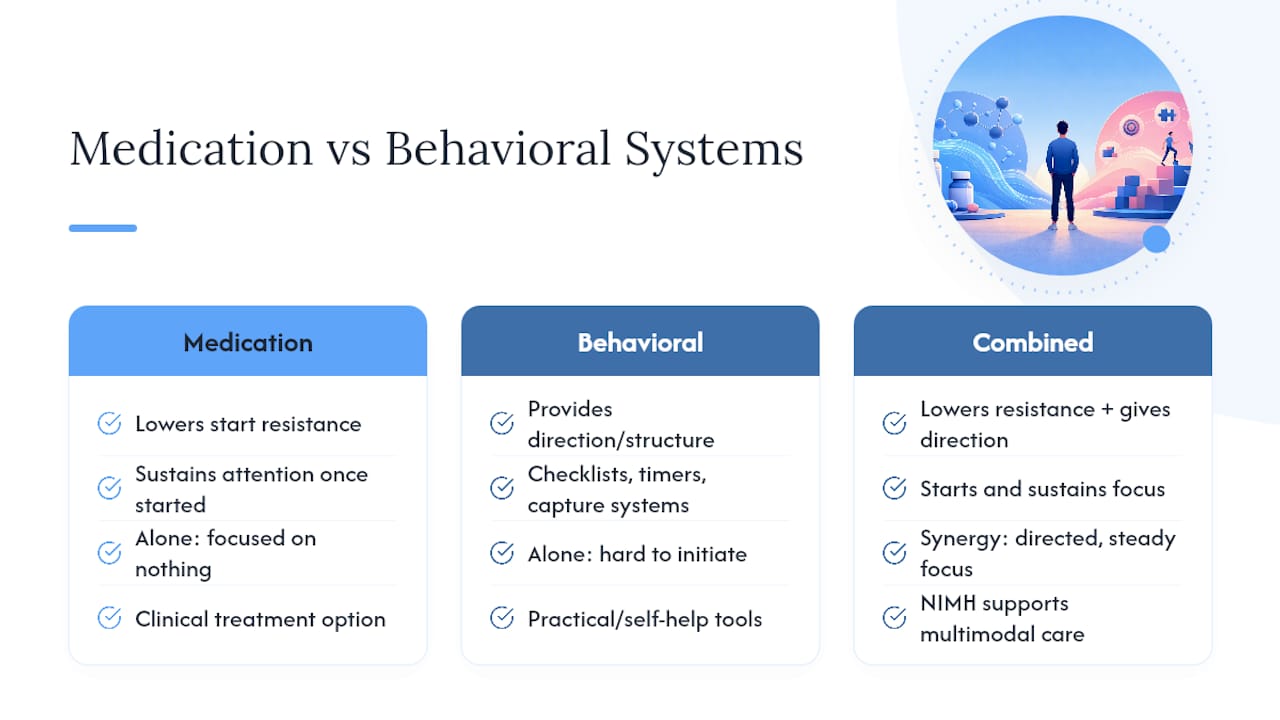
The National Institute of Mental Health supports multi-modal approaches that combine clinical care, which can include medication, with behavioral strategies, rather than treating either as sufficient alone. Whether medication is right for you, at what dose, and on what schedule is a conversation for a prescribing clinician, not a productivity article. What’s useful to know going in is that medication and the tactics above solve different halves of the same problem.
Specialized Apps and Technology Aids for ADHD Focus
Generic to-do apps often fail ADHD users because they assume reliable initiation and consistent daily engagement, exactly the two things ADHD makes inconsistent. Tools built around visible timers, gamified micro-rewards, and low-friction capture tend to hold attention longer than a plain checklist app.
Look for three features specifically: a built-in timer you can see without opening a separate app, a one-tap capture system for the thought-dump habit, and some form of reward or progress tracking that makes finishing a sprint feel like something rather than nothing. Signal not Noise builds its structure around exactly this pattern, breaking tasks into small steps with visible timers, as a self-guided companion to the habits in this article, not a replacement for clinical care.
Beyond dedicated ADHD apps, simple technology swaps help too: a smart speaker timer you can start by voice instead of unlocking your phone, browser extensions that block specific sites during work blocks, and calendar apps that send a notification at the exact appointment time you set for a task rather than a vague daily reminder.
Techniques for Addressing Procrastination
ADHD-related procrastination usually isn’t laziness. It’s what researchers describe as short-term mood repair, avoiding a task because starting it feels emotionally unpleasant right now, even when you know the delay will cost more later. The fix isn’t more willpower, it’s lowering the emotional cost of starting.
Shrink the task until the first step feels almost too easy to skip: not “write the report” but “open the document and type one sentence.” Pre-stage everything you can the night before, so morning-you doesn’t have to make any setup decisions while already dreading the task.
Use a body double or a public commitment, telling someone you’ll start at a specific time, to borrow accountability your own brain isn’t reliably supplying in the moment. And separate the decision to start from the decision to finish: give yourself permission to stop after one sprint, which makes starting far less intimidating than committing to finish the whole thing upfront.
Mindfulness and Meditation Practices Tailored for ADHD
Standard meditation advice, “just sit and focus on your breath for twenty minutes,” tends to backfire for ADHD brains, since it demands the exact sustained, unstructured attention that’s hardest to access. Structured behavioral strategies and mindfulness can both improve attention and inhibitory control over time, but the format matters more for ADHD than for neurotypical practitioners.
Shorter sessions work better than long ones: three minutes of focused breathing beats a fifteen-minute session abandoned halfway through from restlessness. Movement-based mindfulness, walking meditation, mindful stretching, or even washing dishes with full attention on the sensation, often lands better than seated stillness.

Use a guided audio track rather than silent meditation at first. Having a voice to follow reduces the mental wandering that silence invites. And treat noticing your mind wander as the actual practice, not a failure of it, since that repeated noticing is what builds the attentional muscle mindfulness is meant to train.
A Short Note From Ryan
The change that actually stuck for me wasn’t a big system, it was pre-staging my desk the night before, nothing else. Give yourself permission to try things imperfectly and drop what doesn’t fit. Your one step today: pick one tactic above and test it for ten minutes.
— Ryan
Try Signal not Noise for Micro-Step Focus Training
Life is a Game turns the tactics above into something you actually stick with, instead of a list you read once and forget. Signal not Noise breaks tasks into micro-steps, runs visible timers for your sprints, gives you a built-in parking lot for stray thoughts, and rewards each finished block so momentum builds instead of fizzling out. It’s a self-guided tool, not therapy, and it doesn’t treat, cure, or diagnose anything, it’s simply built around the same structure that makes bounded, externalized focus work in the real world.
If sleep and movement are part of your plan too, Improve Concentration in Two Weeks walks through the distraction and sleep side in more detail. When you’re ready to test the app itself, try one free micro-exercise inside Signal not Noise today and see if one sprint is enough to build momentum for the next.
Sources
This article is general information, not a substitute for advice from a qualified doctor. Consult a qualified healthcare professional about your own circumstances before acting on anything here.
FAQ
What Is the 1/3/5 Rule for ADHD?
It’s a task-planning method where you pick one big task, three medium tasks, and five small tasks for the day, giving your brain a bounded, visible structure instead of an open-ended to-do list.
What Are the 5 C’s of ADHD?
Definitions of this framework vary across sources and it isn’t a standardized clinical term, so treat any specific list of “5 C’s” you encounter as one author’s model rather than an established diagnostic category.
How Do You Calm Down ADHD in Adults?
Short bursts of movement, a paced breathing exercise, and naming the emotion out loud all interrupt an emotional spike faster than trying to think your way out of it, and pairing that with a brief break before returning to the task tends to work better than pushing through.
What Is the 10-3 Rule for ADHD?
It generally refers to taking a 3-minute break for every 10 minutes of focused work, a tighter ratio than standard Pomodoro sprints, useful for tasks that feel especially draining or unpleasant to start.
Can ADHD Focus Strategies Replace Medication?
No. Behavioral strategies and medication target different parts of the same problem, initiation and sustained attention, and the National Institute of Mental Health supports combining both rather than relying on either alone.