
Shrink One Fear: Comfort Zone Challenge with SUDS and 50% Rule

A comfort zone challenge is a structured, graded exposure plan, inspired by exposure principles, that shrinks one specific fear into small steps you can practice on purpose. It works by facing a manageable dose of the thing you avoid, staying with it until the anxiety eases, then repeating at a slightly harder level, using proven CELPIP test anxiety: overcome strategies that work for gradual practice and stepwise exposure. Your tiny first step today: pick one fear, rate how anxious just thinking about it makes you from 0 to 100, and write down the easiest possible version of facing it.
TL;DR:
- Starting exposures at a SUDS of 30 to 40 ensures they are challenging enough to provoke anxiety but manageable enough to maintain without backfiring.
- Staying in the exposure until distress drops by about 50 percent reinforces habituation and signals the brain updates its threat prediction.
- Repeating the same exposure across sessions and settings until your initial SUDS rating consistently decreases builds long-term confidence and reduces fear.
- Avoiding safety behaviors like distraction or reassurance during exposures is crucial; if they occur, re-expose without the safety behavior to maintain learning.
- Gamified tools enhance engagement with progress visualization and immediate feedback but should supplement, not replace, structured practice guided by clinical principles.
Table of Contents
- What makes a comfort zone challenge actually work?
- How do you build your own comfort zone challenge?
- What should you do if the exposure gets too hard or a compulsion sneaks in?
- Which app features actually help with exposure practice?
- My take: small wins compound faster than you expect
- Try one small step with a gamified exposure tool
- Sources
- FAQ
What makes a comfort zone challenge actually work?
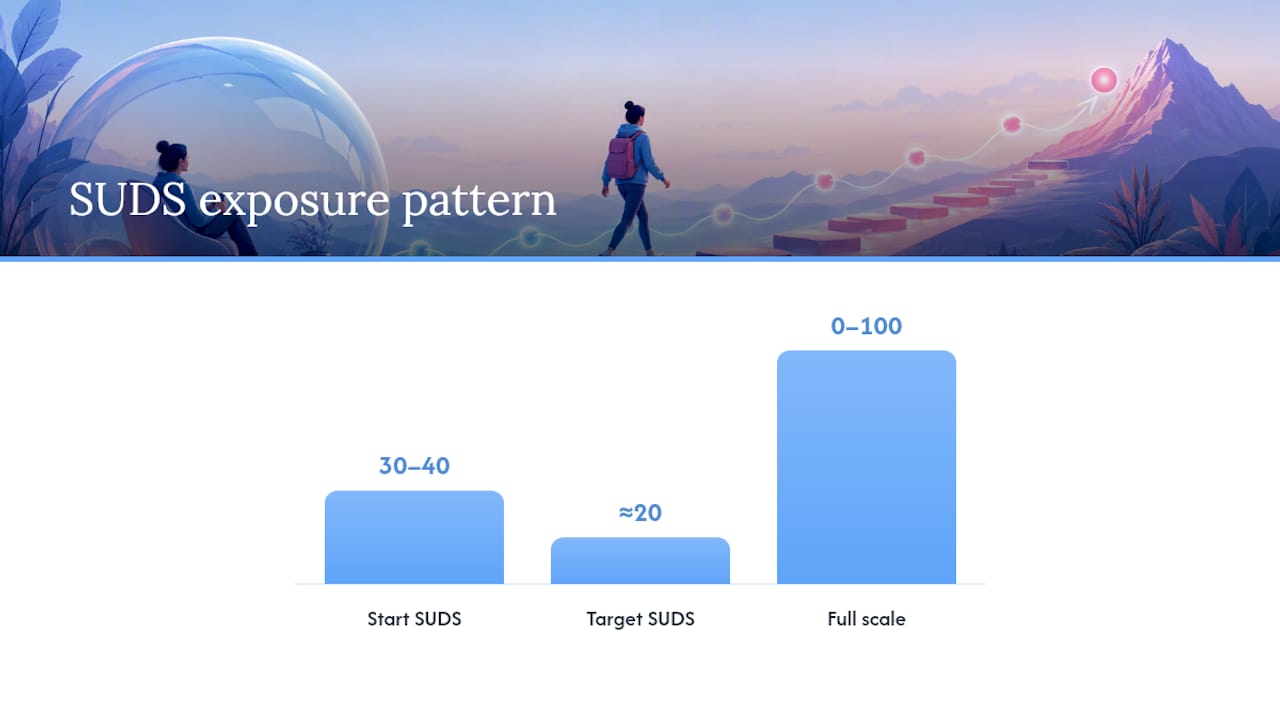
Fear fades through repeated, deliberate contact with it, not through white-knuckling your way past it once. Clinicians use the Subjective Units of Distress Scale, or SUDS, a 0 to 100 rating of how anxious a moment feels, to calibrate exposure so it’s hard enough to matter but not so hard it backfires. Guidance from Hertfordshire Partnership University NHS Foundation Trust suggests starting a graded exposure where your SUDS sits around 30 to 40. That’s the sweet spot: uncomfortable enough to trigger real anxiety, low enough that you can stay in it.
Staying is the whole point. The goal within a single exposure isn’t to feel nothing. It’s to remain until your distress drops by roughly 50% from where it started. That drop is what tells your nervous system the situation isn’t as dangerous as it feels, a process often called habituation, though newer models frame it as your brain updating a prediction it got wrong. Either way, you can’t skip the sitting-with-it part.
Repetition seals the lesson in. One good exposure rarely fixes a fear permanently. Guidance on exposure and response prevention from East London NHS Foundation Trust recommends repeating exposures across different contexts and tracking whether your starting SUDS rating for that step drops over time. A systematic review of gamified digital mental health tools backs this up from a different angle: engagement features help people show up consistently, but the actual reduction in fear still comes from how faithfully the exposure work follows these principles.
Quick reference:
- Start exposures at a SUDS of roughly 30–40, not higher.
- Stay until distress falls by about 50% from your starting point.
- Repeat the same step across sessions and settings until it stops spiking.
- Track your starting SUDS each time. A falling trend means the step is working.
How do you build your own comfort zone challenge?
Every comfort zone challenge starts with a fear ladder: a list of versions of your feared situation, ranked from mildest to worst. This is the single most useful document you’ll create in this whole process, and it takes about ten minutes.
- Name the fear specifically. Not “driving” but “driving on the highway during rush hour.” Not “phone calls” but “cold-calling someone I don’t know.”
- List 5 to 10 versions of it, easy to hard. For driving, that might run: sit in the parked car, drive around the block, drive to a nearby store, drive on a quiet road, drive on a two-lane highway, drive in light highway traffic, drive in rush hour. For phone calls: listen to a voicemail and don’t call back, listen and call back within an hour, make a low-stakes call to customer service, make a 1-minute call to someone new, hold a 5-minute conversation with someone new.
- Rate each rung on the SUDS scale. Ballpark is fine. You’re looking for the rung that lands around 30 to 40, not the easiest one on the list.
- Pick your starting rung and commit to a schedule. Aim for several practice sessions a week if your schedule allows it, based on the repetition guidance in ERP protocols. Fewer sessions still work; they just take longer to show a trend.
- Log before and after every session. Before-SUDS, after-SUDS, and one sentence about what you noticed. That single sentence often matters more than the numbers, because it’s where you catch yourself thinking “nothing terrible happened” instead of just feeling relieved it’s over.
A SUDS scoring guide can help if the 0 to 100 rating feels arbitrary at first. It gets more intuitive after two or three sessions.
Pro Tip: Don’t jump rungs just because one session went well. Repeat the same rung until your starting SUDS for it drops noticeably, usually two or three sessions, before moving up. Climbing too fast is the most common way people stall out.
If your fear involves other people, whether it’s phone calls, presentations, or approaching strangers, a gamified four-week structure for social exposures shows how the same ladder logic adapts to social situations specifically.
What should you do if the exposure gets too hard or a compulsion sneaks in?
The biggest way people sabotage their own comfort zone challenge is unintentional: they lean on safety behaviors. A safety behavior is anything that makes the exposure feel safer without actually facing the fear, like gripping the wheel with white knuckles instead of driving normally, having someone else make the call for you, or silently repeating a reassuring phrase throughout. Practitioner guidance is blunt about this: safety behaviors blunt the learning process because your brain credits the crutch, not your own coping, for getting you through.
Watch for these common ones:
- Distracting yourself the entire time instead of staying present with the discomfort.
- Asking someone to accompany you “just in case.”
- Checking your phone, escape routes, or exits obsessively during the exposure.
- Seeking reassurance from someone else right before or during the step.
If a compulsion or safety behavior slips in anyway, the fix is straightforward. Re-expose to that same step, without the compulsion this time, and stay until your distress drops by about 50% from that restart point, per ERP guidance on undoing compulsions. This preserves the learning curve instead of letting the compulsion count as progress it isn’t.
If an exposure becomes genuinely overwhelming, not just uncomfortable, slow down. Break the current rung into a smaller version. Ground yourself with slow breathing while staying in the situation rather than leaving it, since leaving mid-exposure teaches your brain the opposite lesson you want. If panic attacks, contamination fears, or intrusive thoughts feel unmanageable even at small steps, that’s a signal to loop in a clinician rather than push through alone.
Pro Tip: Grounding yourself with a few slow breaths is fine. Using those breaths as an excuse to leave the situation early is not. The difference is whether you stay through the discomfort or use the technique to escape it.
Which app features actually help with exposure practice?
Not every gamified feature pulls its weight. Research on gamification in digital mental health interventions found that progress visualization, immediate feedback, and narrative milestones meaningfully boost engagement and follow-through, while points-only leaderboards tend to add novelty without much staying power.
The features worth using:
- Progress visualization, so you can see your SUDS ratings trending down across sessions instead of relying on memory.
- Immediate feedback right after logging a session, reinforcing the connection between practice and improvement.
- Adaptive difficulty, which nudges you to the next rung when you’re ready instead of guessing.
- Narrative milestones that frame small wins as real progress, not just checkboxes.
Use these to support the clinical rules, not replace them. A gamified layer that rewards you for skipping steps or leaving early is working against the exposure, not for it. Conquer Fear organizes exposure practice this way, as a self-guided tool inspired by exposure principles, not a substitute for therapy or a clinical diagnosis, with matching fear pages for specific triggers like driving, phone calls, or public speaking.
My take: small wins compound faster than you expect
The first exposure step I ever tracked seriously wasn’t dramatic. It was a two-minute phone call I’d been avoiding for a week, and my SUDS dropped from about 45 to 20 in that one sitting. Nothing about that felt like a breakthrough. It felt like relief.
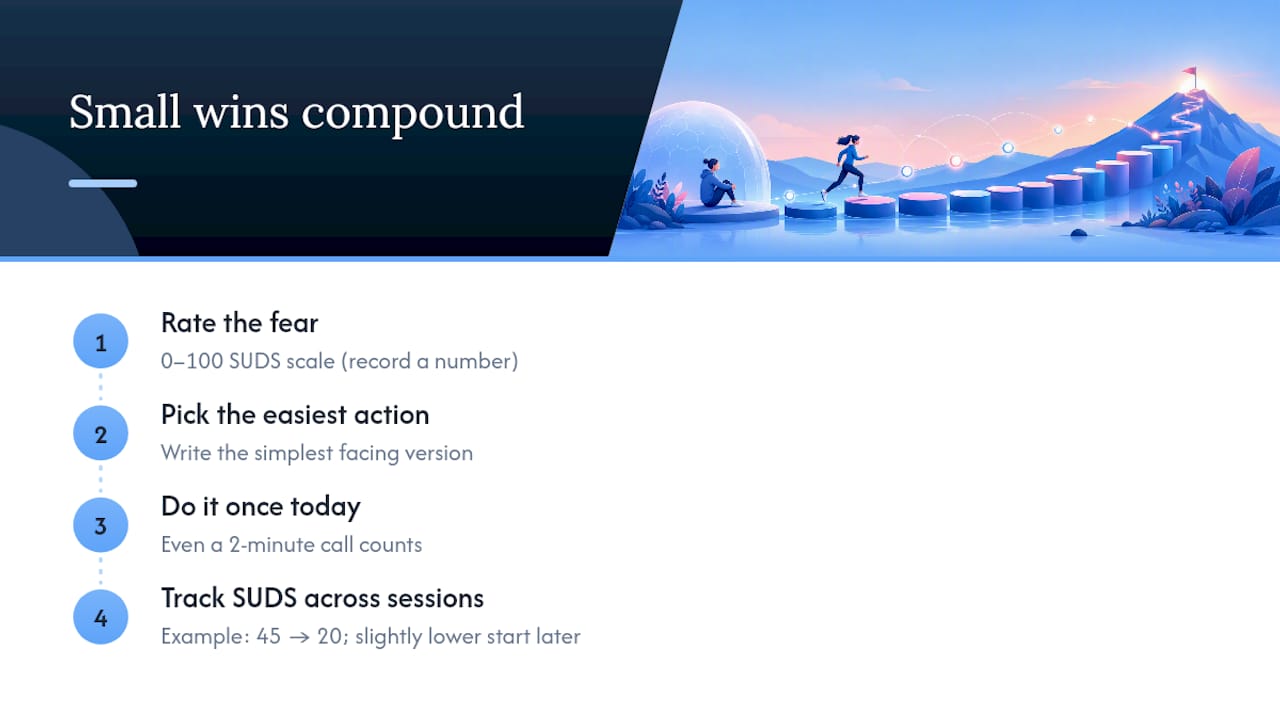
That’s the part people underestimate. Progress in a comfort zone challenge rarely feels big in the moment. It shows up as a slightly lower starting number three sessions later, and you only notice it if you’re writing the numbers down. Repetition is doing more work than willpower ever will.
Your next move doesn’t need to be impressive. Rate one fear on a 0 to 100 scale right now, write down the easiest version of facing it, and do that version once today.
— Ryan
Try one small step with a gamified exposure tool
Building your own fear ladder and logging SUDS scores by hand works, but it’s easy to lose track after a few sessions. Life is a Game turns that same graded exposure structure into a guided, gamified format so you don’t have to build the tracking system yourself.
Its fear-specific programs, from driving to phone calls to public speaking, break each fear into small rungs, prompt you before and after each session, and visualize your progress so a dropping trend is obvious instead of buried in a notebook. These are self-guided tools, inspired by exposure principles, not therapy and not a diagnosis, are built for people who want structure without committing to a clinical program first. If your fear is more about mental noise than a specific trigger, Signal not Noise applies a similar step-by-step approach to focus instead. Open Life is a Game and try one tiny challenge today, just the first rung, nothing more.
Sources
- Hertfordshire Partnership University NHS Foundation Trust — Talking Therapies / Exposure guidance
- East London NHS Foundation Trust — Exposure and response prevention (ERP) guidance
- The role of gamification in digital mental health interventions (PMC article)
FAQ
What is a comfort zone challenge?
It’s a structured, graded exposure plan that breaks one specific fear into small, ranked steps you practice repeatedly, starting with a manageable step and working upward as your anxiety around it drops.
What SUDS score should I start with?
Guidance from Hertfordshire Partnership University NHS Foundation Trust suggests starting where your distress rating is around 30 to 40 on the 0 to 100 SUDS scale, hard enough to matter, manageable enough to stay with.
How long should I stay in an exposure?
Stay until your distress drops by about 50% from where it started, not until it hits zero. That drop is what signals your brain is updating its prediction about the situation.
How often should I practice?
Aim for 4 to 5 sessions a week if your schedule allows, based on repetition guidance in exposure and response prevention protocols. Fewer sessions still work, they just take longer to show a clear trend.
What if I use a safety behavior without meaning to?
This keeps the learning intact instead of letting the compulsion count as progress.
Can a gamified app replace therapy?
No. Tools like Life is a Game are self-guided and inspired by exposure principles, useful for practicing structured steps on your own, but they aren’t therapy and can’t diagnose a condition. Talk to a clinician if a fear feels unmanageable even at small steps.