
Gym anxiety: how to actually start going (a step by step plan)
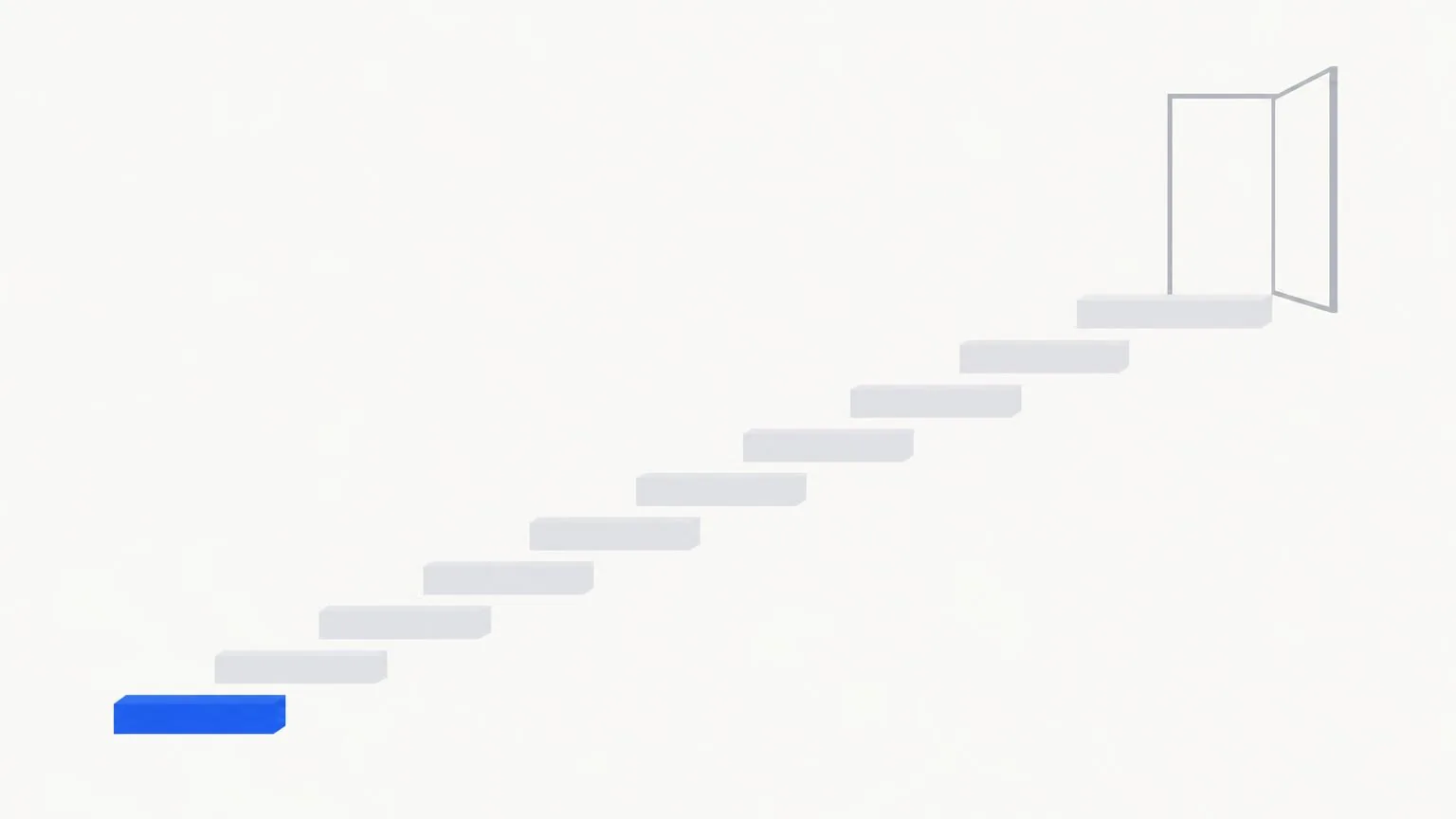
If gym anxiety keeps you out, the fix is not a better list of tips. It's splitting "go to the gym" into ten or so small visits, in order, from sitting in the car park to training at the busiest hour, and only moving up when the current one feels dull. Rate your fear from 0 to 10 before and after each visit so you can see what is actually changing.
Why the tips don't get you through the door
Search "gym anxiety" and you get the same list on almost every page. Go off-peak. Bring a friend. Plan your workout. Wear headphones. Watch videos of the machines first. Book an induction.
None of that is wrong. Most of it is good. The trouble is that every tip is something you do once you're already going, and the problem is that you're not going. You can have a plan, a playlist and a friend lined up and still sit at home on Monday evening, because the thing you're facing is still one giant step: walk into a room full of strangers, not know what you're doing, and do it anyway for an hour.
You are not unusual for finding that hard. PureGym's own research found that "50% of non-gym members say they find the idea of going to the gym scary", with one in five saying very scary. That's a gym chain's survey and it doesn't publish a sample size, so read it as a rough sense of scale rather than a precise figure. In the same report, 48% said they were too embarrassed to ask other gym-goers for help.
The tips list
- Go off-peak
- Bring a friend
- Have a plan
- Wear headphones
- Watch the machine videos
Still one step. Still a big one.
The ladder
- 1Sit in the car park for five minutes
- 2Ask reception for a timetable
- 3Use the changing room, leave
- 4Ten minutes on a bike, quiet hour
- 5Cardio plus one machine
- 6One dumbbell exercise
- 7Ask someone one question
- 8Same routine, an hour nearer peak
- 9Drop one prop
- 10Full session at peak time
Rate 0 to 10 before and after. Move up when it's boring.
The ladder instead
A ladder is a list of visits, each a bit harder than the last. You start with one that's almost too easy, repeat it until your fear rating before it is low and boring, and then move up one rung. You don't skip rungs because a good day made you brave.
Here's an example. Yours might look different. If your worst bit is the changing room, that gets its own rungs. If it's the free-weights area, that gets three.
| Rung | What you do | What makes it harder next time |
|---|---|---|
| 1 | Go to the gym and sit outside or in the car park for five minutes. Watch people go in. Go home. | Stay ten minutes, close enough to see the door. |
| 2 | Walk in, ask reception for a timetable or a quick look round, leave. | Go at a busier time of day. |
| 3 | Go in, use the changing room, fill your water bottle, leave without training. | Change into your gym kit there instead of arriving in it. |
| 4 | Ten minutes on a bike or treadmill at a quiet hour. | Pick a machine that faces the room, not the wall. |
| 5 | Twenty minutes of cardio, then one resistance machine you've looked up first. | Choose a machine you have to adjust, with someone nearby. |
| 6 | One dumbbell exercise in the free-weights area, quiet hour. | Three sets instead of one, standing where people walk past. |
| 7 | Ask one question: a staff member how a machine adjusts, or someone if they're using the bench. | Ask another gym-goer rather than staff. |
| 8 | Your rung 6 routine, one hour closer to the busiest time. | Another hour closer. |
| 9 | The same routine, with one of your props dropped (see below). | Drop the next one. |
| 10 | A full planned session at peak time, logged. | Use the busy kit, like the squat rack, and wait your turn for it. |
This is the same shape as the worked gym ladder on our fear pages, stretched out at the bottom. The first two rungs look silly written down. They're there because a lot of people's real first barrier is the car park, and a plan that starts at "ten minutes on the treadmill" has already skipped it.
Rate it before and after
Before each visit, give your fear a number from 0 to 10. Afterwards, give it another. Write both down.
Say rung 4 is a 7 before and a 4 after. That gap is the information. You expected a 7 and got through it. Next time, the before number tends to come down too, and when it's sitting around 2 or 3 and the visit feels a bit pointless, that's your sign to move up. If you want more on how this number works, we wrote a plain guide to the 0 to 10 scale.
Two or three visits a week is a sensible pace. Small and often beats one heroic Saturday.
The tips that turn into props
Here's the part most tip lists miss. Some of those tips are useful on day one and quietly become the only way you can go. Common ones:
- Headphones in, always, so nobody can talk to you.
- Only ever going at the quietest hour.
- Only going if your friend comes.
- Always the corner treadmill, facing the wall.
- Checking the gym app's busy chart and staying home if it looks busy.
- Wearing the baggiest kit you own, every time.
- Skipping the changing room and leaving straight after.
None of these is a problem in itself. Lots of confident gym-goers wear headphones. The test is simple: could you go without it? If the honest answer is no, it has stopped being a preference and become part of what keeps the fear going, because you never find out what happens without it.
So make dropping each one a rung of its own. Leave the headphones in your bag for the first ten minutes. Go once when the busy chart says busy. Go once without your friend. One at a time, and rate it like any other step. We've written more about why these props keep a fear going.
If you're starting in January
If you're reading this in November or December and planning a January start, that's fine. Just know that you'll be starting alongside everyone else who made the same plan, so the "quiet hour" might not be very quiet. If you can, do rungs 1 to 3 in December. Then January's crowd becomes a later rung you're ready for, not the first thing you meet.
When a gym is not the answer
Be honest with yourself about what the fear is really about.
If the worry is mostly about your weight or shape, or exercise feels like something you owe after eating, a ladder into the gym can make things worse rather than better. The NHS lists "spending a lot of time worrying about your weight and body shape" and "exercising too much" among the signs of an eating problem, and says to see a GP as soon as you can if you think that's you. The charity Beat also runs a helpline on 0808 801 0677. The same goes if you spend a lot of time comparing your looks with other people's or checking mirrors: the NHS describes those as signs worth talking to a GP about.
In those cases, the gym can wait. A GP comes first.
And the gym isn't compulsory. If you'd be happier walking, swimming or doing a video at home, that counts. This plan is for people who want to go and can't make themselves, not a rule that everyone should.
If you have a health condition
The NHS advises getting advice from a healthcare professional, such as a GP, before starting new exercise if you have a health problem or injury, have had a recent heart attack or operation, are pregnant or have recently given birth, or aren't sure the exercise suits your fitness. It also says to stop straight away if you feel pain or become unwell. Most gyms offer an induction, and it's worth taking. It also works as an early rung, because a staff member is expected to talk to you.
Where Conquer Fear fits, and where it doesn't
We make Conquer Fear, so read this part as interested rather than neutral.
You tell it your goal, say "train at the gym three times a week", and the fear in the way. It writes a ladder of small real-world steps for that exact fear and shows you one step at a time. You rate your fear 0 to 10 before and after each attempt. If you turn up but don't finish, that's logged as partial, not as failure. If a step feels too big there's a "Make it smaller" option, and if you've tried a step twice without finishing it, the app offers to split it for you. The free tier gives you one ladder and its first three steps. Premium is £9.99 a month or £49.99 a year, with a 7 day free trial on the annual plan. It's on the App Store.
Where it's not the right choice:
- It won't tell you what exercises to do or how to use the machines. An induction, a session with a personal trainer, or the gym's own videos are better for that.
- It's iOS only, so no Android.
- It needs a connection, and it doesn't pace you to a date.
- If eating or body image is part of this, see the section above first. An app is not the right starting point.
- If a paper list and a pen keep you honest, the table above does the same job for free.
Sources
All checked 24 October 2026.
- PureGym, gym fear and intimidation report (published 25 October 2023; survey sample size and dates not stated): https://www.puregym.com/blog/gym-fear-intimidation-report/
- NHS, Eating disorders overview: https://www.nhs.uk/conditions/eating-disorders/ (redirects to the NHS eating disorders overview)
- NHS, Body dysmorphia: https://www.nhs.uk/mental-health/conditions/body-dysmorphia/
- NHS, Strength and Flex exercise plan (advice on checking with a healthcare professional): https://www.nhs.uk/live-well/exercise/strength-and-flex-exercise-plan-how-to-videos/
Conquer Fear is a self-help tool inspired by exposure principles. It isn't therapy or medical care, and it is not intended to diagnose, treat, cure or prevent any disease. If fear or anxiety is affecting your daily life, check with your GP or a qualified professional.