Label, Breathe, Return: Micro Skills to Calm Intrusive Thoughts

Intrusive thoughts are common, and the best immediate move is not to fight them but to label them and ground yourself, then return to what you were doing. Naming the thought as “just an intrusive thought” and doing 30 seconds of grounding or paced breathing calms the spike faster than trying to reason it away, a key strategy in mindfulness depression treatment. For thoughts that keep interfering with daily life, Cognitive Behavioral Therapy and Exposure and Response Prevention are the treatments with the strongest track record, and a therapist is worth calling if the thoughts are stealing hours from your day.
TL;DR:
- Ground yourself with a sensory exercise or paced breathing immediately after identifying an intrusive thought to reduce its intensity.
- Avoid suppression or reassurance-seeking, as these strategies tend to reinforce intrusive thoughts, especially in conditions like OCD and anxiety disorders.
- Use graded exposure, tracking distress levels with SUDS ratings, and resist safety behaviors to gradually weaken the power of triggers.
- Practice labeling thoughts daily and rehearse simple scripts to build automatic responses for managing distress during episodes.
- Seek professional help when intrusive thoughts significantly disrupt daily life, consume excessive time, or involve urges to harm oneself or others.
Table of Contents
- How to Handle Intrusive Thoughts in the Moment
- What Are CBT, ERP, and ACT, and How Do They Work?
- Why Do Intrusive Thoughts Happen?
- When Should You Get Professional Help?
- Common Myths About Intrusive Thoughts
- Practitioner Tips: Building a Safe Self-Practice Routine
- A Note From Ryan
- A Structured Way to Practice Between Sessions
- Where to Read More
- Sources
- FAQ
How to Handle Intrusive Thoughts in the Moment
The urge to fight an intrusive thought is exactly what keeps it circling back. What actually works is a short sequence you can do anywhere, in under a minute, without anyone noticing.
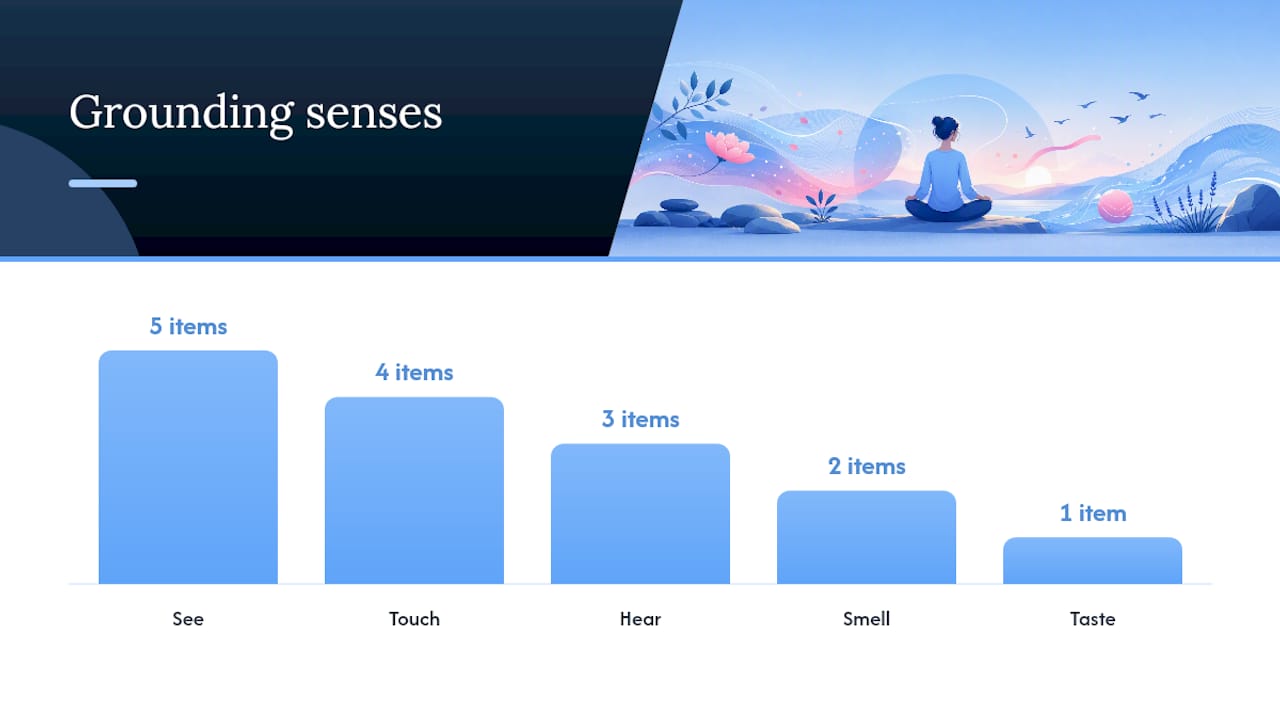
Start by naming it. Say to yourself, silently or out loud, “I’m noticing an intrusive thought.” This is a defusion technique: it puts a small gap between you and the thought instead of treating it as a fact you have to respond to. From there, ground your body. The 5-4-3-2-1 method works well here: notice five things you can see, four you can touch, three you can hear, two you can smell, one you can taste. Pair it with 4-4-8 breathing, four seconds in, four seconds held, eight seconds out, which slows the physical alarm bell that makes the thought feel urgent.
Two behavioral rules make this stick over time:
- The 50% rule: if the urge is to avoid something completely, do half of it instead. Skip a full retreat and stay in the situation a little longer than feels comfortable.
- Float, don’t fight: let the thought sit there without acting on it, responding to it, or trying to push it out. It will lose intensity faster than you expect.
Micro-exposures build on this. Deliberately tolerate a small dose of the anxiety, on purpose, for a set amount of time, without doing anything to neutralize it. That means resisting the pull toward safety behaviors, checking rituals, or reassurance from someone else. Reassurance-seeking feels like relief in the moment, but it trains the brain to keep asking, which strengthens the whole cycle.
A few scripts worth rehearsing before you need them:
- “This is a thought, not a warning.”
- “I don’t have to solve this right now.”
- “Noted. Back to what I was doing.”
Pro Tip: Practice your labeling script out loud once a day, even when you’re calm. Rehearsal builds a habit that fires automatically when distress actually hits, instead of you trying to invent the right words mid-panic.
What Are CBT, ERP, and ACT, and How Do They Work?
Three therapies dominate the evidence base for intrusive thoughts, and each targets a slightly different piece of the problem.
Cognitive Behavioral Therapy (CBT) examines the thinking patterns that turn a passing thought into a spiral, and it teaches you to catch and challenge those patterns before they take over. Exposure and Response Prevention (ERP) is the specific tool most often used for OCD-type intrusions: you face the trigger deliberately while blocking the compulsive response that usually follows. Acceptance and Commitment Therapy (ACT) takes a different angle. Instead of arguing with the thought’s content, it works on your relationship to the thought, building tolerance so the thought loses its grip even if it never fully disappears.
ERP in practice looks like this:
- Build a graded exposure ladder, ranking triggers from mildly uncomfortable to highly distressing.
- Track your distress on a 0 to 10 SUDS (Subjective Units of Distress Scale) before and after each exposure.
- Practice response prevention, resisting the ritual or avoidance that normally follows the trigger.
- Log homework between sessions so your therapist can adjust the pace.
A typical pathway starts with an assessment, moves into guided exposures in session, and then assigns homework you repeat on your own. Progress usually shows up as lower SUDS ratings on the same trigger over repeated tries, not as the thoughts vanishing outright. Medication sometimes supports this work as an adjunct, and ERP can be as effective as medication for many people with OCD, though any medication decision belongs to you and a prescriber, not a self-help guide.
To find a qualified clinician, look for someone who specifically lists ERP or exposure therapy, not just general talk therapy. Teletherapy directories and OCD-specialty clinics both list ERP-trained providers, and understanding how CBT actually works beforehand makes the first session less intimidating.
Why Do Intrusive Thoughts Happen?
Intrusive thoughts are automatic mental events. Everyone’s brain generates them, but anxiety, stress, and poor sleep turn the volume up, making a stray thought feel like a threat instead of noise.
They show up more often alongside certain conditions: OCD, generalized anxiety disorder, and PTSD are the most closely linked, and depression and ADHD can amplify them too. Sleep loss and hormonal shifts, including postpartum changes, are common triggers worth watching for.
Here is the trap: trying to suppress a thought, or seeking reassurance that it isn’t true, backfires. This is the classic “white bear” effect, first demonstrated when people told not to think about a white bear thought about it more, not less, and the same pattern shows up with intrusive thoughts. Understanding this mechanism matters because it tells you which strategy to skip (suppression, reassurance) and which to lean into (labeling, tolerance).
When Should You Get Professional Help?
Some signs mean it is time to bring in a clinician rather than manage this alone:
- Rituals or checking behaviors are eating up an hour or more of your day.
- You are avoiding places, people, or responsibilities because of the thoughts.
- The distress feels severe, constant, or is getting worse over weeks.
- You feel any urge to act on a thought that could hurt yourself or someone else.
That last one is urgent, not optional. If safety feels at risk in any way, call your local emergency services immediately, or in the United States, call or text 988 for the Suicide and Crisis Lifeline. That line is available right now, day or night.
When you do sit down with a clinician, come ready to describe frequency (how often, roughly), common triggers, any compulsive behaviors you have developed in response, how much the thoughts are disrupting work or relationships, and any urges tied to the thoughts. Specialist OCD clinics, ERP-trained therapists, and teletherapy platforms are all reasonable starting points.
Common Myths About Intrusive Thoughts
Shame keeps a lot of people quiet about this, usually because of a myth that does not hold up.
- Myth: a thought reveals your real intent. Reframe: a thought is a mental event your brain produced, not a decision you made or a preview of your character.
- Myth: suppressing or seeking reassurance about the thought resolves it. Reframe: non-engagement and gradual tolerance reduce the thought’s grip; fighting it or seeking reassurance keeps the cycle running.
- Myth: you have to feel ready before you practice. Reframe: rehearse a short script, “Thank you, mind, not now,” and a one-line reminder of what you actually value doing today.
Track small wins as they happen. A day where you noticed a thought and kept moving anyway counts, even if the thought showed up five times.
Practitioner Tips: Building a Safe Self-Practice Routine
A well-built exposure ladder does not need to be dramatic. Something like 30 to 60 minutes of planned practice per week, broken into small steps, is enough to start seeing your SUDS ratings drop on repeated exposures.
- Pick one trigger and rank three or four versions of it from mildly uncomfortable to genuinely hard.
- Record your SUDS score before and immediately after each attempt.
- Skip the safety behaviors, no checking, no seeking reassurance mid-exposure, even when it is tempting.
- Repeat the same step until the distress consistently drops before moving up the ladder.
A structured app can help here by prompting the practice, logging the SUDS numbers, and keeping a record of what you actually attempted between sessions. That kind of tracking is useful precisely because memory is unreliable when you are anxious. It is worth being direct about the limits, though: an app inspired by exposure principles is a self-guided support tool, not therapy, and it does not diagnose or cure anything.
That single data point is often more convincing than any explanation of why exposure works.*
A Note From Ryan
This work is genuinely uncomfortable at first, and it should get easier gradually, not overnight. Give one micro-skill, like labeling plus a single paced breath, a real week of daily practice before judging whether it helps. Try it the next time a thought hits: name it for 30 seconds, take one slow breath, then get back to whatever you were doing. That is the whole first step.
— Ryan
A Structured Way to Practice Between Sessions
Reading about exposure therapy is one thing. Actually running the exercises consistently, without ducking the hard parts, is where most people stall out. Conquer Fear is built around that gap: it breaks a specific fear into small, ordered steps, prompts you to log your SUDS rating before and after each attempt, and keeps a record of what you actually tried between one practice session and the next.

Such apps can work alongside therapist-led ERP for people who already have a clinician, providing the therapist a between-session record to review with consent. They also offer a starting point for someone not yet in therapy who wants to try structured practice inspired by exposure principles before deciding on next steps. These are self-guided tools, not therapy, and do not diagnose, treat, or replace professional care. If your specific struggle is something like driving, flying, or talking to strangers rather than OCD-style intrusions, the fear-specific pages inside the app walk through the same step-based approach. Try one short exercise inside the app this week and see what your SUDS numbers actually do.
Where to Read More
For deeper clinical grounding, Harvard Health’s overview covers the “white bear” suppression effect and when to seek care. Cleveland Clinic offers concrete self-help steps and crisis guidance. The NIMH overview of OCD explains diagnostic criteria, and the PMC clinical review breaks down how CBT and ERP perform in treatment.
This article is general information, not a substitute for advice from a qualified doctor. Consult a qualified healthcare professional about your own circumstances before acting on anything here.
Sources
- Managing intrusive thoughts — Harvard Health Publishing
- PMC review on CBT/ERP effectiveness (systematic/clinical review)
- How to stop intrusive thoughts — Cleveland Clinic
- Obsessive-compulsive disorder overview — NIMH
FAQ
How do you calm down from intrusive thoughts?
Label the thought as “just an intrusive thought,” then ground yourself with the 5-4-3-2-1 sensory exercise or 4-4-8 paced breathing before returning to your task.
What causes repetitive thoughts?
Repetitive thoughts are often driven by anxiety, stress, or fatigue, and they are common in OCD, generalized anxiety disorder, and PTSD; trying to suppress them tends to make them louder, not quieter.
What are obsessive thoughts?
Obsessive thoughts are unwanted, recurring thoughts that cause distress and often trigger compulsive behaviors aimed at relieving that distress, a pattern central to OCD.
How do I stop obsessing over the same thought?
Stop trying to push the thought out directly. Instead, let it float without responding to it, skip reassurance-seeking, and practice brief planned tolerance of the discomfort, the same approach used in ERP.
Does Life is a Game offer help for intrusive thoughts?
Conquer Fear offers self-guided, step-based exposure practice inspired by exposure principles, useful alongside or before professional ERP, though it does not diagnose or replace therapy. Current pricing details are listed on the app’s own page.