
Start in 60 Seconds: Self Compassion Exercises with Micro Scripts

Start with three moves today: a 60-second Self-Compassion Break, a one-minute “what would I tell a friend” script, and a hand-on-heart gesture paired with one kind phrase. Together they interrupt harsh self-talk and speed emotional recovery after a mistake or setback. Pick one, do it right now for sixty seconds, and notice what shifts before you read further.
TL;DR:
- Self-compassion exercises work best when practiced regularly, ideally by pairing two micro-practices with daily routines over at least two weeks.
- The Self-Compassion Break involves three simple steps—acknowledging pain, recognizing shared experience, and offering kindness—that can be done in under a minute.
- Writing a supportive letter to oneself and using compassionate scripts to reframe inner critics can deepen self-kindness and reduce harsh self-talk over time.
- Physical gestures like hand on heart or self-hugs paired with slow breathing provide quick relief during intense emotional moments, especially if touch feels comfortable.
- These exercises are supportive tools for emotional recovery but are not substitutes for professional mental health treatment when dealing with persistent or severe mental health issues.
Table of Contents
- 8 Self-Compassion Exercises To Try Today
- How Would You Treat a Friend? Exact Steps and Scripts
- The Self-Compassion Break: Three Steps, Several Phrasings
- Writing a Compassionate Letter to Yourself
- Soothing Touch and Grounding for Fast Relief
- Reframing the Inner Critic Into Something Useful
- A 5-Minute Loving-Kindness Script for Self-Compassion
- Making Self-Compassion a Habit, Not a Rescue Tool
- What Self-Compassion Practice Can’t Do
- Starting Small and Staying With It
- Building the Habit With a Little Structure
- Sources
- FAQ
8 Self-Compassion Exercises To Try Today
Each of these draws on the same three-part model Kristin Neff built her research around: self-kindness, common humanity, and mindfulness. You do not need all eight. Pick two, use them for two weeks, then add more.
- How would you treat a friend? — Reveals the gap between how gently you’d talk to someone else and how harshly you talk to yourself.
- Self-Compassion Break — The classic three-step mindfulness, common humanity, self-kindness sequence for acute stress.
- Compassionate letter — Writing to yourself as a caring friend would, which reduces self-judgment.
- Soothing touch — Hand on heart or a self-hug to calm physical arousal.
- Reframing the inner critic (5 to 10 minutes) — A four-step drill that turns criticism into usable feedback.
- Loving-kindness (metta) script — Structured phrases that build warmth toward yourself and others.
- Journaling prompts for compassion moments — Tracking when you were kind to yourself, so the pattern becomes visible.
- Grounding plus compassionate phrase — Three slow breaths paired with one steadying sentence.
None of these require a meditation cushion or an hour of free time. The shortest ones fit into a bathroom break.
How Would You Treat a Friend? Exact Steps and Scripts
Pick one recent event where you were hard on yourself. Maybe you fumbled a sentence in a meeting or forgot to follow up with a client. Write down exactly what you said to yourself about it.
Now write what you would say to a close friend in the identical situation. Most people notice the friend-version is warmer, more forgiving, and more useful. Comparing the two responses exposes just how much harsher your internal voice is than your external one, and that contrast is the whole point of the exercise.
Sample script: “You messed up. That’s rough, but one mistake doesn’t undo everything you’ve built. Take a breath, fix what you can, and move on.”
60-second micro-version: Ask yourself one line, out loud if you can: “What would I say to someone I care about right now?” Say the answer to yourself in second person, as if a friend were speaking it.
Use this after mistakes, before a hard conversation, or anytime the inner monologue turns cruel. It works because it borrows a skill you already have. Most people are far better at extending kindness outward than inward, so this exercise redirects an existing strength instead of building one from scratch.
The Self-Compassion Break: Three Steps, Several Phrasings
This is the most studied of the bunch, and for good reason. The Self-Compassion Break runs on three fixed steps, each roughly one sentence.
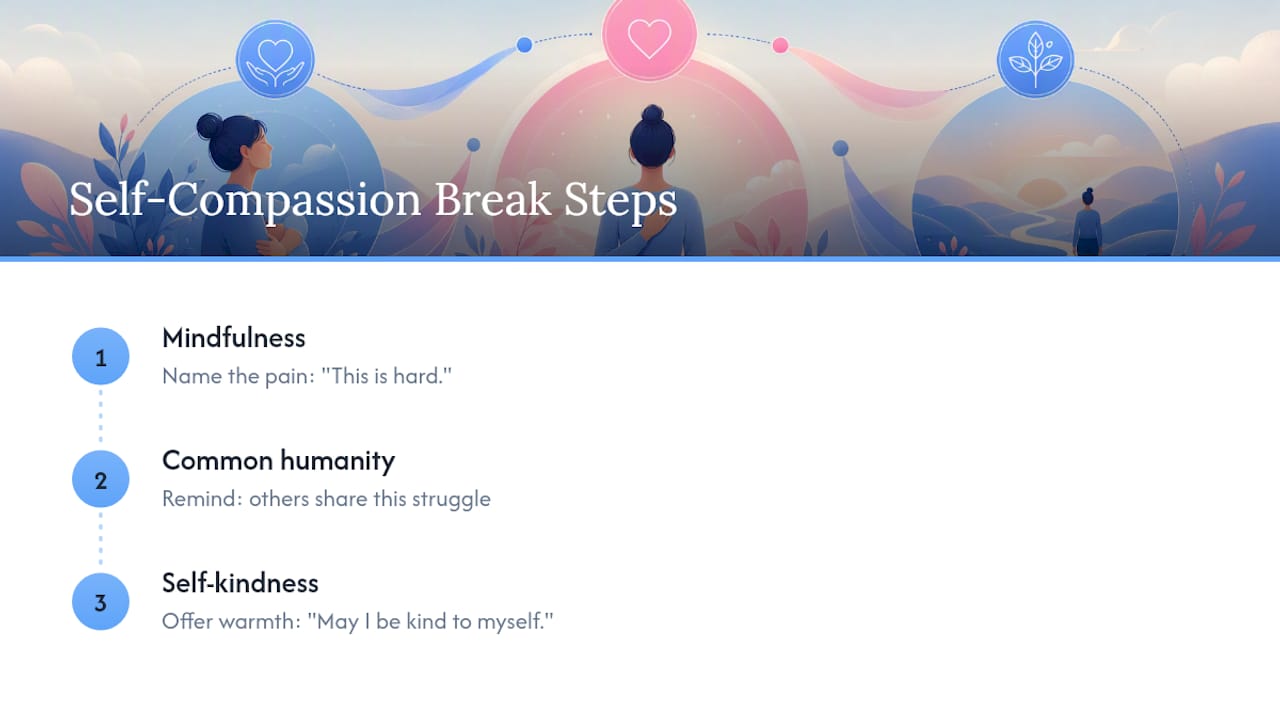
Step 1, mindfulness: Name what’s happening. “This is hard.” Or: “This hurts right now.” The point is acknowledging pain without dramatizing or minimizing it.
Step 2, common humanity: Remind yourself suffering is shared. “Other people feel this exact thing.” Or: “I’m not the only one who struggles with this.”
Step 3, self-kindness: Offer yourself something warm. “May I be kind to myself.” Or simply: “It’s okay to be gentle with myself right now.”
Place a hand over your heart, or cross your arms and squeeze your own shoulders, while you say the three lines. The gesture matters. Add three slow breaths if you have the extra thirty seconds. The whole thing runs about five minutes when done slowly, or under a minute in a rushed moment.
Practice it once daily in a calm moment first, so the sequence feels familiar before you need it during an actual spike of stress.
Writing a Compassionate Letter to Yourself
Set a timer for fifteen minutes and write a letter to yourself about a specific struggle, from the perspective of someone who loves you unconditionally and understands exactly what you’re going through. The self-compassionate letter works because it borrows the same perspective shift as the friend exercise, but goes deeper because writing forces you to slow down.
Full version prompts:
- Describe the situation honestly, without editing for how it makes you look.
- Write what an unconditionally loving friend would understand about why this is hard for you.
- Offer supportive, specific advice, the way that friend would.
Read the letter back to yourself, out loud if you’re alone. That step matters almost as much as writing it.
5-minute micro-version: Write three sentences only. What happened, why it’s understandable, and one kind thing to do next. Read it aloud once.

Full letters work best weekly, tied to whatever struggle is loudest that week. The micro-version can run daily, especially paired with a journaling habit through an app like Groundwork, which structures short reflective writing into a repeatable routine.
Soothing Touch and Grounding for Fast Relief
When you’re mid-panic, mid tears, or just overwhelmed, thinking your way to calm rarely works. The body needs a signal first. Soothing touch gives it one.
Gestures that work:
- Hand flat on the chest, over the heart.
- Both arms wrapped around yourself, a slow self-hug.
- One hand cupped over the other on your lap.
- A gentle hand on your own cheek.
Combined script: Place your hand on your heart. Breathe in for four counts, hold for two, exhale for six. Do that three times. On the third exhale, say quietly: “I’m allowed to feel this. I’m not alone in it.”
This combination works best during acute overwhelm, before a feared event like a presentation or a hard phone call, or right after something goes wrong. If touch itself feels uncomfortable or triggers distress rather than easing it, skip the physical contact and use the breathing and phrase alone. Not everyone responds the same way, and that’s a normal variation, not a failure of the exercise.
Reframing the Inner Critic Into Something Useful
Criticism is not inherently bad. It’s trying to protect you from failure or embarrassment. The problem is the tone, not the intent, and that means you can keep the useful part while dropping the cruelty.
The four-step drill:
- Notice the critical thought as it happens. “I’m going to mess this up.”
- Label it. “That’s my inner critic talking, not a fact.”
- Ask if it’s helpful. Does this thought move you toward action, or just toward shame?
- Reframe into something practical. “I’m nervous about this presentation. Let me review my notes one more time and focus on my opening line.”
For perfectionism, a common reframe is swapping “this has to be flawless” for “this needs to be good enough to serve its purpose.” For procrastination, swap “I’m lazy” for “I’m avoiding something that feels overwhelming, so let me break it into one small piece.”
Run this drill once a day for a week on whatever thought shows up most. Five minutes is enough. The goal isn’t silencing the critic. It’s teaching it to speak like someone who actually wants you to succeed.
A 5-Minute Loving-Kindness Script for Self-Compassion
Loving-kindness meditation, also called metta, uses repeated phrases to build warmth rather than analyze a specific problem. It’s less about fixing a thought and more about softening your general baseline toward yourself.
Sit comfortably, close your eyes if that’s comfortable, and silently repeat these four lines, pausing between each:
May I be safe. May I be healthy. May I be kind to myself. May I accept myself as I am.
Repeat the set three or four times over about five minutes. Let your breathing settle into a natural rhythm rather than forcing it.
Micro version: One line only. “May I be kind to myself.” Repeat it silently three times while waiting in line, before a phone call, or right before walking into a room full of strangers.
Choose metta when you need general warmth rather than a response to one specific incident. Choose the Self-Compassion Break or the inner-critic reframe when a particular thought or event is the trigger. They solve slightly different problems.
Making Self-Compassion a Habit, Not a Rescue Tool
Sporadic practice, used only during a crisis, builds far less skill than short daily repetition. Two weeks of consistent thirty-second practices changes habitual self-talk more than one long session ever will.
Start small. Pick two micro-practices from the list above, not five. Attach each to something you already do every day, a technique sometimes called habit stacking.
- After brushing your teeth, do one round of the Self-Compassion Break.
- Before opening your laptop, place a hand on your chest and say one kind phrase.
- Right after a hard conversation ends, ask “what would I tell a friend?”
- Commit to fourteen days before judging whether it’s working.
Pro Tip: Pair the practice with a cue you cannot skip, like turning off your alarm or sitting down at your desk. Willpower fades by afternoon; a fixed trigger doesn’t.
If you keep forgetting, the cue is probably too vague. “Sometime in the morning” fails where “right after I pour coffee” succeeds.
What Self-Compassion Practice Can’t Do
These exercises calm self-criticism and speed emotional recovery after setbacks. They are not clinical treatment, and they won’t resolve trauma, clinical depression, or a persistent inability to function.
Watch for red flags: if self-critical thoughts are constant, if daily life feels impossible to manage, or if you notice thoughts of suicide, contact a mental health professional or a crisis line right away. Self-compassion exercises support wellbeing; they don’t replace care from someone qualified to treat what’s underneath the pattern.
One tiny next step, right now: put a hand on your chest, take one slow breath, and say “this is hard, and that’s okay.” That’s the whole first move.
Starting Small and Staying With It
I was skeptical the first time I tried the Self-Compassion Break. Saying a scripted line to myself while touching my own chest felt performative, like I was acting out a self-help pamphlet. I did it anyway, mostly out of stubbornness, for about a week after a work email exchange that left me spiraling.
By day five, something small changed. I caught myself mid-spiral, before the usual hour of stewing, and the “what would I tell a friend” line just showed up on its own. That’s it. Not a transformation, just a slightly faster recovery.
Start with whichever exercise feels least awkward, not the one that sounds most impressive. Stay curious about tiny shifts rather than expecting a dramatic before-and-after. The small win is the actual signal that it’s working.
— Ryan
Building the Habit With a Little Structure
Journaling and reflection exercises like the compassionate letter work best with some structure behind them, especially on days when writing a full page feels like too much. That’s the gap Life is a Game’s Groundwork app is built for: it breaks inner work into small guided steps instead of a blank page, with prompts, reminders, and light gamified progress tracking so a two-minute session still counts as a win.
If your self-criticism shows up specifically around a fear, like freezing before phone calls, avoiding the gym, or dreading a doctor’s visit, that’s a different but related problem, and Life is a Game’s Conquer Fear app builds small, guided exposure steps inspired by exposure principles to work through it gradually. Both apps are self-guided tools. They don’t diagnose, treat, or replace professional care, and they work best as a daily companion to the exercises above, not a substitute for them. When caregivers feel overwhelmed, recognizing carer burnout signs can be a vital first step to getting the right support. Open either app today and try the first tiny step it suggests.
Sources
- Self-Compassion Break | Greater Good in Action
- Self-compassion: An often misunderstood part of health and well-being | MSU Extension
FAQ
What Are the Three Components of Self-Compassion?
Kristin Neff’s model names self-kindness, common humanity, and mindfulness as the three parts of self-compassion, and most guided exercises build directly on that structure.
How Long Does a Self-Compassion Break Take?
The Self-Compassion Break takes about one to five minutes and can be practiced daily or in moments of acute stress.
Should I Practice Self-Compassion Daily or Only When Struggling?
Short, regular daily practice builds the skill more reliably than using these exercises only during a crisis.
What If Soothing Touch Feels Uncomfortable?
Skip the physical gesture and use slow breathing paired with a compassionate phrase instead. Not everyone responds the same way to touch, and that’s a normal variation.
Can an App Help Me Stay Consistent With Self-Compassion Exercises?
Yes. Structured, guided tools like Life is a Game’s Groundwork app can break writing and reflection exercises into small daily steps, though they’re self-guided and not a substitute for professional care.