Do Exposure Homework in an App: Build an 8–12 Rung SUDS Ladder

Start by building a SUDS-rated fear ladder with 8 to 12 rungs, then pick one rung sitting around 30 to 50 SUDS and schedule it as a repeat session. Log your anxiety before, during, and after each attempt, and stay in the situation until that number drops substantially rather than bailing the second it spikes. This is self-guided practice inspired by exposure principles, not a clinical program, and an app like Conquer Fear can handle the ladder-building and tracking for you.
TL;DR:
- Building a SUDS-rated fear ladder involves ranking situations from mild to severe based on current anxiety levels and inserting specific, scheduled steps for effective exposure.
- During practice, staying until anxiety drops about half, avoiding safety behaviors, and recording pre- and post-exposure scores are essential for meaningful habituation.
- Repeating exposures three to five times weekly on the same rung is recommended until anxiety decreases significantly before progressing upward.
- If a rung feels unmanageable or progress stalls beyond a few weeks, scaling back or consulting a professional is advised to prevent setbacks.
- Apps like Conquer Fear simplify ladder creation and tracking but are tools for autonomy and do not replace professional therapy for complex or traumatic fears.
Table of Contents
- How Do You Build a Simple Exposure Ladder in an App?
- How Do You Run Each Exposure Homework Session?
- When Should You Slow Down or Get Professional Help?
- Making Homework Stick: Tracking, Rewards, and the 50% Rule
- What the Research Actually Supports, and What Gets Oversold
- A Practical Next Step: Building Ladders Inside Conquer Fear
- Sources
- FAQ
How Do You Build a Simple Exposure Ladder in an App?
A fear ladder, also called an exposure hierarchy, is a ranked list of situations tied to your fear, ordered from least to most anxiety-provoking using a SUDS scale from 0 to 100. SUDS stands for Subjective Units of Distress, and it matters because it turns a vague feeling into a number you can track, compare, and act on. Without it, “I felt anxious” tells you nothing useful three weeks from now.
Building one is mechanical once you know the steps:
- List multiple situations connected to your fear, from mildly uncomfortable to genuinely hard.
- Rate each one on the 0 to 100 SUDS scale, right now, before you’ve done anything.
- Order them low to high, then trim or merge until you have a manageable number of distinct rungs.
- Where two rungs jump a large number of SUDS points apart, add a bridging step in between.
- Write each rung using a “what, where, when” format: not “talk to people” but “ask a barista a follow-up question, at the coffee shop near work, Tuesday morning.”
That last step is the one most people skip, and it’s the one that makes homework actually happen. A vague rung gets postponed indefinitely. A specific one gets scheduled.
If you’re working through something like phone calls, driving, or public speaking, duplicate similar rungs across contexts — home, work, and public — since anxiety rarely behaves identically in every setting.
Pro Tip: Rate your whole ladder in one sitting, before you start practicing. Rating rungs as you go tends to inflate the numbers once you’re already anxious about the exercise itself.
How Do You Run Each Exposure Homework Session?
Every rep follows the same three phases, and skipping any one of them is why homework tends to fall apart after a good first week.
Before the session:
- Pick the rung and lock in a specific time and place. Vague plans (“sometime this week”) rarely survive contact with a Tuesday.
- Record your pre-SUDS score and write down your anxious prediction. What exactly do you think will happen?
- Remove any planned escape routes or safety behaviors before you start, not mid-exposure.
During the session, stay in the situation until your anxiety drops meaningfully from where it started, roughly half, rather than watching the clock. Habituation and lasting learning depend on staying put long enough for your nervous system to register that the feared outcome didn’t happen, and leaving early tends to reinforce the avoidance pattern instead of weakening it. Avoid the small safety behaviors too, gripping the wheel with white knuckles, rehearsing an exit line, checking your phone as a distraction. They feel protective, but they quietly block the evidence-gathering that makes exposure work.
After the session:
- Record your post-SUDS score immediately, while it’s fresh.
- Note what actually happened versus your prediction. This gap is the real payoff.
- Schedule the next repeat before you close the app.
On frequency, a commonly cited target is three to five practice attempts per week on the same rung until your starting anxiety is noticeably lower before you move up.
When Should You Slow Down or Get Professional Help?
Self-guided exposure homework works well for everyday fears, but certain situations call for more than an app.
- Stop and contact a licensed professional if your fear connects to a traumatic event, complex OCD patterns, panic that includes fainting, or any thoughts of self-harm.
- If a rung feels unmanageable rather than uncomfortable, don’t force it. Scale back to a smaller step or insert a bridging rung instead.
- Never attempt flooding-style exposure (jumping straight to your highest-SUDS rung) alone. That’s a clinical technique, not a homework shortcut.
- If progress stalls for more than two or three weeks, that’s a signal to reassess, not push harder.
Clinicians generally frame self-guided apps as tools for autonomy between sessions, not replacements for care when a fear runs deeper than everyday anxiety. Exported SUDS logs, which rung you attempted, your pre and post scores, and how many repeats, give a therapist or coach something concrete to review instead of a vague “it was a rough week.”
Making Homework Stick: Tracking, Rewards, and the 50% Rule
The gap between people who keep doing exposure homework and people who quit after week one usually isn’t willpower. It’s structure. A gamified smartphone tool that added home practice modules, reminders, and rewards measurably increased how often people actually completed their between-session homework, and that pattern holds up across other self-guided, structured exposure formats too.
A few habits carry most of the weight:
- Log SUDS at all three points, before, during, after, every single time, even when the session feels unremarkable.
- Set repeat reminders instead of relying on memory or motivation.
- Reward completion and consistency (a streak, a badge), never reward escaping early or skipping the hard part.
- When you’re stuck on a rung for a while, apply the 50% rule: cut the step size roughly in half rather than abandoning the ladder entirely.
Pro Tip: If you’re sharing progress with a therapist or coach, keep the log simple: which rung, the three SUDS numbers, any safety behaviors you noticed yourself doing, and how many times you repeated it that week. That’s more useful to them than pages of notes.
What the Research Actually Supports, and What Gets Oversold
Most advice on exposure homework focuses on the wrong variable. People fixate on duration, “did I sit with it for ten minutes,” when the mechanism that matters is intensity-based completion: did your anxiety actually come down before you stopped. A ten-minute exposure where you white-knuckled through it while checking your phone every thirty seconds teaches your brain almost nothing. A four-minute exposure where you genuinely felt the anxiety peak and fall teaches it plenty.
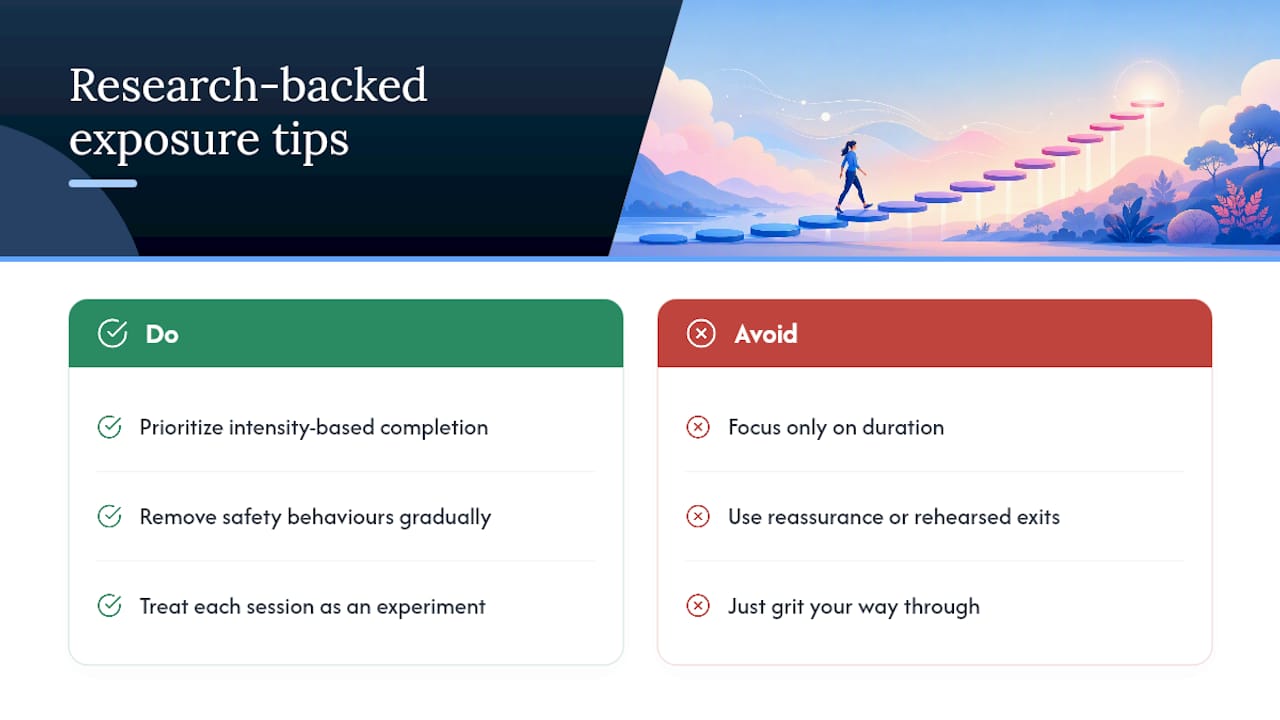
The other place conventional advice falls short is safety behaviors. Everyone talks about “facing your fear,” almost nobody talks about the quiet workarounds, the reassurance-seeking text, the rehearsed exit line, that make the fear feel faced without actually testing anything. Removing those, honestly and gradually, is harder than picking a scarier rung, and it matters more.
If you’re starting this week, prioritize one thing: treat each session as a small experiment testing a specific prediction, not a performance to survive. Log the prediction, log what actually happened, and let the gap between the two do the persuading. That’s the part gamified tracking tools are good at capturing, and it’s the part most people skip when they’re just trying to grit their way through.
— Ryan
A Practical Next Step: Building Ladders Inside Conquer Fear
If you’ve read this far and thought “I don’t want to build a spreadsheet for this,” that’s exactly the gap Conquer Fear is built to close. Conquer Fear lets you build a SUDS-rated ladder for one specific fear, whether that’s driving, phone calls, needles, or walking into a gym, and it handles the scheduling, the before/during/after logging, and the reminders so you’re not relying on memory to keep momentum.
It’s a self-guided tool inspired by exposure principles, not a therapy replacement, and it works whether you’re practicing entirely on your own or sharing progress with a coach or therapist through the linked platform. If your fear is something specific, like driving, presentations, or the gym, there’s a matching path already built for it. The first step is small: open the app, list five situations tied to your fear, and rate the first one. That’s the whole ladder, started.
Sources
- PMC article on habituation and exposure mechanisms (PMC4525711)
- Gamified virtual reality exposure interventions for public speaking anxiety (Frontiers, 2023)
FAQ
What Is a SUDS Score in Exposure Homework?
SUDS, or Subjective Units of Distress, is a 0 to 100 self-rating of anxiety intensity you record before, during, and after each exposure attempt to track progress objectively.
How Often Should I Repeat an Exposure Homework Assignment?
A common target is three to five repeats per week on the same rung until your starting anxiety noticeably drops before moving to the next step.
Can an App Replace Therapist-Assigned Exposure Homework?
No. Apps like Conquer Fear are self-guided tools inspired by exposure principles for everyday fears, not a substitute for professional care when trauma, complex OCD, or panic with fainting is involved.
What Should I Do if My Anxiety Doesn’t Drop During a Session?
Stay a bit longer if it’s tolerable, check for hidden safety behaviors you might be using, and if it’s still unmanageable, scale down to an easier rung next time instead of forcing it.