5-Minute Routine to Stop Blanking From Interview Anxiety

Interview anxiety is common, and it’s manageable. The most reliable approach isn’t a single trick but a short, repeatable routine: build your answers ahead of time, run a five-minute reset just before you walk in, and use one or two in-the-moment regulation moves once you’re in the chair. The steps below break each phase down.
TL;DR:
- Slightly over 19% of Americans experience an anxiety disorder annually, with interview-related spikes being even more common.
- Managing nerves involves building flexible stories with the STAR method and practicing retrieval under pressure through daily drills.
- Pre-interview routines like breathing exercises, posture resets, and reframing anxiety as excitement can significantly reduce immediate stress.
- Recognizing that nervousness is normal, and that small, repeated exposure and structured practice improve resilience more than trying to eliminate nerves.
- For persistent or severe anxiety, cognitive behavioral therapy and structured exposure are recommended alongside routine preparation strategies.
Table of Contents
- What Causes Interview Anxiety in the First Place?
- What Are the Signs of Interview Anxiety?
- How Do You Manage Interview Anxiety in Each Phase?
- How Should You Rehearse So Answers Survive Under Pressure?
- When Does Interview Anxiety Need More Than a Routine?
- How Do You Handle Post-Interview Anxiety?
- What Myths About Interview Anxiety Make It Worse?
- Can Sleep, Food, and Exercise Change How Anxious You Feel?
- Do Mindfulness Practices Actually Help With Interview Prep?
- Does Anxiety Feel Different in Virtual, Panel, or Stress Interviews?
- Ryan’s Take: Small Reps Beat Big Willpower
- Try a Structured Way to Practice Before It Counts
- Sources
- FAQ
What Causes Interview Anxiety in the First Place?
Your brain treats a job interview as a social-evaluative threat, meaning a stranger is judging your worth in real time. That’s enough to activate the amygdala, your brain’s threat detector, which then pulls resources away from the prefrontal cortex, the part responsible for working memory and coherent speech. This is why a candidate who knows their resume cold can suddenly forget the name of their last employer mid-sentence.
Stress hormones like cortisol and adrenaline flood the system during this response, and they specifically impair retrieval and verbal fluency. That’s the biological reason you can rehearse an answer twenty times at home and still blank when a stranger in a blazer asks you to walk through it.
None of this means nerves are the enemy. The Yerkes-Dodson law, a century-old model of arousal and performance, shows that moderate arousal actually sharpens focus and reaction time. Performance only drops once arousal crosses a tipping point into panic. Roughly 19% of American adults experience an anxiety disorder in a given year, according to the National Institute of Mental Health, and situational spikes tied to high-stakes events like interviews are far more common still. The goal isn’t zero nerves. It’s keeping arousal in the zone where it helps rather than hijacks you.
What Are the Signs of Interview Anxiety?
Interview anxiety shows up in three overlapping ways, and naming your specific symptoms helps you pick the right fix instead of guessing.
- Physical: racing heart, sweaty palms, dry mouth, shallow breathing
- Cognitive: blanking on facts you know, racing or looping thoughts, trouble putting an answer in order
- Behavioral: talking too fast, over-apologizing, fidgeting with a pen or your hair
Run a quick three-question check before you decide what to do: Is this happening right now, in the room? Is it mild-to-moderate, or does it feel like full panic? Has it happened before and passed once you started talking? If the answer is “right now, mild-to-moderate, and it usually passes,” an in-the-moment technique will handle it. If it doesn’t pass, that points toward the longer-term strategies covered further down.
How Do You Manage Interview Anxiety in Each Phase?
Treat interview prep like three separate jobs, not one big blur of nervousness. What works four days out is different from what works four minutes out, which is different again from what works four seconds after a question lands.
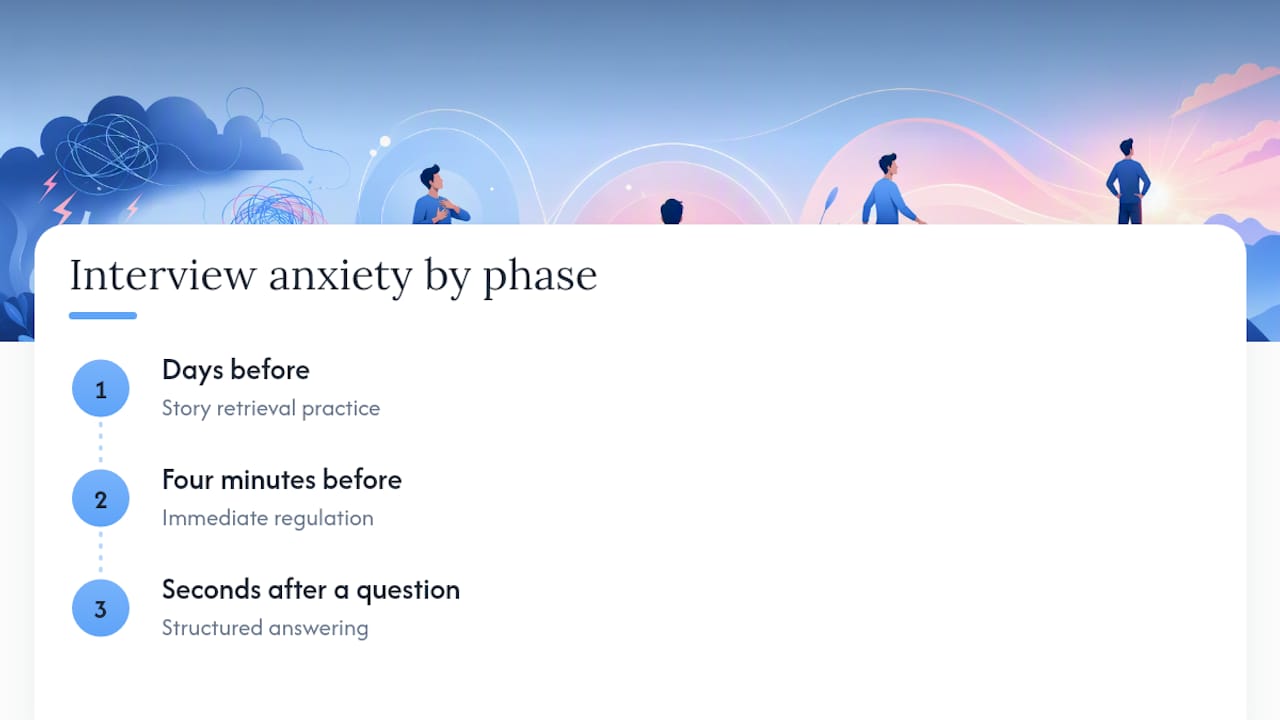
Days before: build stories you can retrieve under pressure
Start by drafting five or six core stories using the STAR method (situation, task, action, result), each one flexible enough to answer several different behavioral questions; for additional preparation tips, see this Interview Day Checklist for Premeds. Don’t just read them silently. Practice pulling them up from a cold start, meaning you say the opening line out loud with no notes and no warmup, the same way a real question will hit you.
Record yourself on camera at least twice. Watching your own speech patterns back is uncomfortable the first time and genuinely useful by the third. In the final day or two, ramp the pressure deliberately: have someone interrupt you, ask a follow-up you didn’t expect, or give you thirty seconds less than you wanted.
Final minutes: a routine you run in the waiting room or at your desk
This is the part most people skip, and it’s the part that actually moves the needle. Run this three-step sequence:
- Breathe with an extended exhale. Inhale for four seconds, exhale for six to eight, and repeat that four or five times. The longer exhale activates your parasympathetic nervous system and brings your heart rate down within a couple of minutes, and it’s discreet enough to do sitting in a lobby chair or staring at a laptop camera.
- Move and reset your posture. Roll your shoulders, plant both feet, and sit or stand tall. A slouched, tense posture feeds the anxious signal back to your brain; an open one interrupts it.
- Say a short reappraisal line to yourself. Something like “I’m excited, I’m prepared” works because anxiety and excitement share nearly identical physical signals, racing heart and all. Relabeling the sensation as excitement rather than dread has been shown to improve performance on evaluated tasks, because it keeps your prefrontal cortex online instead of fighting the sensation.
Pro Tip: Do the breathing and the reset in the parking lot or elevator, not the waiting room chair. Standing up and moving while you breathe compounds the effect.
During the interview: buy time and use structure
Once you’re in the conversation, three moves matter more than any script. Slow your speaking pace on purpose. It feels agonizingly slow to you and sounds completely normal to the interviewer. If a question catches you off guard, ask a brief clarifying question. “Do you want a specific example, or a general approach?” buys you three or four seconds to organize a real answer instead of stalling mid-sentence. And lean on your STAR framework as scaffolding. Naming the structure to yourself (situation, task, action, result) gives your stalled working memory a rail to hold onto.
University career-services offices recommend treating a pause as a deliberate tool rather than a failure. Taking two full seconds of silence before answering reads as thoughtful, not lost.
How Should You Rehearse So Answers Survive Under Pressure?
Calm rehearsal teaches you the content. Pressured rehearsal teaches you to retrieve that content when your hands are sweating, which is a different skill entirely. The testing effect, a well-documented finding in memory research, shows that actively recalling information under mild difficulty cements it far better than passively rereading or rewatching your notes.
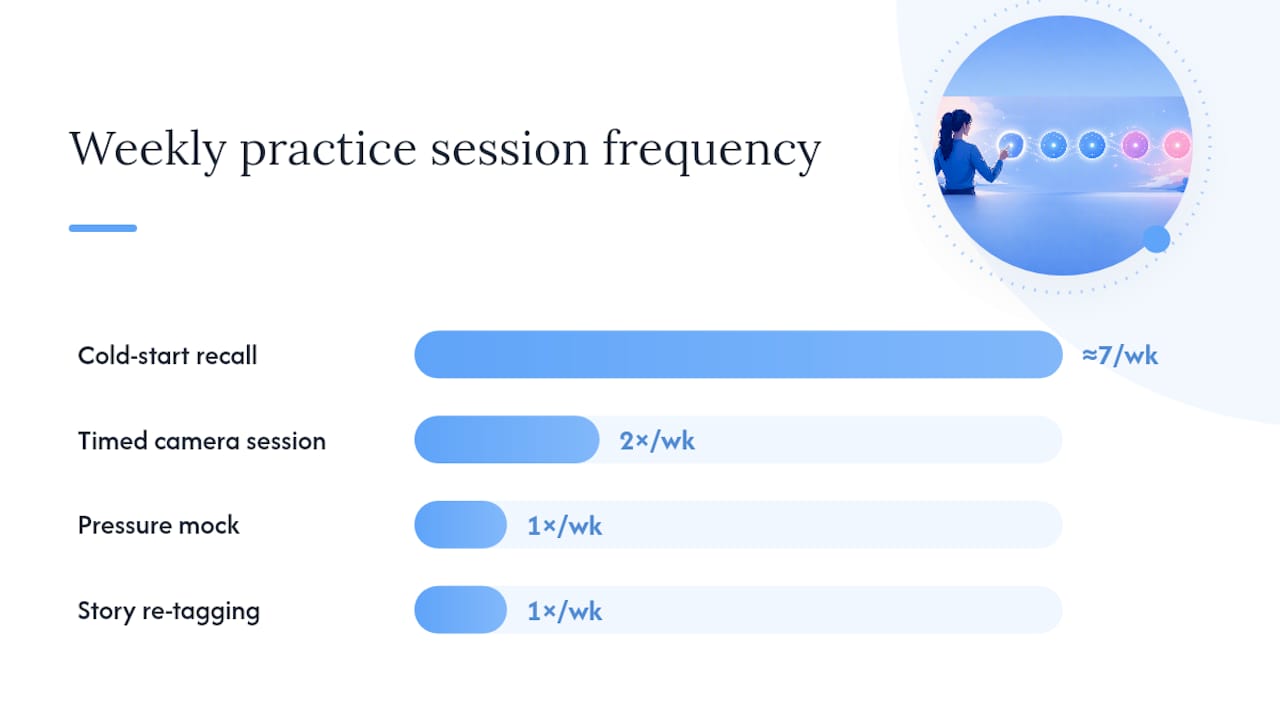
Build a short drill plan: daily one-minute cold starts on random questions from your list, twice-weekly camera sessions where you time yourself, and one escalating “pressure mock” a week where a friend interrupts you or throws in a curveball question. Tag each story with one or two keywords, like “conflict, project delay” or “leadership, budget cut,” so you can retrieve it by association instead of hunting through a mental filing cabinet. If a story consistently stalls in practice, re-tag it with a sharper cue or cut it for a stronger one.
For remote interviews, a small sticky note with three or four story tags taped near your camera is a reasonable anchor. It’s not cheating. It’s the same principle as a speaker’s note card, used discreetly and sparingly.
| Drill | Frequency | What it builds |
|---|---|---|
| Cold-start recall (no notes) | Daily, 1-2 minutes | Fast retrieval without warmup |
| Timed camera session | 2x per week | Pacing and self-awareness |
| Escalating pressure mock | 1x per week | Composure under interruption |
| Story re-tagging review | After each mock | Sharper, faster cue words |
When Does Interview Anxiety Need More Than a Routine?
Most interview nerves respond to preparation and the in-the-moment steps above. A smaller number of cases point to something that deserves more attention than a breathing exercise can offer.
- Avoiding applying to jobs altogether because the thought of an interview feels unbearable
- Physical panic that doesn’t ease once the interview starts (chest tightness, dizziness, dissociation)
- Anxiety that’s spreading into other evaluative situations, like presentations or even phone calls
If any of those sound familiar, structured exposure and cognitive behavioral therapy (CBT) are two well-established, general approaches that a licensed therapist can tailor to your situation. You don’t have to choose between getting help and keeping up your job search. Most people do both at once. If you’re worried about disclosing a mental health condition to an employer, the EEOC outlines general legal protections around this, though a qualified professional is the right resource for your specific case.
How Do You Handle Post-Interview Anxiety?
The interview ends, and for a lot of people the anxiety doesn’t. Instead it shifts into replaying every answer, hunting for the one thing you said wrong. This loop is common enough to have a name among career coaches: post-interview rumination.
Set a hard time limit on the replay. Give yourself twenty minutes to think it through once, then close the loop. Write down three things: one answer you’re proud of, one you’d tighten up, and one question you didn’t expect. That’s a debrief, not a spiral, and it turns a vague bad feeling into two or three concrete adjustments for next time.
Resist the urge to send a follow-up email as an anxiety release valve. A thank-you note the next day is good practice. A rambling message trying to “clarify” something you said out of panic usually does more harm than the original stumble. If you don’t hear back on the timeline they gave you, that’s a scheduling reality far more often than a verdict on your performance.
The most useful post-interview habit is treating every interview as a data point for your cold-start practice. If you blanked on a specific question type, add it to tomorrow’s drill list. If your pacing sped up under one interviewer’s rapid-fire style, that’s exactly the kind of pressure to build into your next mock session. Anxiety after the fact fades faster when it’s converted into a specific action rather than left as a floating feeling.
What Myths About Interview Anxiety Make It Worse?
The idea that “confident people don’t get nervous” is probably the most damaging myth in circulation. Experienced interviewers get nervous. The physical sensations don’t disappear with practice so much as they stop being interpreted as catastrophe, which is a very different outcome than feeling nothing.
Another common misconception: that any visible sign of nerves reads as weakness to the interviewer. In practice, career counselors note that briefly naming your nerves, something as simple as “I’m a little nervous, I’m excited about this role,” often reduces the internal pressure and reads as self-aware rather than unprepared.
A third myth is that you need to eliminate anxiety before you can perform well. That’s backwards. The Yerkes-Dodson relationship between arousal and performance means some activation sharpens you. Chasing total calm can actually flatten your energy and make you seem disengaged. And a fourth: that blanking once means the interview is ruined. Interviewers forget a stumbled sentence far faster than candidates assume. A pause, a “let me start that over,” and a clean second attempt rarely costs you anything.
Can Sleep, Food, and Exercise Change How Anxious You Feel?
Your body’s baseline stress reactivity on interview day is set well before you walk in the door, largely by what you did the night and morning before.
Sleep deprivation doesn’t just make you tired. It measurably reduces the prefrontal cortex’s ability to regulate an anxious amygdala response, which means the same interview question hits harder on four hours of sleep than on seven. Protecting sleep the night before an interview matters more than any single cram session.
Caffeine is worth a second look too. A moderate amount can sharpen focus, but overdoing it on an already-anxious morning pushes your heart rate and jitteriness past the point where it helps, straight into the territory where the Yerkes-Dodson curve tips against you. A light, protein-forward meal beforehand steadies blood sugar, which prevents the shaky, lightheaded feeling that’s easy to mistake for pure nerves.
Exercise earns its place here too. A short walk or light movement in the hours before an interview burns off some of the adrenaline that would otherwise show up as a shaky hand or a cracking voice. You don’t need a workout, just enough movement to signal to your body that the threat response has somewhere to go besides your vocal cords.
Do Mindfulness Practices Actually Help With Interview Prep?
Mindfulness isn’t about clearing your mind of thoughts about the interview. It’s about noticing the anxious thought without immediately obeying it. That distinction matters because trying to force calm often backfires, adding a second layer of frustration on top of the original nerves.
A short, focused practice in the days leading up to an interview, five to ten minutes of simply noticing your breath and letting thoughts pass without chasing them, trains the same attentional control you’ll need when a tough question lands and your mind wants to spiral. It’s less about the interview itself and more about building a general skill: catching a racing thought early, before it snowballs into a blank stare.
The extended-exhale breathing described earlier in the waiting-room routine is itself a mindfulness technique in miniature. If you want a slightly longer daily practice to build the underlying skill, structured breathing exercises practiced regularly, not just on interview day, tend to make the in-the-moment version easier to access when it counts.
Does Anxiety Feel Different in Virtual, Panel, or Stress Interviews?
Format changes the flavor of anxiety even when the underlying mechanism stays the same. A virtual interview strips out normal conversational cues like a slight nod or an interviewer leaning forward, which can leave you unsure whether you’re doing well, and that uncertainty itself becomes a stressor. Compensate by over-nodding slightly and pausing a half-second longer than feels natural, since video lag eats real-time feedback that you’d otherwise read off a face in the room.
A panel interview multiplies the social-evaluative threat by however many people are sitting across from you, and it’s common to fixate on one skeptical-looking face while ignoring three encouraging ones. Pick one friendly face early and direct more of your answers there without ignoring the rest of the panel.
A stress interview, where an interviewer deliberately interrupts, challenges, or goes silent to see how you react, is designed to provoke exactly the anxiety response this article has been describing. Recognizing the tactic for what it is, a test of composure rather than a sign you’re failing, is often enough to keep your arousal from tipping past useful into overwhelming. The clarifying-question technique from the in-interview section works especially well here, since it gives you a beat to reset before responding to a pointed challenge.
Ryan’s Take: Small Reps Beat Big Willpower
Most interview anxiety advice assumes you just need to feel braver. I don’t think that’s the real lever. What actually shifts things is repetition broken into pieces small enough that you’ll do them: one cold-start question today, one camera rep tomorrow. That’s graded exposure, plain and simple, and it’s the same logic behind structured interview rehearsal built around exposure principles rather than pep talks. Progress tracking that shows you attempted the hard rep, even a shaky one, does more for confidence than any single perfect answer.
— Ryan
Try a Structured Way to Practice Before It Counts
Cold-start drills and pressure mocks work, but doing them alone with no structure is exactly where most people quit after two days. There are alternatives to white-knuckling your way through interview prep solo: breaking rehearsal into small, trackable steps instead of one vague goal to “get less nervous.”
The Conquer Fear app is built around this same idea of graded, gamified steps, inspired by exposure principles rather than clinical treatment. It’s a self-guided tool, not therapy, and it’s meant for people who want a structured way to practice facing a specific fear, interviews included, one small rep at a time instead of a single high-stakes leap. You track each attempt, see your own progress build, and the next rep gets a little easier because the last one is behind you. If you’ve got an interview coming up, start tonight with one cold-start question, no notes, said out loud, and log it as your first rep.
Sources
The PubMed reappraisal study explains the science behind relabeling anxiety as excitement. NIMH’s anxiety statistics give context on how common anxiety disorders are nationally. The APA’s exposure therapy guidance covers the evidence behind graded exposure. Penn Career Services offers a practical pre-interview routine, and ADAA’s symptom guide catalogs the physical and cognitive signs covered in this article.
This article is general information, not a substitute for advice from a qualified doctor. Consult a qualified healthcare professional about your own circumstances before acting on anything here.
- PubMed: Reappraisal research (2013)
- Managing Interview Anxiety - Penn Career Services
- NIMH: Any anxiety disorder statistics
FAQ
What is the 3-3-3 rule for anxiety?
It’s a quick grounding technique: name three things you see, three sounds you hear, and move three parts of your body. It interrupts a racing-thought spiral by redirecting attention to the present moment, similar to the grounding techniques used for anxiety more broadly.
What is the 80/20 rule in interviewing?
Applied to interviews, it means roughly 80% of your answers should draw from about 20% of your prepared stories, the five or six flexible STAR examples that can be adapted to cover most behavioral questions you’ll face.
How can I calm down before an interview?
Run the three-step waiting-room routine: extended-exhale breathing (four seconds in, six to eight seconds out, repeated four or five times), a posture reset, and a short reappraisal line like “I’m excited, I’m prepared.”
How do I avoid blanking during an interview?
Practice cold-start retrieval of your core stories without notes so recall doesn’t depend on calm conditions, and use a brief clarifying question in the moment to buy a few seconds to organize your answer instead of freezing.