
8 Graded Exposure Steps to Beat Public Speaking Anxiety

Public speaking anxiety, also called glossophobia, is a common fear tied to being judged while performing in front of others. Millions of people deal with it in some form, and the two approaches with the strongest track record for lasting relief are exposure-based practice and cognitive-behavioral strategies. The rest comes down to knowing your symptoms, understanding why your body reacts this way, and building a practice routine that actually mimics the pressure of the real moment.
TL;DR:
- Most improvements come from exposure-based practice and cognitive-behavioral strategies, which are supported by substantial research evidence.
- Practicing in environments that closely mimic real speaking conditions, including stressors like distractions, enhances confidence and reduces panic.
- Using a graded exposure ladder, starting with simple tasks like recording oneself, gradually builds comfort with speaking in front of others.
- Medications like beta-blockers can manage physical symptoms temporarily, while long-term management may involve SSRIs or SNRIs if anxiety persists for more than six months.
- Consistent preparation, including rehearsing under realistic conditions and reframing bodily sensations as excitement, helps speed recovery and build speaking resilience.
Table of Contents
- What Counts as Public Speaking Anxiety?
- What Symptoms Show Up Before and During a Talk?
- Why Does Public Speaking Trigger Such a Strong Reaction?
- What Actually Works: CBT, Exposure, VRET, and Medication
- How Do You Prepare, Perform, and Recover From a Talk?
- How Do You Build a Graded Exposure Ladder?
- A Personal Note on Facing This Fear
- A Practice Tool Worth Trying for Presentation Fear
- Sources
- FAQ
What Counts as Public Speaking Anxiety?
Glossophobia is often described as a “performance-only” form of social anxiety. It shows up specifically when you’re being watched and evaluated while speaking. Someone with this fear might feel completely at ease at a dinner party but freeze the moment they have to give a toast.
It becomes a diagnosable condition when it crosses a specific threshold. According to the National Institute of Mental Health, symptoms must persist for six months or longer and meaningfully interfere with daily functioning, whether that’s work, school, or relationships, before it qualifies as social anxiety disorder.
That distinction matters because most people never reach that threshold. Common contexts where this fear appears include:
- Work presentations or client pitches
- Wedding toasts and eulogies
- Classroom presentations or oral exams
- Team meetings where you have to speak up
- Interviews with a panel or group format
If your fear is limited to these moments and doesn’t spread into avoiding your job or social life altogether, you’re likely dealing with a common performance fear rather than a clinical disorder.
What Symptoms Show Up Before and During a Talk?
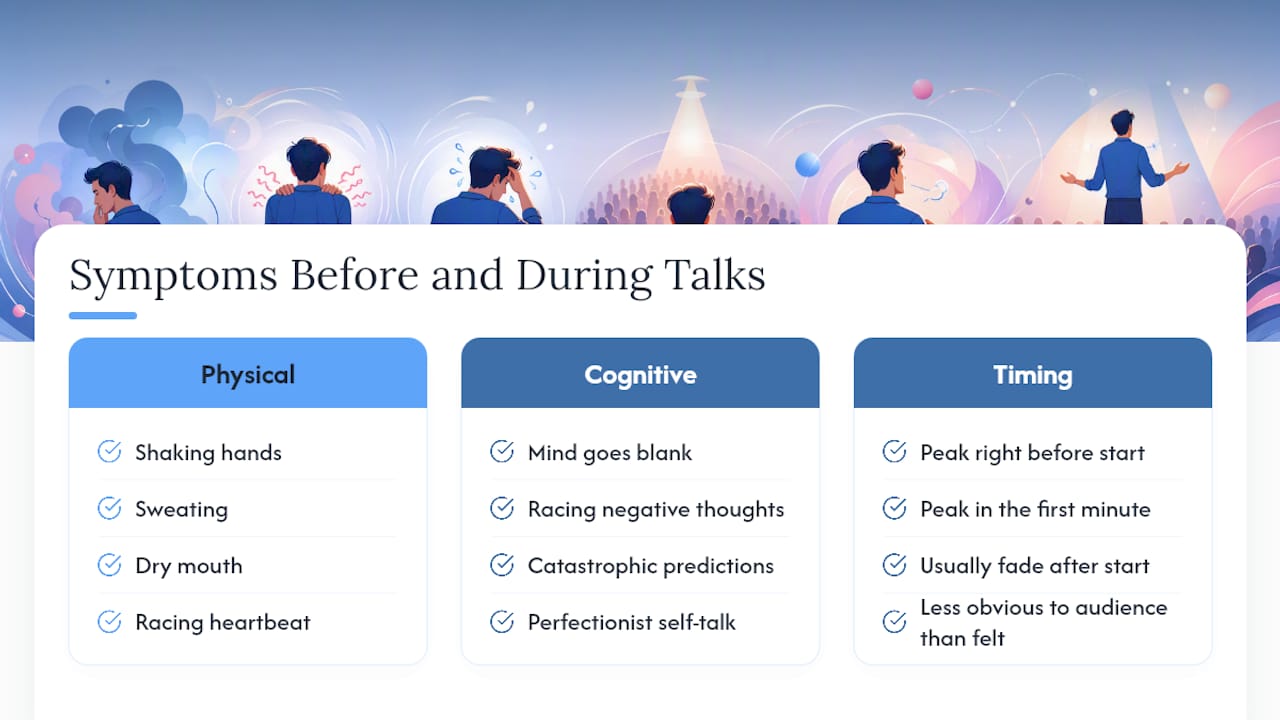
Your body and mind react together, and the symptoms usually cluster into two categories. Physical symptoms include shaking hands, sweating, a dry mouth, a racing heartbeat, and sometimes nausea. Cognitive symptoms include your mind going blank, racing negative thoughts, catastrophic predictions about failure, and perfectionist self-talk that nothing you say will be good enough.
Pro Tip: Write your opening line on an index card, even if you know it cold. Having it visible removes the one moment where a blank mind can derail your entire start.
Here’s the part almost nobody tells you: those symptoms peak right before you start and in the first minute, then usually fade. The University of Pittsburgh’s communication department notes that many visible signs, like a shaky hand or a slightly unsteady voice, are far less obvious to an audience than they feel to the speaker in the moment.
Why Does Public Speaking Trigger Such a Strong Reaction?
Your brain treats a room full of watching eyes the same way it once treated a physical threat. That fight-or-flight response floods your system with adrenaline and cortisol, which sharpens your senses for danger but actively interferes with your prefrontal cortex, the part of your brain responsible for pulling up memorized information. That’s the biological reason your mind goes blank right when you need it most. It isn’t a character flaw. It’s a stress hormone doing exactly what it evolved to do.
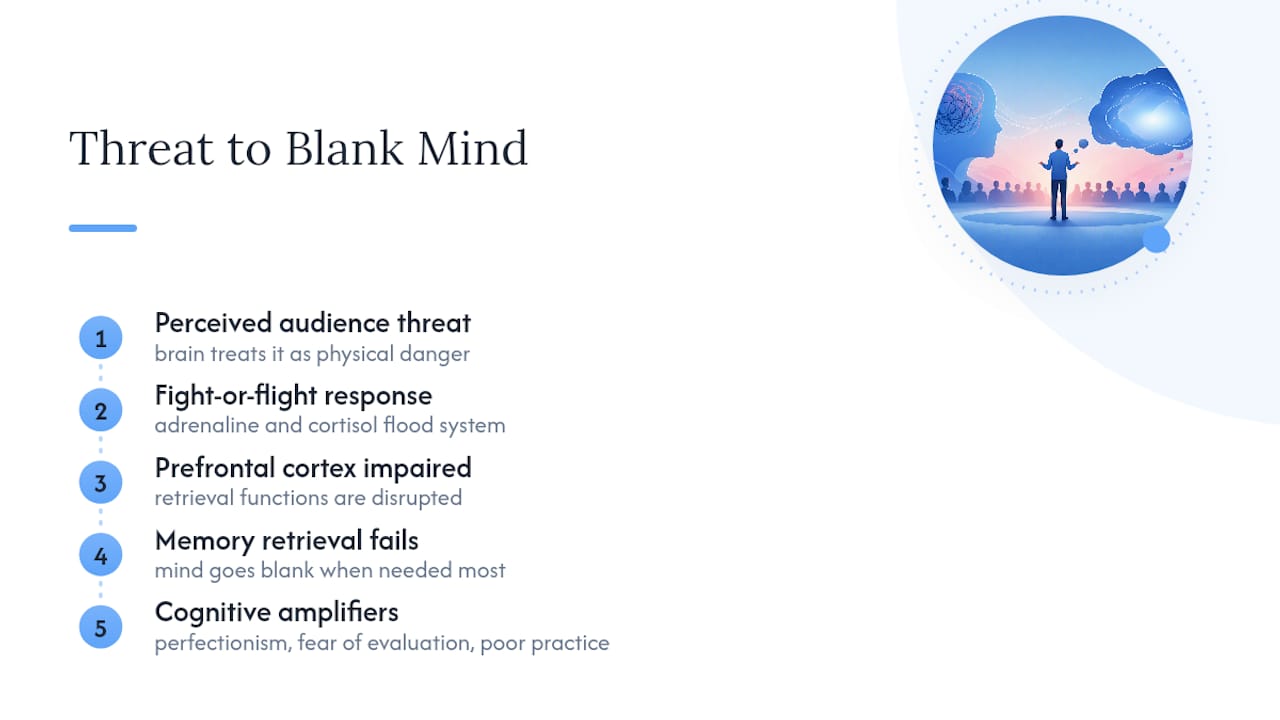
Two cognitive patterns make this worse. Perfectionism convinces you that anything short of flawless delivery counts as failure, and fear of negative evaluation makes you scan the audience for signs of judgment instead of connection. There’s also a practical mismatch most people miss: rehearsing quietly in your bedroom trains your brain for a calm environment, not the adrenaline spike of a real room. Practice conditions that don’t resemble the real event leave your retrieval skills untested under actual stress.
What Actually Works: CBT, Exposure, VRET, and Medication
Cognitive-behavioral therapy (CBT) and exposure-based interventions are the first-line psychological approaches for this fear, and the research backing them is substantial. A meta-analysis of 11 studies covering 508 participants found that both Virtual Reality Exposure Therapy (VRET) and traditional in vivo exposure therapy produced large, statistically significant reductions in public speaking anxiety compared to control groups, with effect sizes around −1.39 and −1.41. In plain terms, both approaches work, and neither clearly outperforms the other.
The value of VRET is that it removes the practical barriers of in vivo exposure. You don’t need a real audience, a real stage, or a scheduling favor from ten coworkers. You need a controllable, repeatable scenario that still triggers the same stress response as the real thing.
Beyond therapy, there are medication options worth knowing about:
- Beta-blockers are commonly used short-term to blunt physical symptoms like a racing heart for a single event, such as a wedding speech or one high-stakes pitch.
- SSRIs or SNRIs may be prescribed for longer-term management when anxiety is more persistent or meets the clinical threshold for social anxiety disorder.
Clinical guidance generally recommends CBT and exposure work as the foundation, with medication used to support rather than replace that process. If your fear has lasted six months or longer and is interfering with your job, education, or relationships, that’s your signal to talk to a doctor or therapist rather than keep managing it alone.
How Do You Prepare, Perform, and Recover From a Talk?
Anxiety before a talk drops significantly when your preparation actually matches how you’ll deliver it. Here’s a sequence that works across before, during, and after your talk.
- Choose a topic you actually care about. Genuine interest reduces the cognitive load of faking enthusiasm on top of managing nerves.
- Build a short outline, not a script. Full scripts increase panic when you lose your place; a five-point outline is easier to recover from.
- Rehearse standing up, out loud, under conditions close to the real thing. Sitting at your desk mumbling through slides does not count as practice.
- On the day, move your body first. A short walk or light exercise burns off some of the adrenaline before it turns into shaking hands.
- Check the venue and your tech ahead of time. Knowing where you’ll stand and that your slides actually load removes several unknowns at once.
- During the talk, accept brief pauses instead of fighting them. A silence that feels like an eternity to you is usually just a few seconds to your audience, and Mayo Clinic notes that learning to tolerate these micro-pauses reduces panic and speeds recovery.
- Reframe the physical jolt as excitement, not fear. The sensations are nearly identical; the label you give them changes how your body responds next.
- Afterward, name one concrete thing that went right. Then schedule a short, low-stakes practice rep within the week to keep the skill warm.
Pro Tip: Grounding techniques like pressing your feet into the floor or naming five things you can see work because they pull your attention out of your head and back into the room, breaking the spiral of catastrophic thoughts.
How Do You Build a Graded Exposure Ladder?
A graded exposure ladder works by starting small and stacking difficulty gradually, rather than jumping straight into the scenario you fear most. A simple version might look like this:
- Level 1: Record yourself talking for two minutes, alone, and watch it back.
- Level 2: Give a short talk to one trusted friend or family member.
- Level 3: Present to a small group of three to five people you know.
- Level 4: Speak to a slightly larger or less familiar group, like a work team.
- Level 5: Take on a higher-stakes talk with strangers or an unfamiliar audience.
The realism of your rehearsal at each level matters more than the length of it. Cambridge’s reporting on VR and AI-assisted practice found that brief, self-guided sessions produced measurable gains in confidence when the practice conditions mirrored the real event: standing up, using the same slides or tech, and even simulating distractions like a phone buzzing or someone interrupting. Short, frequent reps beat long, infrequent ones, and each level should feel only slightly harder than the last, not overwhelming. Self-guided, gamified tools inspired by exposure principles can give you a low-stakes way to run these reps on your own schedule.
A Personal Note on Facing This Fear
If presentations make your stomach drop, you’re reacting to a threat your brain takes seriously, not overreacting to something trivial. The fear is real, and so is your capacity to shrink it, one small rep at a time. I’d rather see you give a shaky three-minute talk to a friend this week than wait for confidence to arrive before you start. This topic is supported by self-guided, gamified exposure tools designed for this kind of fear, with no therapy claims attached. Your first step: record sixty seconds of yourself talking, today, and watch it once.
— Ryan
A Practice Tool Worth Trying for Presentation Fear
Reading about exposure ladders is useful. Actually running one is what changes how your body responds to a room full of eyes. That’s the gap Conquer Fear is built to close: a self-guided way to work through stepwise presentation exercises, inspired by exposure principles, at your own pace and without needing to schedule a real audience for every rep.
The app structure mirrors the ladder described above. You start with low-pressure tasks, add realism and difficulty gradually, and repeat often enough that your brain stops treating a talk as a threat. It’s a complement to the practice habits in this article, not a replacement for a therapist if your anxiety has crossed into the six-month, life-interfering territory NIMH describes. For that, professional support is the right call. For the everyday dread of a pitch, a toast, or a team update, it’s a practical place to start. Try one micro-exposure exercise this week and see how it feels before your next real talk. You can explore the full suite of tools at Life is a Game if other fears or focus struggles are also on your list.
This article is general information, not a substitute for advice from a qualified doctor. Consult a qualified healthcare professional about your own circumstances before acting on anything here.
Sources
- Social Anxiety Disorder: What You Need to Know - National Institute of Mental Health (NIMH)
- A Meta-Analysis of the Efficacy of Virtual Reality and In Vivo Exposure Therapy as Psychological Interventions for Public Speaking Anxiety
- Free tech helps eliminate fear of public speaking | University of Cambridge
- Speech Anxiety: Public Speaking With Social Anxiety - Verywell Mind
FAQ
How do you overcome public speaking anxiety?
The most reliable path combines graded exposure practice, where you rehearse under increasingly realistic conditions, with cognitive-behavioral strategies that target perfectionist thinking and fear of judgment.
How is glossophobia treated?
CBT and exposure-based therapy, including VRET, are the first-line treatments, and both have been shown to produce large reductions in anxiety symptoms; short-term beta-blockers can also help manage physical symptoms for a single event.
Why does public speaking make me so anxious?
Your brain’s fight-or-flight response floods your system with stress hormones that sharpen threat detection but interfere with the memory retrieval you need to speak smoothly, which is why your mind can go blank at the worst moment.
What medication is used for anxiety during public speaking?
Beta-blockers are commonly used short-term to reduce physical symptoms like a racing heart before a single event, while SSRIs or SNRIs are sometimes prescribed for longer-term management when anxiety meets a clinical threshold.
When should I see a professional about this fear?
If your anxiety has lasted six months or longer and is interfering with your work, school, or relationships, that meets the NIMH criteria for seeking professional support rather than managing it alone.