
5–10 Minute CBT Tools for Therapists: Homework Hacks and App Adjunct

The essential toolkit for CBT therapists breaks into four categories: structured worksheets (thought records, cognitive distortion checklists, behavioral activation logs), standardized assessment scales (PHQ-9, GAD-7), graded behavioral tasks, and digital between-session tracking. Used well, these tools generalize skills beyond the therapy room and give you measurable progress data. A thought record usually takes a client 5 to 10 minutes to complete once they know the format.
TL;DR:
- Thought records should be introduced gradually, starting with four columns and adding complexity only after consistent use, to prevent client drop-out.
- Standardized measures like the PHQ-9 and GAD-7 should be administered at regular intervals, ideally every two to four sessions, to track progress objectively.
- Digital tools should be selected carefully, ensuring client data privacy, and used to automate scoring and trend analysis without replacing clinical judgment.
- Assigning small, specific tasks with the 5-minute rule enhances homework compliance and reduces avoidance in clients.
- Personalization of worksheets using clients’ vocabulary and staging their introduction increases engagement and prevents abandonment.
Table of Contents
- Categorized Worksheets: What to Use and When to Introduce Them
- Assessment Scales and Progress Tracking: PHQ-9, GAD-7, and Session Measures
- Digital Tools and Workflows for Between-Session Tracking
- How to Choose and Adapt a Tool for a Specific Client
- Homework Compliance: The 5-Minute Rule and Collaborative Assignment
- Evidence and Practitioner Guidance Behind These Tools
- Tools for Therapist Self-Monitoring and Supervision
- Integrating CBT Tools With Teletherapy Platforms
- Emerging Technologies in CBT Practice
- Clinician Perspective: Using Tools Compassionately
- Life Is a Game: A Discreet Adjunct for Between-Session Work
- Authoritative Download Hubs and Clinical Resources
- Sources
- FAQ
Categorized Worksheets: What to Use and When to Introduce Them
Worksheets are not interchangeable. A thought record serves a different purpose than a behavioral activation log, and using the wrong one at the wrong phase of treatment is one of the fastest ways to lose a client’s buy-in.
Thought records remain the workhorse of cognitive restructuring. The Beck Institute’s worksheet packet recommends starting with just four columns: situation, automatic thought, emotion, and rating. Add the “testing your thoughts” or evidence columns only once the client has practiced the basic version with you in session. Rushing to the seven-column version in week two is a common reason clients stop filling them out at home.
Cognitive distortion checklists and psychoeducation sheets work best as a bridge, not an endpoint. Hand a client a list of distortions (catastrophizing, mind reading, all-or-nothing thinking) after they’ve already identified two or three of their own automatic thoughts in session. The checklist gives language to something they’ve already started noticing, rather than asking them to memorize a taxonomy cold.
Behavioral activation and activity scheduling templates need a grading system built in. Rather than assigning “go for a walk,” structure the task with a specific window and a mastery/pleasure rating so the review conversation has something concrete to work from. A basic template might look like this:
Core belief and schema worksheets belong later in treatment, generally after eight to twelve sessions of successful thought-record work. These forms dig into “I am unlovable” or “I am incompetent” level beliefs, and introducing them too early can feel like being handed a diagnosis rather than a tool.
- Thought records: cognitive restructuring, ongoing use, 5 to 10 minutes
- Distortion checklists: psychoeducation, early to mid-treatment
- Activity scheduling: behavioral activation, depression and low motivation cases
- Core belief worksheets: later-stage treatment, requires strong alliance
Not every client benefits from paper worksheets. Clients with limited literacy, high cognitive load, or acute crisis presentations often do better with verbal Socratic questioning in session and a single spoken “homework” task, rather than a form to fill out.
Pro Tip: If a client returns a thought record blank two sessions in a row, stop assigning it and ask what got in the way. That conversation usually reveals more than the worksheet would have.
Assessment Scales and Progress Tracking: PHQ-9, GAD-7, and Session Measures
Standardized measures give you a number to track against clinical judgment, and clinical judgment alone drifts over a course of treatment.
- Administer the PHQ-9 and GAD-7 at intake, then every two to four sessions. Weekly administration can feel clinical and repetitive to clients; monthly is often too sparse to catch a downward trend before it becomes a crisis.
- Pair standardized measures with a single-item session rating. A quick “how would you rate your anxiety today, 0 to 10” at the start of session takes fifteen seconds and catches fluctuations the PHQ-9 and GAD-7 miss between administrations.
- Use client-rated SUDS (Subjective Units of Distress Scale) for exposure and activation work specifically. SUDS ratings before and after a task give you the before/after comparison that a monthly questionnaire cannot.
- Chart the trend, not the single score. A GAD-7 score of 14 means something different if it’s dropped from 19 over six weeks versus climbed from 8. Graph it if your notes software allows, even a simple line on paper works.
- Pivot treatment when scores plateau or worsen for two consecutive administrations. A flat PHQ-9 across three sessions is a cue to revisit the formulation, not just push harder on the same worksheet.
Document scores in the same place every time, ideally directly in the session note, and note the date and any context (medication change, major life event) that might explain a shift. Confidentiality applies to these numbers the same way it applies to session content. If you use a digital portal to collect them, confirm the platform’s data handling before you send a client their first questionnaire link.
Digital Tools and Workflows for Between-Session Tracking
Three types of digital tools show up in most CBT practices now: static worksheet libraries you print or email, personalized generators that build a worksheet around a client’s own words, and dedicated practice workspaces with a client-facing app component.
Static libraries are the simplest and the most common starting point. Personalized generators, like Reframe Practice’s tool, build the worksheet using language the client already used in session, which tends to increase relevance over a generic template pulled from a binder. Practice workspaces go a step further, combining assignment, reminders, and auto-scoring into one place, as platforms like CBT Flow illustrate.
A typical workflow looks like this:
- You assign a specific worksheet or task in session, ideally after completing the first item together.
- The client completes it on their own device or on paper between sessions.
- An automated reminder nudges them midweek if the platform supports it.
- You review the completed item at the start of the next session, using it as the first agenda item rather than an afterthought.
Auto-scored outcome measures save real time. Instead of hand-scoring a GAD-7 during session, a digital form calculates the total instantly and can plot it against prior administrations, letting you spend the minute you saved on discussing what the trend means.
Privacy considerations matter more here than with paper. Confirm the platform stores health data with encryption at rest and in transit, get explicit consent before sending any assessment link, and know exactly what data the platform retains after a client disengages. A therapist-facing tool that lets you see completion timestamps and ratings, without asking the client to send you screenshots, tends to reduce the exposure of the raw session content.
Pro Tip: Before adopting any digital homework tool, ask what happens to a client’s data if they stop paying for the app or platform. That answer tells you more about the vendor’s priorities than the feature list does.
How to Choose and Adapt a Tool for a Specific Client
The right worksheet for the presenting problem is rarely the right worksheet for the person sitting across from you. Run through a short checklist before assigning anything new:
- Match the tool to the presenting problem. Depression and low motivation call for activity scheduling before cognitive work; panic and phobias call for graded exposure hierarchies before deep belief work.
- Check readiness. A client still in the “convince me this will help” phase needs a smaller, lower-stakes task than one who’s already bought into the model.
- Account for literacy and cognitive load. A client managing significant stress, sleep deprivation, or a demanding job may complete a three-line task and abandon a full-page form.
- Consider the session phase. Early sessions call for simple, teachable formats; later sessions can handle more columns and more independent work.
- Scaffold in steps. Introduce the shortest version of a tool first, then add complexity only after two or three successful completions.
Personalization tactics make the difference between a worksheet that gets used and one that gets abandoned in a glove compartment. Rewrite generic prompts using the client’s own vocabulary. If a client calls their anxiety “the static,” use that phrase in the worksheet header instead of “anxious thoughts.” For behavioral activation, grade the task down: “text one friend” instead of “reconnect with your social circle” for a client who hasn’t initiated contact with anyone in three weeks.
A simplified thought record for a client overwhelmed by columns might drop straight to two questions: “What happened?” and “What went through your mind?” Add the rating and alternative-thought columns once those two questions come back filled in consistently.
Watch for red flags. If a client seems to dread session because homework wasn’t done, that’s a signal the task was pitched too high, not that the client is unmotivated. Scale back, revisit the rationale together, and reassign something smaller.
Pro Tip: When a worksheet keeps coming back blank, try assigning half of it. A thought record with two columns filled in beats a five-column form that never gets opened.
Homework Compliance: The 5-Minute Rule and Collaborative Assignment
Homework compliance drives outcomes more than the sophistication of the worksheet itself. Structured homework is associated with larger treatment effects than sessions without between-session tasks, which makes assignment strategy as important as tool selection.
Start every new task by completing the first item together, in session. This single move eliminates most of the “I didn’t understand the form” excuses that show up the following week. Use the 5-minute rule, a technique borrowed from behavioral activation practice that breaks an overwhelming task into a version small enough to start in five minutes. A client resisting exercise doesn’t get “work out three times this week”; they get “put on your shoes and stand outside for five minutes.”
- Tie the task to something the client already cares about, not an abstract skill.
- Praise completion explicitly, even partial completion, before moving to what didn’t get done.
- Use a brief SUDS or 0 to 10 rating before and after each task so the review has a number to anchor to.
- Keep the check-in at the top of the session agenda, not squeezed in at the end.
Clients prone to avoidance respond particularly well to micro-tasks bounded by time rather than outcome. “Sit with the discomfort for five minutes” is easier to start than “get through the whole grocery store,” and completion of the small version builds the momentum needed for the larger one.
Evidence and Practitioner Guidance Behind These Tools
None of this is guesswork pulled from a therapist forum. The Beck Institute’s worksheet packet is the standard reference for introducing thought records collaboratively and in stages. Psychology Tools maintains one of the larger libraries of clinician handouts organized by presenting problem, useful when you need a specific distortion checklist fast. The National Institute of Mental Health frames CBT and other structured psychotherapies as skill-building interventions, which is the same principle underlying every tool in this article: the worksheet is a vehicle for a skill, not the treatment itself.
- Beck Institute: worksheet packets, staged introduction guidance
- Psychology Tools: downloadable worksheets by presenting problem
- NIMH: overview of structured psychotherapy and its clinical role
For clients working through a specific fear rather than general anxiety, an app like Conquer Fear can serve as a self-guided companion between sessions, inspired by exposure principles. It is not therapy and does not replace your clinical work. It only reflects what a client chooses to log.
Tools for Therapist Self-Monitoring and Supervision
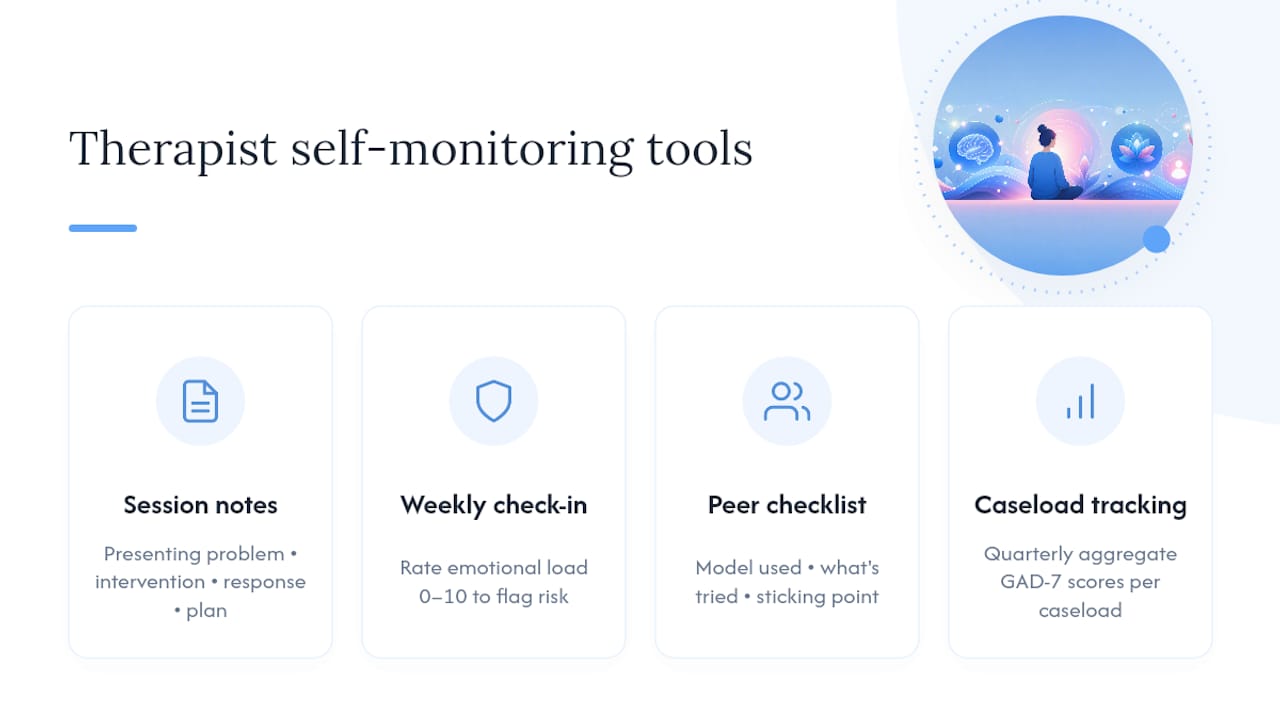
Clinicians burn out too, and the same structured logic that helps clients track progress applies to your own practice sustainability. Session note templates that flag countertransference reactions, caseload complexity ratings, and simple weekly self-assessment scales all serve the same function a thought record serves for a client: they externalize something that’s easy to lose track of in the moment.
Supervision-ready tools matter here. Recording brief session summaries with a consistent structure, presenting problem, intervention used, client response, plan for next session, makes case presentation in supervision faster and catches drift in your own technique before it becomes a pattern. Some clinicians keep a simple weekly log rating their own emotional load on a 0 to 10 scale, which flags burnout risk before it shows up as missed documentation or short-tempered sessions.
Peer consultation groups often use a shared checklist for case presentation: what CBT model is being applied, what’s been tried, what the sticking point is. That structure prevents supervision time from turning into unfocused venting, and it mirrors exactly the kind of scaffolding you’d build for a client. If you’re assigning clients standardized measures like the GAD-7, consider tracking your own caseload’s aggregate scores over a quarter. A caseload trending upward across multiple clients might say more about your current capacity than any single case does.
Integrating CBT Tools With Teletherapy Platforms
Most teletherapy platforms now support some form of document sharing, but the fit between your worksheet workflow and your video platform varies more than most clinicians expect.
Screen-sharing a thought record during a session works, but it puts the mechanics of navigating a PDF between you and the actual clinical conversation. A cleaner approach: send the worksheet ahead of session through the platform’s secure messaging feature, walk through it together with both of you looking at your own copy, then have the client complete it independently before the next appointment. This avoids the awkward “can you see my screen” troubleshooting that eats into session time.
Confirm your video platform’s file-sharing feature is covered under the same compliance framework as the session itself. Some teletherapy platforms cover video encryption but route file attachments through a separate, less secure email integration, a gap worth checking before you send anything with identifying details.
For measures like the PHQ-9 and GAD-7, a built-in intake form within the teletherapy platform, if available, saves you from juggling a third-party survey tool with its own consent and storage questions. Where the platform doesn’t support that, a simple secure PDF form attached to the session confirmation email is a reasonable substitute, as long as you’ve confirmed how long that email system retains attachments.
Emerging Technologies in CBT Practice
AI-assisted tools are showing up in CBT practice mostly as drafting aids: generating a first draft of a psychoeducation handout in a client’s own vocabulary, or summarizing session themes to speed up documentation. These tools support your workflow. They do not replace clinical judgment about what a specific client needs, and any output should be reviewed and edited before it reaches a client.
Virtual reality exposure tools have moved from research settings into some specialty clinics, mostly for phobias like flying, heights, and public speaking, where recreating the feared stimulus in the real world is expensive or impractical. Access remains limited by hardware cost and clinic setup, so most general practices won’t have VR on hand, but it’s worth knowing the option exists for a client whose exposure hierarchy hits a logistical wall.
Self-guided apps that apply exposure principles outside session are the most accessible of the emerging tools for a typical practice, since they run on a phone a client already owns. Used as an adjunct, one where the client logs attempted steps and fear ratings that you can review with their consent, these tools extend the between-session window without adding to your caseload of manual check-ins. They remain self-guided and are not a substitute for the therapeutic relationship or your clinical formulation.
Clinician Perspective: Using Tools Compassionately
Every tool in this piece works better after alliance, never before it. Introduce a worksheet as an experiment you’re running together, not a test the client can pass or fail. If you try one thing from this list next session, make it small: assign a single five-minute activation task or a two-column thought record, complete the first entry together, and review it before adding anything else. The tool matters less than whether the client feels like a collaborator in using it.
— Ryan
Life Is a Game: A Discreet Adjunct for Between-Session Work
For clients working through a specific fear like phone calls, driving, doctor visits, or public speaking, some digital tools provide a way to see what happened between sessions without relying on a client’s memory. Through a therapist platform, a clinician may invite a client with a link, build or assign graded exposure steps tailored to their fear, and review consented progress logged, including which steps were attempted and the client’s fear ratings before and after.
This isn’t a replacement for the thought records and activation logs covered above. It’s a way to extend graded exposure work into the hours you don’t see, inspired by exposure principles, for clients who need more scaffolding than a printed hierarchy provides. The client keeps free access to the app for as long as they’re linked to you, and the clinician view only reflects what they choose to record. If you have a client currently avoiding something specific, driving, needles, the gym, take five minutes this week and look at the Conquer Fear platform for therapists to see whether building their first exposure step there fits your treatment plan.
Authoritative Download Hubs and Clinical Resources
A handful of hubs cover most of what you’ll need for worksheets, assessment forms, and clinician guidance:
- Beck Institute: the CBT worksheet packet and staged clinician materials for introducing thought records and cognitive restructuring tools.
- Psychology Tools: a large library of downloadable worksheets, handouts, and skills-development audio organized by presenting problem.
- TherapistAid: printable worksheets and interactive tools covering CBT, DBT, and general clinical practice, useful for quick session prep.
- NIMH: overview material on psychotherapies and the evidence base for structured interventions, useful when explaining treatment rationale to clients or supervisors.
Sources
- CBT Worksheets, Handouts, And Skills-Development Audio: Therapy Resources for Mental Health Professionals
- Self-help CBT techniques (Every Mind Matters) — NHS
- CBT WORKSHEET PACKET (Beck Institute resource)
- Psychotherapies — NIMH
FAQ
What tools are used in CBT?
CBT relies on structured worksheets like thought records and cognitive distortion checklists, standardized measures like the PHQ-9 and GAD-7, behavioral activation and activity scheduling templates, and increasingly, digital portals that track homework completion and outcome trends between sessions.
Why can CBT feel invalidating to some clients?
Worksheets and structured techniques can feel invalidating when they’re introduced before a strong therapeutic alliance is established, since a client may experience the form as a test rather than a collaborative tool; Beck Institute guidance recommends teaching any worksheet in session first and validating the client’s experience before assigning it as homework.
What is the 5-minute rule in CBT?
The 5-minute rule breaks an overwhelming task into a version small enough to start within five minutes, which reduces avoidance and builds momentum toward the fuller task.
What are the three C’s in CBT?
Definitions vary by clinician and training program, but a common version refers to catching, checking, and changing automatic thoughts, the sequence of noticing a thought, evaluating its accuracy, and replacing it with a more balanced alternative.
How long should a CBT worksheet take a client to complete?
Most thought records take 5 to 10 minutes once a client is familiar with the format, and tasks that consistently take longer are usually a sign to simplify the worksheet or reduce the number of columns.