Try One Micro Exposure Tonight for Mild Anxiety Using the 50% Rule

Exposure practice means approaching a feared situation in small, measurable steps so you prove to your own brain that you can handle more than it thinks. The single most useful thing to do today is pick one tiny, specific version of your fear, rate how anxious it makes you on a 0 to 100 scale, and try it once. If your anxiety is tangled up with trauma memories, severe compulsions, or thoughts of self-harm, this is a job for a licensed professional first, not a solo project.
TL;DR:
- Self-guided exposure work is suitable for mild to moderate anxiety but is unsafe for severe cases involving trauma memories, panics, or self-harm risks.
- Building a fear ladder with SUDS ratings and aiming for a 50% reduction each time emphasizes consistency and gradual progression in varied contexts.
- Incorporating variability, expectancy violation, and practicing in different settings enhances long-term fear reduction over repetitive, identical exposures.
- Preparation techniques like breathing exercises and concrete predictions improve coping and reinforce learning during exposure attempts.
- Using structured apps like Conquer Fear can support building, logging, and reviewing your exposure steps, but should complement professional treatment rather than replace it.
Table of Contents
- What Are Safe Exposure Ideas for Anxiety, and Who Should Try Them Alone?
- How to Build a Fear Ladder Using SUDS and the 50% Rule
- Exposure Exercises by Anxiety Type
- Practice Rules That Actually Reduce Fear Long Term
- How Life is a Game’s Conquer Fear App Supports This Method
- Preparation Techniques Before You Start an Exposure
- Where Cognitive Restructuring Fits Alongside Exposure
- Matching Exposure to Your Specific Fear and Its Severity
- A Personal Take: Treat It as Practice, Not a Performance
- Try One Micro-Exposure Today With Conquer Fear
- Sources
- FAQ
What Are Safe Exposure Ideas for Anxiety, and Who Should Try Them Alone?
Self-guided exposure work fits mild to moderate anxiety: the kind that makes you cancel plans, avoid the phone, or rehearse conversations for days before they happen. It’s a poor fit if your fear is rooted in a specific traumatic event, if you’re managing severe compulsions that feel impossible to interrupt, or if panic episodes have ever left you worried about your physical safety.
The NIMH’s guidance on anxiety disorders is direct about this: get professional support when anxiety interferes with daily functioning, or when exposure would involve trauma memories, self-harm risk, medically concerning physical sensations, or panic that feels uncontrollable. That’s not a scare tactic. It’s a sorting rule that keeps people from accidentally making things worse by going too big, too fast, alone.
If you’re in the right category for self-guided work, know what to expect. Your heart rate will climb. Your palms might sweat. That’s the anxiety response doing exactly what it’s designed to do, and it will pass whether you leave the situation or not.
Keep these rules in your pocket before you start:
- Stop and breathe slowly if a situation escalates far past what you predicted.
- Reach out to a friend, family member, or professional if distress doesn’t settle within an hour or two.
- Never combine a new exposure with alcohol, sedatives, or other means of numbing the response.
- If you notice chest pain, fainting, or thoughts of harming yourself, treat that as a medical or crisis situation, not an anxiety spike.
The ADAA’s overview of exposure therapy makes the same point in plain language: exposure works because you learn you can tolerate distress and that your feared outcome usually doesn’t happen. That learning only sticks when the exposure is planned, not when it’s forced on you by circumstance.
How to Build a Fear Ladder Using SUDS and the 50% Rule
A fear ladder is a ranked list of situations tied to your specific fear, ordered from mildly uncomfortable to genuinely hard. Say your fear is talking to strangers. Your ladder might run from “make eye contact and smile at a cashier” up to “start a conversation with someone in line and ask a follow-up question.”
Here’s the build process:
- List every situation connected to your fear, even ones that seem too small to count.
- Rate each one on the SUDS scale (Subjective Units of Distress, 0 to 100), where 0 is total calm and 100 is the worst panic you can imagine.
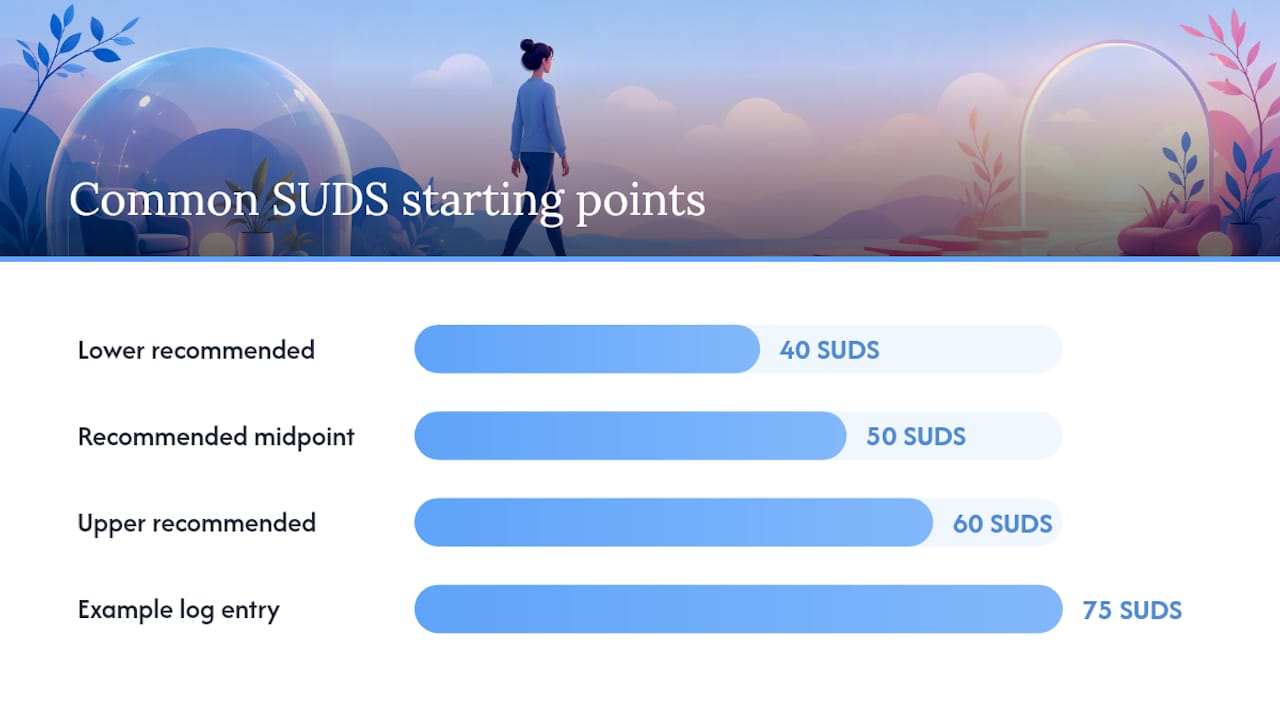
- Pick a starting rung around 40 to 60 SUDS. Lower than that teaches you almost nothing; higher than that often backfires on a first attempt.
- Stay in the situation until your SUDS drops by roughly half. Fear-ladder worksheets consistently point to this 50% reduction as the signal you’ve stayed long enough for real learning to happen, not just endurance.
- Repeat the same rung two or three times across the week before moving up. One success can be a fluke; three in a row is a pattern.
The Mayo Clinic’s Anxiety Coach frames the ladder the same way: rank, attempt, stay, repeat, climb.
After every attempt, jot down four things: your starting SUDS, your ending SUDS, any safety behavior you leaned on (rehearsed lines, avoided eye contact, gripped your phone), and whether your feared outcome actually happened.
Pro Tip: Keep a running log in a notes app or a paper index card. Three weeks in, rereading your own numbers dropping from 75 to 40 on the same task is more convincing than anything anyone else could tell you.
Exposure Exercises by Anxiety Type
Different fears call for different starting points. Below are graded ideas organized by what’s actually driving the anxiety, each with a rough SUDS band and a micro-step small enough to attempt today.
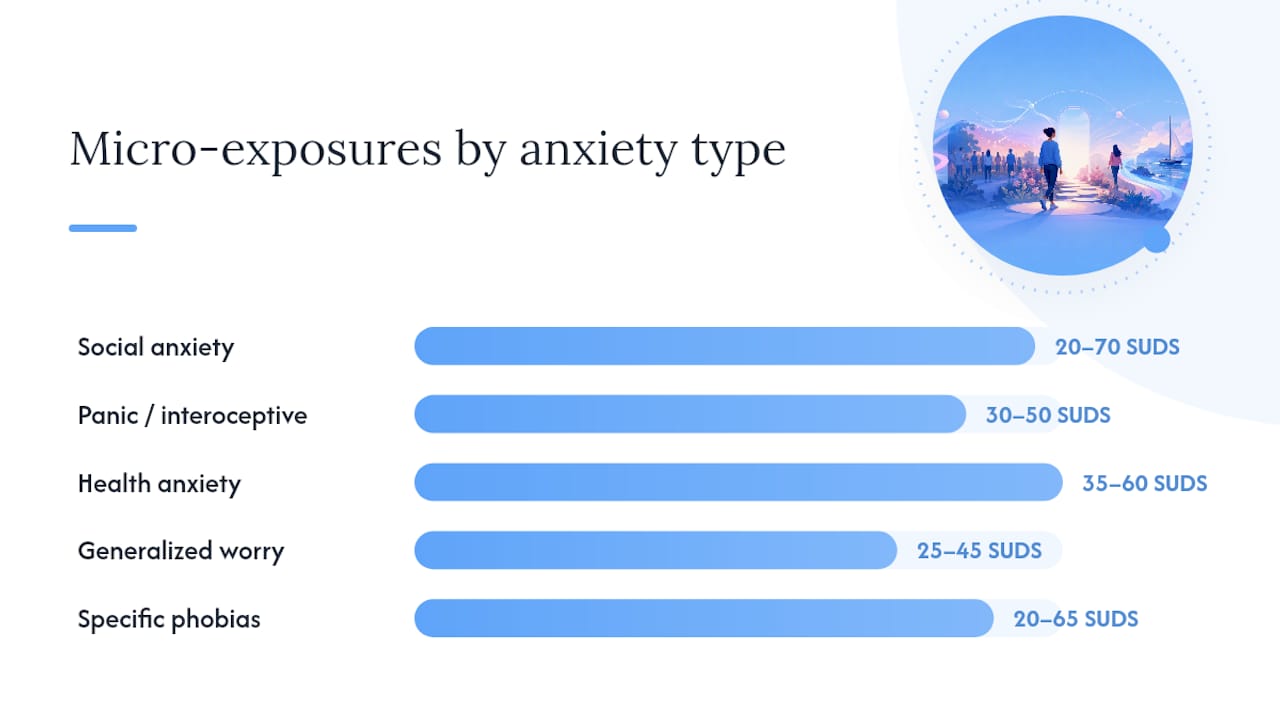
Social anxiety. If talking to strangers is the trigger, start absurdly small: ask a store employee where something is located (SUDS 20 to 30), then order a drink by making eye contact and adding one extra sentence (SUDS 30 to 40). Work up to a one-minute conversation with an acquaintance (SUDS 45 to 55), attending a social event for just fifteen minutes without leaving early (SUDS 55 to 65), and speaking up once, unprompted, in a group or meeting (SUDS 60 to 70). The ADAA’s examples specifically list greeting a stranger and speaking once in a meeting as standard early and mid-ladder steps.
Panic and interoceptive fear. If you’re afraid of the physical sensations of panic itself, the goal is deliberately producing mild versions of those sensations in a safe setting. A short burst of jumping jacks or running in place for thirty seconds raises heart rate and breathlessness (SUDS 30 to 45). Spinning in a chair for fifteen seconds triggers dizziness (SUDS 35 to 50). Breath-holding exercises can simulate air hunger, but they belong on the more cautious end and are better attempted with clinical guidance if your panic has ever felt medically alarming. Later, combine an internal sensation, like a racing heart from stairs, with a public setting like a checkout line. Pairing the internal cue with the external situation is what researchers call deepened extinction, and it tends to produce learning that holds up better over time than practicing either alone, according to research on inhibitory learning.
Health anxiety. Here the exposure is usually about not doing something. Delay a symptom search on your phone by fifteen minutes, then thirty, then an hour (SUDS 40 to 55). Watch a short medical documentary or health-related video without immediately checking your own body for matching symptoms (SUDS 45 to 60). If it’s safe for your specific situation, deliberately notice a normal bodily sensation, like a stomach gurgle, without checking it against a symptom list (SUDS 35 to 50).
Generalized worry. Practice tolerating unresolved uncertainty on purpose. Send an email without rereading it five times first (SUDS 30 to 45). Make weekend plans without checking the forecast three times (SUDS 25 to 40). Choose a restaurant or route without researching every review first (SUDS 30 to 45).
Specific phobias. These respond well to a distance based sequence. If it’s dogs, start with a photo (SUDS 20 to 30), move to watching one from across a park (SUDS 35 to 50), then standing near a calm, leashed dog with its owner present (SUDS 50 to 65), and eventually briefly petting a dog you’ve confirmed is friendly (SUDS 60 to 75). The same photo, distance, closer, touch structure works for heights, needles, and most single-object fears.
Practice Rules That Actually Reduce Fear Long Term
Doing an exposure once teaches you something. Doing it the same way ten times teaches you far less than doing it ten different ways.
The core tactics that make exposure stick come from what researchers call the inhibitory-learning model:
- Expectancy violation means deliberately testing your specific prediction (“everyone will notice I’m nervous”) against what actually happens, not just enduring the situation.
- Variability means changing the location, time of day, or exact scenario each time, instead of running the identical exposure on repeat.
- Multiple contexts means practicing the same fear in different settings so the learning generalizes beyond one room or one person.
- Retrieval cues mean occasionally returning to the setting where you first learned you could cope, which helps that learning resurface later when you need it.
Craske and colleagues’ research on inhibitory learning found that this mix, especially variability and expectancy violation, tends to reduce the return of fear compared with running the same exposure the same way every time. Uniform practice teaches your brain one narrow lesson; varied practice teaches a broader one that holds up under stress.
When an attempt goes badly, don’t scrap the plan. Treat the failed attempt as information: what safety behavior slipped in? Did you rehearse a script, avoid eye contact, or grip your phone as an exit plan? Shrink the next step and remove one safety behavior at a time rather than several at once. Space your sessions across different days and settings instead of cramming them into one afternoon, since spaced, varied practice outperforms a single marathon session for keeping fear down over the following weeks.
How Life is a Game’s Conquer Fear App Supports This Method
Everything above works better with structure, and that’s the gap a phone app can close without pretending to be a therapist. The Conquer Fear app, built by Life is a Game and inspired by exposure principles, gives you a place to build your own ladder instead of tracking it on scattered notes.
Inside the app, you can:
- Build a fear ladder with ranked steps instead of a loose mental list.
- Log your SUDS score before and after each attempt, so your progress is a number, not a guess.
- Review your own history to see which rungs you’ve repeated and which are ready to climb.
If you’re working with a clinician or a coach, you can link your account so they see the steps you attempted, when, and your fear ratings before and after, all with your consent. You control what’s shared, and the app never replaces the actual sessions. It’s a self-guided tool for practice between them.
If talking to strangers is your specific fear, the app’s fear pages let you start with something as small as one sentence to a cashier today.
Preparation Techniques Before You Start an Exposure
Walking into an exposure cold, with your mind racing and your breathing already shallow, sets you up to bail early. A few minutes of preparation changes that.
Slow, deliberate breathing, four seconds in, hold for two, six seconds out, brings your physiological arousal down a notch before you deliberately raise it again. This isn’t about eliminating anxiety before you start; it’s about starting from a baseline where you can actually observe what happens instead of getting swept up before the exposure even begins.
Grounding techniques work the same way. Naming five things you can see, four you can hear, and three you can physically feel pulls your attention out of anticipatory dread and into the present moment, which is exactly where the exposure is going to happen.
Write down your specific prediction before you begin. Not a vague “this will be bad,” but something testable: “If I ask this stranger a question, they’ll look annoyed and walk away.” A concrete prediction gives you something specific to check against reality afterward, which is where most of the actual learning happens.
Keep preparation brief. Five minutes of breathing and grounding is useful. Twenty minutes of preparation starts to function as its own safety behavior, a way of postponing the thing you’re actually there to do. If you notice yourself preparing for the fourth time before you’ll even attempt the first rung, that’s the moment to just start.
Where Cognitive Restructuring Fits Alongside Exposure
Exposure changes what you do. Cognitive restructuring changes what you tell yourself about what happened, and the two work best as a pair rather than a choice between them.
Before an exposure, restructuring looks like naming your catastrophic prediction specifically, “they’ll think I’m strange and tell others,” instead of leaving it as a vague cloud of dread. That specific version is what you’ll actually test.
After the exposure, restructuring is where you compare the prediction to what really occurred. Most of the time, the gap between the two is the whole point: you predicted humiliation, and what happened was a slightly awkward five seconds that nobody else remembered by lunch. Writing that gap down, in your own words, cements the lesson far better than just feeling relieved it’s over.
The trap to avoid is using restructuring as a substitute for exposure, arguing yourself into calm before ever testing the fear in real life. Thoughts alone rarely convince an anxious brain of anything. Evidence does. Use restructuring to sharpen your prediction going in and to lock in the lesson coming out, with the actual exposure doing the heavy lifting in between.
Matching Exposure to Your Specific Fear and Its Severity
A ladder built for someone else’s fear of flying won’t help your fear of talking to strangers, and a ladder that’s too aggressive for your current severity will just teach you to avoid harder.
Start by naming your fear as specifically as possible. “Social anxiety” is a category. “I avoid starting conversations with coworkers I don’t know well” is a target you can actually build a ladder around.
Severity determines your starting rung, not your ambition. If ordering coffee already sits at 70 SUDS for you, that’s your starting point, not a warm up. Someone else might start there and move to a full presentation within two weeks; you might need three weeks just to comfortably hold eye contact with a cashier. Neither pace is wrong. The ladder is calibrated to you, and comparing your rate of climb to anyone else’s is one of the fastest ways to talk yourself out of continuing.
Revisit your ladder every couple of weeks. Fears shift as life changes, a new job, a move, a breakup, and a ladder built three months ago may no longer match what’s actually hardest for you now. Adjust the rungs rather than assuming the whole approach has failed.
A Personal Take: Treat It as Practice, Not a Performance
Exposure isn’t a test you pass or fail. It’s practice, the same way lifting a slightly heavier weight each week is practice, not a referendum on your worth as a person. The ADAA’s framing of avoidance versus engagement gets at something people miss constantly: the goal isn’t feeling calm during the exposure. It’s discovering you can function while anxious, which is a completely different skill.
If your fear is talking to strangers, don’t aim for a confident conversation today. Aim for one sentence to one person, a genuine “excuse me, do you know what time it closes?” Log your SUDS before and after. That’s the whole assignment.
Try it before the end of the day.
— Ryan
Try One Micro-Exposure Today With Conquer Fear
Reading a list of exposure ideas doesn’t move the needle. Attempting one, tonight, does. Life is a Game built Conquer Fear specifically so a fear-focused exposure tool exists on its own, separate from a general wellness app trying to do everything at once, with steps broken small enough that starting doesn’t require a pep talk.
The app is a self-guided tool inspired by exposure principles. It’s not therapy, and it doesn’t diagnose or treat anything. If you’re already working with a clinician or coach, you can link your account so they see your logged steps and SUDS ratings between sessions, with your consent, while you keep full access at no cost during that link.
If public speaking is closer to your actual fear than talking to strangers, Life is a Game’s blog has a graded sequence built the same way. Otherwise, open the app tonight, build your first two rungs, and log one attempt before you go to bed.
Sources
For deeper guidance beyond this article, the NIMH’s anxiety disorders page and ADAA’s exposure therapy resources cover when to seek help. Craske et al.'s inhibitory-learning paper and the University of Michigan’s exposure manual go further into practice optimization and safety-behavior removal. For an outside clinical perspective on when exposure fits into broader treatment, Kin’s overview of anxiety therapy options is worth a look.
This article is general information, not a substitute for advice from a qualified doctor. Consult a qualified healthcare professional about your own circumstances before acting on anything here.
- NIMH – Anxiety disorders: when to get help
- ADAA – Exposure therapy overview and examples
- Mayo Clinic Anxiety Coach – Fear ladder building
FAQ
Can you give an example of exposure therapy for anxiety?
A common example for social anxiety is starting with brief, low-stakes interactions, like asking a store employee a simple question, then working up to ordering food while making eye contact, and eventually initiating a short conversation with someone new. Each step is rated on the SUDS scale and repeated until distress drops by roughly half, per fear-ladder guidance.
What is the 3-3-3 rule for anxiety?
The 3-3-3 rule is a quick grounding technique, not a formal exposure method: name three things you see, three sounds you hear, and move three body parts to interrupt escalating anxiety in the moment. It’s useful as preparation before an exposure, not as a substitute for the exposure itself.
What are some ideas for social anxiety exposure?
Start small: greet a cashier, order at a café while making eye contact, or send a text initiating plans instead of waiting to be asked. From there, progress to speaking once in a group setting or staying at a social event for a set amount of time, following the graded approach ADAA outlines.
How often should I practice exposure exercises?
Most fear-ladder guidance recommends repeating each step several times across a week before moving to the next rung, rather than attempting a new level daily. Consistency and spacing across different days and settings matter more than the total number of attempts in any single session.