How Long Does Exposure Take to Work for One Fear? 5–10 Minute Test
Most people notice some shift within a handful of sessions, but the full course typically runs longer. Evidence-based models like prolonged exposure therapy for PTSD commonly span 8 to 16 weekly sessions. Simpler phobias can move faster. The real caveat: severity, engagement, and how well the exposures target your actual fear all shift that number, and “working” means doing more despite fear, not feeling zero fear.
TL;DR:
- The duration of exposure therapy varies by condition, with specific phobias often resolving in under a month and PTSD typically requiring 8 to 16 weekly sessions.
- Factors such as severity, co-occurring conditions, safety behaviors, therapist fidelity, and medication can significantly extend or hinder progress.
- Monitoring between-session improvements, like reduced avoidance and increased approach behaviors, predicts success better than fear levels during sessions.
- Common challenges include hidden safety behaviors and mis-targeted exposures, which can be addressed by revising the hierarchy or increasing session frequency.
- Consistent, small steps and maintaining practice, even during setbacks, are key to long-term success in exposure-based treatment.
Table of Contents
- How Long Does Exposure Take to Work for Different Conditions?
- What Affects How Fast Exposure Works?
- What Does Progress Actually Look Like Session to Session?
- Why Does Exposure Sometimes Seem to Stop Working?
- A Practitioner’s Take on Making Exposure Stick
- Progress Isn’t a Straight Line
- Try a Self-Guided First Step Today
- Sources
- FAQ
How Long Does Exposure Take to Work for Different Conditions?
The timeline depends heavily on what you’re treating and how the exposure is structured. A single, well-defined phobia (needles, one specific flying trigger) often responds in a handful of sessions to about a month of weekly work. More diffuse conditions take longer because there’s more to work through.
Here’s a rough breakdown by common presentation:
- Specific phobias (needles, driving over bridges, one particular animal): often several sessions, sometimes resolved in under a month.
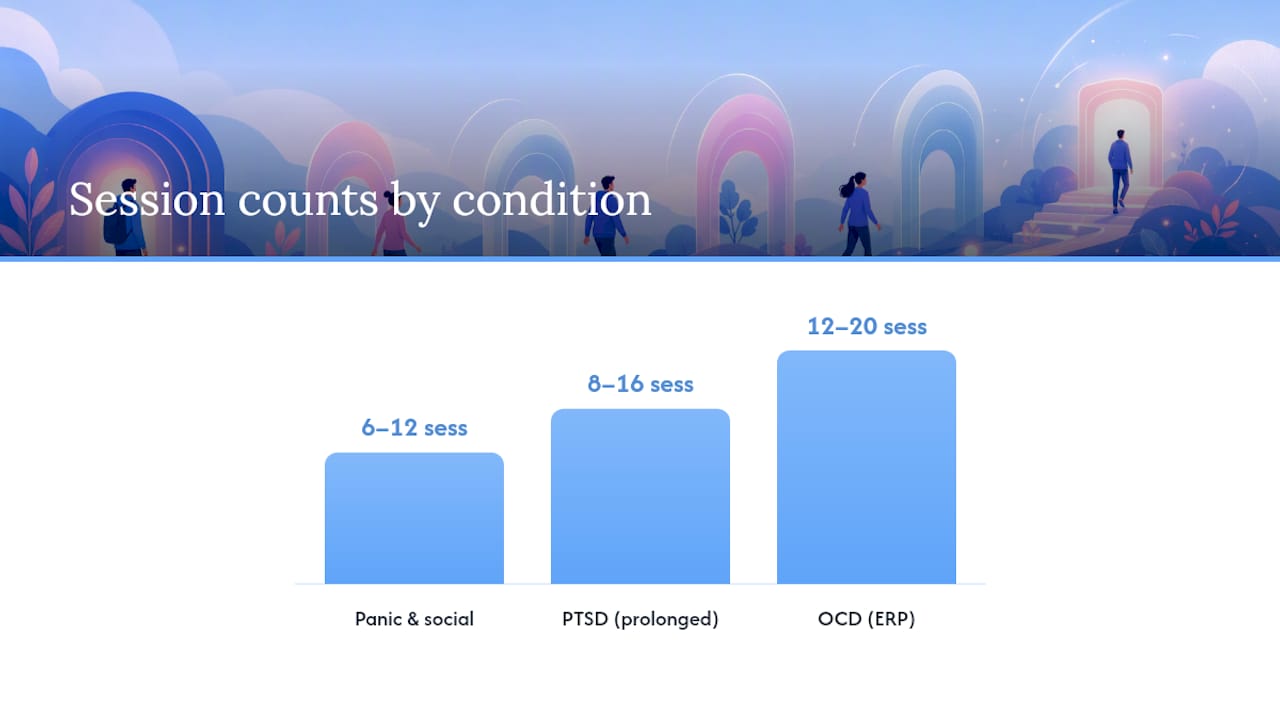
- Panic disorder and social anxiety: typically 6 to 12 sessions, once or twice weekly.
- OCD treated with ERP (exposure and response prevention): usually runs 12 to 20 sessions depending on how many compulsions and rituals are in play.
- PTSD treated with prolonged exposure: 8 to 16 weekly sessions of about 60 minutes each, per VA clinical guidance.
Session length matters as much as session count. Most protocols run 45 to 90 minutes, once a week, with homework between visits. Skipping that homework is one of the fastest ways to stretch out a timeline that should have been shorter. Some clinics also run intensive or daily formats, sometimes called massed exposure, compressing months of weekly sessions into one or two weeks. These suit people who can clear their schedule and want faster results, but they’re not standard for every case and depend on what a specific program offers.
Cleveland Clinic’s guidance on exposure therapy notes some people improve in just a few sessions while others need several months, with clinicians increasing exposure intensity as fast as the person can tolerate it. That range is wide on purpose. Nobody can hand you a guaranteed session count before starting.
What Affects How Fast Exposure Works?
Several variables decide whether you land at the short end of these ranges or the long end. Some you can influence directly.
- Severity and complexity. A single specific phobia clears faster than PTSD with multiple trauma triggers or OCD with several compulsion types running at once.
- Co-occurring conditions. Depression, substance use, or chronic life stress eat into the mental bandwidth exposure requires. A treatment center’s overview of anxiety and substance use points out that recovery timelines stretch to months, not days, when substance use is layered on top of anxiety.
- Safety behaviors. Quietly avoiding eye contact during a feared conversation, gripping the steering wheel a specific way, checking your phone “just in case.” These undercut the learning exposure is supposed to produce, even when you’re technically showing up to the exposure.
- Therapist fidelity and your own between-session practice. Protocols followed loosely, or homework skipped, slow everything down.
- Medication. Some medications can stabilize mood or physical symptoms enough to make exposure tolerable. Others may blunt the anxious arousal exposure relies on to create new learning. This should be discussed directly with a prescriber, not decided solo.
Pro Tip: Track one specific safety behavior you rely on during your hardest exposure this week, and try dropping just that one thing before your next attempt. Small removals like this often move progress faster than adding harder exposures.
What Does Progress Actually Look Like Session to Session?
Fear dropping while you’re in the middle of an exposure feels like the goal, but it’s not the best predictor of whether treatment is working. Research on exposure mechanisms shows that what happens between sessions, not during them, tends to predict outcome better: are you avoiding less, approaching more, doing things you couldn’t do a month ago?
Useful ways to track that:
- Rate anxiety before and after each exposure using SUDS (Subjective Units of Distress Scale, 0 to 100).
- Write down your predicted outcome before the exposure (“I’ll pass out,” “everyone will notice I’m shaking”) and compare it to what actually happened.
- Count how often you avoided the trigger this week versus last week. That trend line matters more than any single session’s fear score.
One thing that trips people up: as bigger fears ease, smaller or subtler anxieties sometimes surface that you didn’t notice before. That’s not a setback. It’s often just increased awareness now that the loudest fear has quieted down.
Why Does Exposure Sometimes Seem to Stop Working?
Stalls happen, and they’re almost always diagnostic rather than a sign the whole approach failed. A few common culprits show up repeatedly in clinical reviews on exposure moderators:
- Hidden safety behaviors. You’re doing the exposure, but you’re also doing something to soften it, which blocks the learning.
- Mental rituals. Silent counting, reassurance seeking, or mentally reviewing “proof” you’re safe can sabotage exposure just as much as an obvious physical avoidance.
- Mis-targeted exposures. If you’re not testing your actual worst prediction, you’re not learning what you need to learn.
- Insufficient dose. Once a week for five minutes isn’t the same intervention as three times a week for thirty.
- Untreated comorbidity. Depression or unmanaged substance use can quietly cap how much progress exposure alone can produce.
Ask yourself: am I testing my worst fear, or a watered-down version of it? Am I avoiding right after the exposure ends? If the honest answer points to any of the above, the fix is usually to revise the hierarchy or increase frequency, not to abandon exposure altogether. If none of that moves the needle after real effort, that’s the point to bring in a specialist for a fresh look at the plan.
A Practitioner’s Take on Making Exposure Stick
One rule that holds up well in practice: aim for roughly 50% difficulty, not 100%. An exposure that terrifies you at the maximum level often triggers avoidance before you finish it; one that’s too easy teaches you nothing. The sweet spot is hard enough to test your prediction, survivable enough to complete.
At Life is a Game, our Conquer Fear app breaks challenges into small steps inspired by exposure principles, precisely because a giant, vague goal (“get over my fear of driving”) is nearly impossible to act on this afternoon. A narrow, five-minute test is.
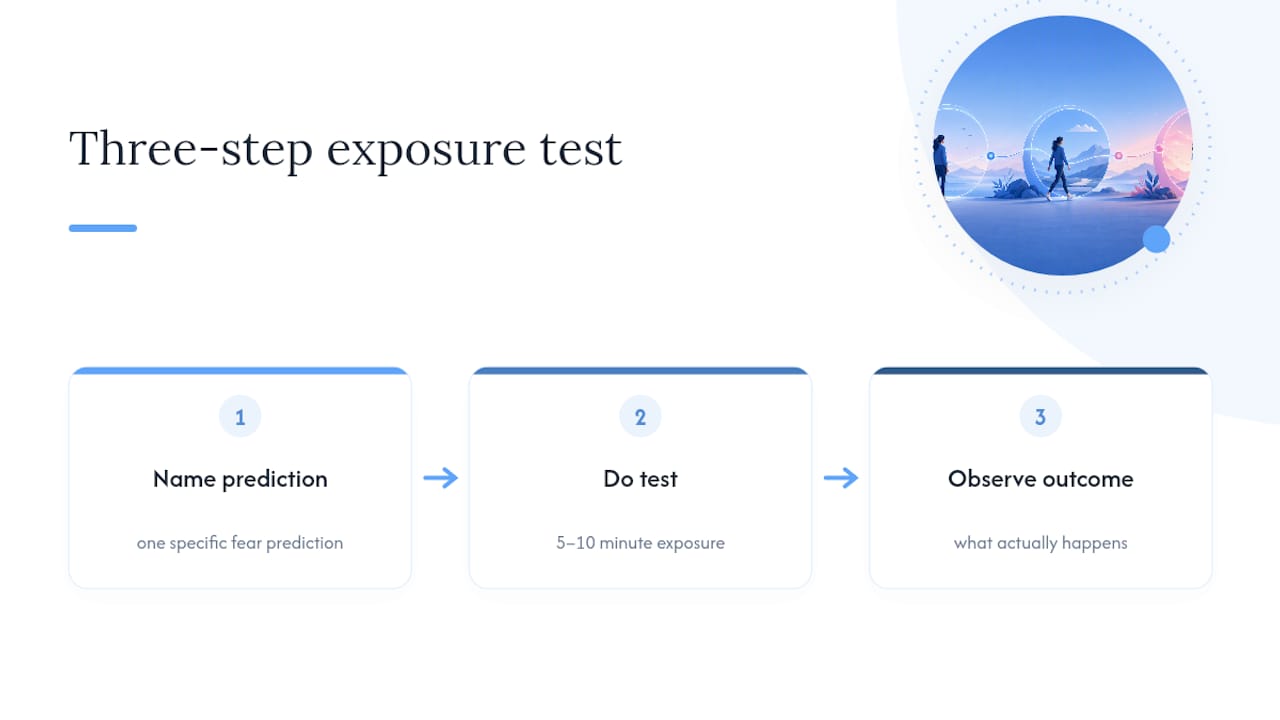
Tiny first step: name one specific prediction your fear makes (not the fear itself, the prediction) and plan a 5 to 10 minute test of it today.
Progress Isn’t a Straight Line
Recovery from any fear rarely moves in a clean upward slope. You’ll have strong weeks and flat ones, sometimes a week that feels like backsliding. That’s not evidence the work has failed. A setback is information: it tells you which safety behavior snuck back in or which exposure needs revisiting, not that you should quit.
What actually predicts long-term change is whether you keep one small, doable practice going, even on the weeks when it feels pointless. Consistency at a manageable size beats intensity you can’t sustain.
— Ryan
Try a Self-Guided First Step Today
Reading about session counts and SUDS scores only gets you so far. At some point you need a structured way to actually practice, and that’s where a tool built specifically for one fear at a time beats a generic wellness app trying to cover everything.
Conquer Fear is Life is a Game’s app for exactly this: breaking a specific fear, whether it’s driving, flying, needles, or public speaking, into small steps inspired by exposure principles, and tracking what you actually attempted between sessions. It’s built for one fear, not bundled into a generic catch-all wellness app, which means the steps are specific enough to act on today rather than vague enough to ignore. It’s a self-guided tool, not therapy, and it works alongside a clinician’s care, not instead of it. If you already have a therapist, our platform for coaches also lets professionals assign and track structured steps between sessions. Download Conquer Fear and set up your first small step in the next five minutes.
This article is general information, not a substitute for advice from a qualified doctor. Consult a qualified healthcare professional about your own circumstances before acting on anything here.
Sources
- Prolonged exposure therapy — APA
- Exposure therapy — Cleveland Clinic
- PMC review article on exposure mechanisms and outcomes — NCBI/PMC6823515
- Prolonged exposure therapy — PTSD: National Center for PTSD (VA)
FAQ
How quickly does exposure therapy work?
Some people notice change within a few sessions, while others need several months of weekly work, according to Cleveland Clinic guidance. Common models like prolonged exposure for PTSD run 8 to 16 weekly sessions of about an hour each.
Why does exposure therapy work so well?
Exposure works through inhibitory learning: you build new, competing associations that override the old fear response rather than simply getting used to the trigger, per research on exposure mechanisms. Trying to suppress anxiety during the exposure actually weakens that learning signal.
What is the success rate of exposure therapy?
There’s no single universal success rate since outcomes vary by condition and severity, but clinical reviews report large effect sizes for exposure-based treatment across anxiety disorders. Success is best judged by increased behavioral freedom, doing more despite fear, rather than the complete absence of anxiety.
Does exposure therapy actually work for anxiety?
Yes, exposure-based approaches show strong evidence across phobias, panic disorder, social anxiety, OCD, and PTSD, with large effect sizes reported in clinical reviews. Results vary by individual, and self-guided tools like Conquer Fear can support practice between professional sessions but don’t replace them.