4 Step Self Guided Therapy Plan You Can Do in 30 Minutes

Self-guided therapy works well for mild to moderate anxiety, depression, insomnia, and social anxiety, and works less reliably for PTSD or severe symptoms. It means structured self-help, not therapy delivered by a clinician: workbooks, apps, and journaling that walk you through evidence-based steps on your own. If you have suicidal thoughts, psychosis, mania, or your ability to function is falling apart fast, stop reading this and get professional help now.
TL;DR:
- Unguided self-help therapy is effective for mild to moderate depression, anxiety, social anxiety, and insomnia, but less so for PTSD.
- Guided programs tend to produce better short-term outcomes and have lower dropout rates, especially for moderate to severe symptoms.
- Most failures happen due to inconsistent practice or collecting techniques rather than lack of motivation, making structured tracking essential.
- Self-guided work should be paused and professional help sought if suicidal thoughts, psychosis, mania, or rapid functional decline occur.
- Using structured apps with clear ladders and tracking improves the chances of completing self-help techniques successfully.
Table of Contents
- What Self-Guided Therapy Actually Means (And Why “Guided” Changes the Math)
- Which Self-Guided Methods Actually Work?
- A Step-by-Step Self-Guided CBT Sequence You Can Start Today
- What the Research Actually Shows About Self-Guided Work
- When to Stop Self-Guided Work and Get Professional Help
- Why Most Self-Guided Attempts Fail (And the Fix)
- How Life is a Game Turns These Ideas Into Something You’ll Actually Finish
- One Small Experiment Beats Ten Big Plans
- A Structured App Beats a Loose Plan (Here’s Why)
- Sources
- FAQ
What Self-Guided Therapy Actually Means (And Why “Guided” Changes the Math)
Self-guided therapy is structured self-help you run yourself, without a clinician sitting across from you. It takes the shape of workbooks, online courses, mobile apps, journaling templates, or behavioral experiments you design and carry out on your own schedule. The NHS’s self-help CBT guidance makes the point plainly: plenty of CBT ideas were built to be practiced independently, not just delivered in a therapist’s office.
Not all self-guided programs are the same, though. Two formats dominate:
- Unguided: you work through material entirely alone, no check-ins, no coach, no clinician.
- Guided: you get occasional human support, sometimes just a few minutes of feedback a week, layered on top of the same self-help content.
Guided programs tend to keep people in the program longer and often produce bigger short-term gains, which matters more than it sounds. A tool nobody finishes doesn’t help anyone. None of this replaces a clinical assessment. Self-guided work is built for mild to moderate problems, not as a stand-in for diagnosis.
Which Self-Guided Methods Actually Work?
You don’t need a shelf of techniques. You need one or two that match your specific problem, done consistently.
Cognitive tools. Thought records are the backbone: you write down the situation, the automatic thought, how intense the emotion felt, what you wanted to do about it, and a more balanced alternative. Activity scheduling counters the withdrawal that comes with depression. Worry time confines rumination to a set 15-minute window instead of letting it run all day. Behavioral experiments test a fear directly instead of arguing with it in your head.
Exposure and ERP principles. If your problem is a specific fear or an OCD compulsion, graded exposure matters more than any cognitive trick. Build a ladder of situations from mildly uncomfortable to genuinely hard, repeat each step until it stops spiking your anxiety, and follow clear rules for when a step is too much and needs to be dialed back. Sites like Life is a Game’s fear exposure guides walk through concrete ladders for driving, flying, heights, and other common fears.
Format matters less than consistency. Apps and structured courses are good because they force a rhythm. Journaling and free worksheets work fine too, if you’re honest about whether you’ll actually open the notebook on day 12.
- Pick one method for one problem. Don’t collect five.
- Match the tool to the target: cognitive tools for rumination and catastrophizing, exposure for avoidance and fear.
- Give any single technique two to three weeks before judging it.
Pro Tip: Write your thought record’s “alternative thought” as something you can actually defend with evidence, not an unrealistically cheerful one liner. “I made one mistake in a 40 minute presentation” beats “everything is fine” every time.
A Step-by-Step Self-Guided CBT Sequence You Can Start Today
This is a four-step loop borrowed from standard CBT guidance, scaled down to something you can run in under 30 minutes.
- Pick one specific target. Not “my anxiety.” Something like “I avoid making phone calls at work.” Write a one-sentence goal: “Make one work phone call today.”
- Run a thought record. Situation → automatic thought (“They’ll think I’m incompetent”) → emotion intensity (rate it 0 to 10) → the urge (avoid, delay, ask someone else to do it) → an alternative, evidence-based thought.
- Design one small experiment or exposure step. Write your prediction first (“My voice will shake and they’ll notice”). Then act. Then record what actually happened, not what you feared would happen.
- Review, log, repeat. Track one number, either your SUDS rating (Subjective Units of Distress, 0 to 100) before and after the step, or a single daily mood score from 1 to 10. Schedule the next attempt within 48 hours while the data is fresh.
A 2024 umbrella review found unguided internet-delivered CBT reduced symptoms across depression, generalized anxiety, social anxiety, and insomnia. The lesson isn’t that any single session will feel dramatic. It’s that a short, repeatable loop run consistently beats one long, intense session run once. Guides like Life is a Game’s comfort zone challenge use the same SUDS tracking and a 50% rule for deciding when to move to the next step.
What the Research Actually Shows About Self-Guided Work
Unguided self-help isn’t a watered-down placebo. The same umbrella review found real symptom reductions for depression, several anxiety disorders, social anxiety, and insomnia, even with zero clinician contact. PTSD is the clear exception: unguided formats show weaker effects there, which tracks with how much clinical judgment trauma work usually needs.
Guidance still tips the scale. A 2024 individual patient data meta-analysis from ANU found guided iCBT produced modestly better short-term outcomes than unguided versions, and the gap widened for people with moderate to severe baseline depression. Mild cases did fine without much support. Severe cases benefited more from even light human oversight.
- Unguided iCBT: effective for mild to moderate depression, anxiety, social anxiety, insomnia.
- Guided iCBT: larger short-term effects, lower dropout, more useful as severity increases.
- PTSD: weaker unguided response, an argument for professional involvement over pure self-help.
The variable that actually predicts your results isn’t which app you download. It’s whether you finish what you start.
When to Stop Self-Guided Work and Get Professional Help
Self-guided tools don’t diagnose anything, and they’re not built to catch what a clinician would catch in an intake session. Certain signals mean you stop the workbook and get a person involved.
- Thoughts of suicide, self-harm intent, or a specific plan.
- Symptoms of psychosis: hearing or seeing things others don’t, disorganized thinking.
- Mania: racing thoughts, no need for sleep, reckless decisions.
- Rapid loss of functioning: can’t work, can’t leave the house, can’t eat.
- Self-harm that’s escalating rather than staying flat or improving.
If any of those apply right now, contact emergency services or a crisis line in your country immediately. For less urgent concerns, book a session with a clinician or move to a guided (not unguided) self-help program. If you’re already seeing someone, tell them what you’re trying on your own. Exposure-based work in particular should stop and get a professional referral if it triggers dissociation or trauma responses instead of manageable discomfort.
Why Most Self-Guided Attempts Fail (And the Fix)
The most common failure mode isn’t lack of willpower. It’s collecting techniques instead of running experiments, according to the NHS’s own guidance: reading about six methods and testing none of them properly. Close behind that: quitting a module halfway through, and avoiding the one exposure step that would actually move things forward.
- Timebox practice to a fixed slot, same time each day, ten minutes is enough.
- Set a reminder rather than relying on remembering.
- Precommit out loud to a friend or write the plan down before you can talk yourself out of it.
- Track one metric only, SUDS or a single mood number, so progress isn’t a feeling, it’s a line on a page.
Pro Tip: A stalled program is data, not failure. If you keep bouncing off the same module, that’s useful information; it may be a sign to add brief human support rather than push harder alone.
How Life is a Game Turns These Ideas Into Something You’ll Actually Finish
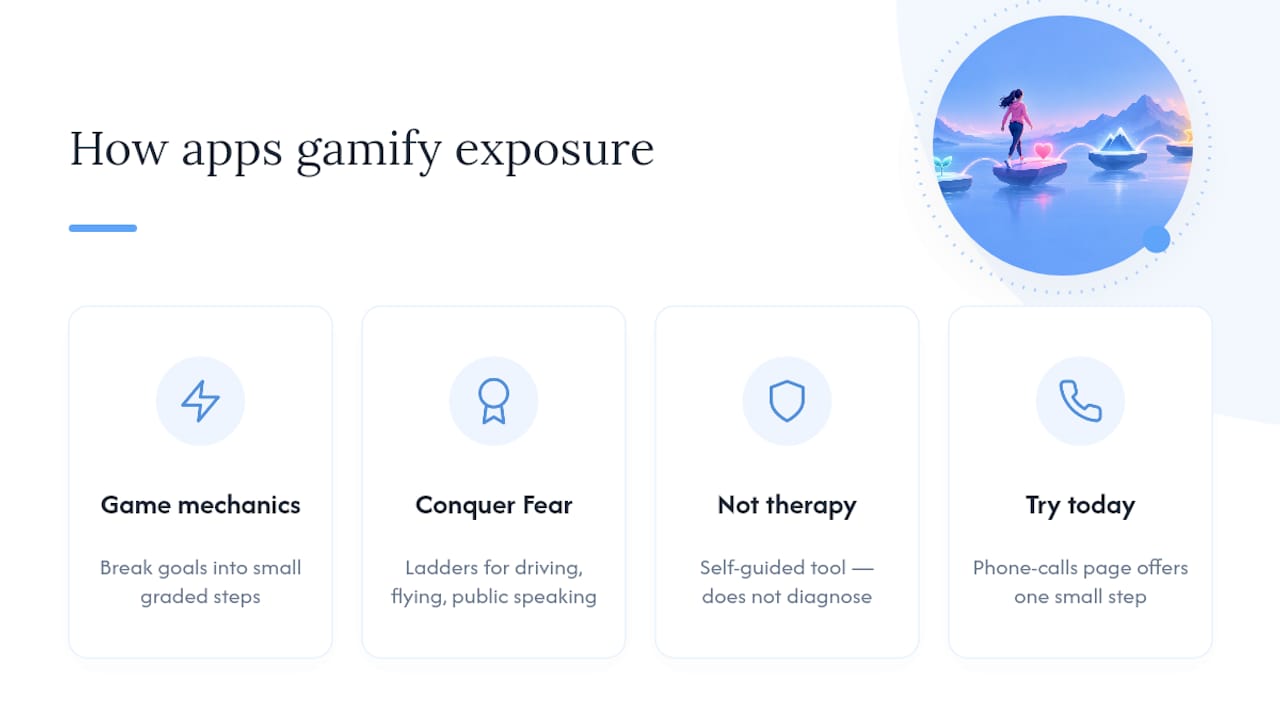
Reading about exposure ladders is one thing. Building one at 11 p.m. when you’re dreading tomorrow’s phone call is another. Some apps break specific fears, focus struggles, and habit goals into small graded steps, using game mechanics to make the next step feel doable instead of loaded. Conquer Fear, its exposure app, is inspired by exposure principles and structures ladders for driving, flying, public speaking, and other specific fears. It’s a self-guided tool, not therapy, and it doesn’t diagnose anything. If phone calls are your specific problem, the phone calls fear page is a reasonable place to try one small step today.
One Small Experiment Beats Ten Big Plans
Pick one fear. One struggle. Not five. Run one micro-step, write down what actually happened, not what you predicted, and let that data decide the next step. If a step is too much twice in a row, that’s information too, not a verdict on you. Self-guided work has real limits. Respect them, and it still moves you forward.
— Ryan
A Structured App Beats a Loose Plan (Here’s Why)
Most self-guided attempts don’t fail because the technique was wrong. They fail because there was no structure holding the practice together, no reminder, no ladder, no record of what happened last time. That’s the gap a built app closes better than a notebook usually does.
Life is a Game’s apps break a single fear or habit into small, graded steps and track what you actually completed, not what you meant to do. Conquer Fear is inspired by exposure principles and structures ladders for driving, public speaking, needles, heights, and other specific fears, one small step at a time. If your struggle is focus rather than fear, Signal not Noise applies the same graded structure to attention and distraction. Both are self-guided tools, not therapy, and neither diagnoses or treats anything. Try one ten-minute module today and see if the step feels doable. That’s the whole test.
Sources
NHS self-help CBT techniques, the PMC umbrella review, the ANU iCBT meta-analysis, and the WHO digital mental health report.
This article is general information, not a substitute for advice from a qualified doctor. Consult a qualified healthcare professional about your own circumstances before acting on anything here.
- Online self-help CBT techniques - Every Mind Matters (NHS)
- Internet-delivered cognitive behaviour therapy: An updated systematic umbrella review (PMC)
- Internet-based cognitive behavioral therapy for depression: an IPD network meta-analysis (ANU, 2024)
FAQ
Why Does Talk Therapy Not Work for Me?
Talk therapy sometimes underperforms when the approach doesn’t match the problem, when homework between sessions goes undone, or when severity is high enough that weekly sessions alone aren’t enough structure. Self-guided tools that add daily practice between sessions, or a guided program with brief check-ins, often close that gap better than talk therapy alone.
What Is the “2 Year Rule” in Therapy?
There’s no single, universally recognized “2 year rule” in psychotherapy. Definitions vary by context, sometimes referring to insurance coverage limits, sometimes to research follow-up windows, so treat any specific figure you see elsewhere with caution and check it against your own provider or plan.
What Are Some Self-Care Activities I Can Do on My Own?
Journaling with a structured prompt, a scheduled worry-time window, gentle exposure to something you’ve been avoiding, and activity scheduling to counter withdrawal all count as evidence-informed self-care, not just relaxation. The NHS’s self-help CBT guidance covers several of these in more detail.
How Do I Do CBT by Myself?
Start with one specific situation, run a thought record (situation, automatic thought, emotion intensity, urge, balanced alternative), then design one small behavioral experiment to test the thought directly. Repeat that loop two to three times a week and track one metric, like a SUDS rating or a daily mood score, to see if it’s working.
What Is the Difference Between Guided and Unguided Self-Help?
Unguided self-help means working through material entirely alone with no human check-ins. Guided self-help adds occasional human support layered onto the same content, and a 2024 meta-analysis found guided versions produce modestly better short-term results, especially for moderate to severe cases.